





Journal of Historic Buildings and Places, Vol 4, 2025
A substantial publication that would definitely justify readers’ membership of Historic Buildings and Places is its annual Journal of Historic Buildings and Places (Vol 4, 2025), which runs to 200 pages. The issue contains six substantial papers, reflecting the society’s aims and objectives of studying and conserving heritage assets of all periods and styles.
The first paper is by John Darlington, director of projects for the World Monument Fund, where he leads UK-based initiatives. Entitled ‘Fake Heritage or Faithful Homage: why we reconstruct the past’, it was the annual lecture given to the society in 2023. The author has some particularly wellchosen examples in asking why the issue of fake or copied heritage is relevant today, and why we should care (or not). He argues that the past is important as it colours the places we live in and visit, contributes to character and local distinctiveness, and helps establish our place in the world.
Darlington argues that, crucially, history gives us the power of memory, without which we have no recall and therefore risk reinventing the wheel, repeating mistakes or making rootless decisions. He uses some excellent examples to illustrate the issues, such as from China, where European heritage is often replicated (he includes an illustration of a housing estate in Hangzhou, modelled on Haussmann’s Paris, with a miserable shrunken version of the Eiffel Tower); from Saddam Hussein’s reconstruction of Babylon; and the replication of medieval townscapes in Germany following the severe damage of second world war.
Depending on how you see it – a collection of lies and imitations, or a tribute to the past – the main points are: think about the goals and energy of those who shared their stories. But also, be wary of the origins of nationalism, and question those who do not pay attention to evidence and science. He writes that curiosity is often the best defence for understanding the motivation behind these monuments. This is a fascinating discussion in relation to the pressures that arise from time to time in heritage management to accede to pastiche.
Dealing with heritage of all periods brings us to a re-evaluation of the iconic BT Tower in London in the Historic Buildings and Places Stephen Croad Prize essay for 2024. The award was established in 2019 in memory of the former head of the National Building Record at the Royal Commission on the Historical Monuments of England. Contributions for the prize document new discoveries about historic buildings in the UK, and essays on building conservation and heritage crafts, are also welcomed.
The 2024 winner, Tavia Swain, explores the historical framework of the BT Tower, placing it within a political, social and technical context, and evaluating the structure’s trailblazing unique qualities both in form and function. The author also references the excitement, glamour and pride surrounding its former unprecedented popular appeal. The paper argues that by comparison with its contemporary status, its progressive engineering was a technical triumph that marked it as a monument to past glories – or a lost Britain. The future of the BT Tower appears to depend on the 2024 sale by BT to MCR hotels for £275 million, with the objective of preserving it as an iconic hotel and securing its place as a London landmark.
The journal also includes a Stephen Croad Award entry for 2024 by Christopher Painter, a London architect. He looks at the contested narratives surrounding Binney Walk, a linear block at Thamesmead, which Stanley Kubrick used as a location for his 1971 dystopian film A Clockwork Orange. The paper discusses the spatial criticisms of post-war modernist architecture and looks at lessons such designs have to offer and how they could shape future housing delivery in the UK. Painter touches on the political pressures facing the building in the late 1970s and the debate about the dismantling of modern design features in the name of safety, which came to a head in the 1980s.
He concludes by asking: what if more people thought differently about the buildings we built for housing after the war? And what if, instead of saying those welfare state buildings are bad and tearing them down (which wastes the energy used to build them and means we build new things), we tried to learn from them? What if we respected why they were built and found a better way to use them?
The journal (formerly the Transactions of the Ancient Monuments Society) is well known for shedding new light on both buildings and their architects. In this issue, Richard Hewlings puts Mount Edgcumbe in Cornwall in a context that could be discerned as international as much as local and national. Peter Howell examines the life of Samuel Joseph Nicholl, a somewhat obscure figure from the 19th century but an important designer of many Roman Catholic churches; and Chris Miele discusses the rebuilding of St Mary Abbotts, Kensington, by Sir George Gilbert Scott.
The church, one of a group of large parish churches dating from the end of Scott’s long and illustrious career, was designed over the course of 1866 and 1867, and opened for worship in 1872. Particularly notable is the beautifully detailed and proportioned tower and spire that rise 278 feet from the ground, making St Mary’s one of the tallest church spires in England and Wales.
This article originally appeared in the Institute of Historic Building Conservation’s (IHBC’s) Context 184, published in June 2025.
--Institute of Historic Building Conservation
Related articles on Designing Buildings Conservation.
IHBC NewsBlog
IHBC sponsors Gardens Trust event 23-4 Sept 2026
.jpeg)
'Learning from the Past, Shaping the Future’ takes place in Milton Keynes
Renovations to Frank Lloyd Wright's Fallingwater complete
.jpg)
World Heritage Preserved project opens house for tours again
Shakespeare Birthplace Trust places Hall's Croft on HAR Register
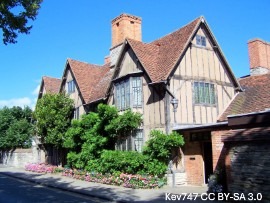
Stratford-upon-Avon home of Shakespeare's daughter is 'At Risk'
Lady Grange’s House repaired on St Kilda
.jpg)
National Trust for Scotland repairs stone cleit with link to famous island resident
Griff Rhys Jones on BBC Radio 4 Today programme
,_Green_Lane,_Derby.jpg)
The Victorian Society’s President unveiled its latest Top Ten Endangered Buildings 2026.
Need a MATE? Book your place now.
IHBC offers free webinars on applying for IHBC accreditation (Full & Associate).
UK Stained Glass Repository finds windows new homes
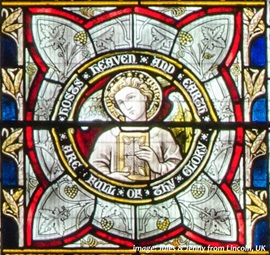
How are stained glass windows are rescued, stored and repurposed?
APPGEBE report sets high aims for quality
'Government must not sacrifice quality in drive to build 1.5m homes'
New measures protect Historic Shipwrecks from heritage crime

Underwater cultural heritage benefits from new HE guidance
How could the City of London skyline look in 6 years' time?

Visualisation shows approved planning applications as completed buildings
National Trust for Scotland calls for VAT cuts
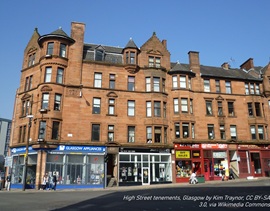
Heritage neglect is encouraged by current policies
IHBC's 'Context' Issue 186 features Industrial Heritage
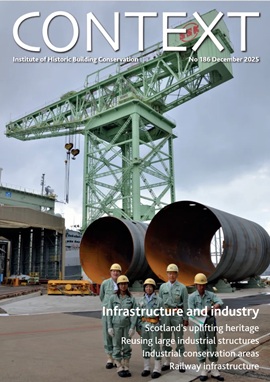
IHBC's members' journal reports on the challenges of conserving infrastructure
Book now for IHBC Annual School 2026

IHBC Annual School is taking place 18-20 June 2026 in Newcastle
RICHeS Research Infrastructure offers ‘Full Access Fund Call’
RICHeS offers a ‘Help’ webinar on 11 March
Latest IHBC Issue of Context features Roofing
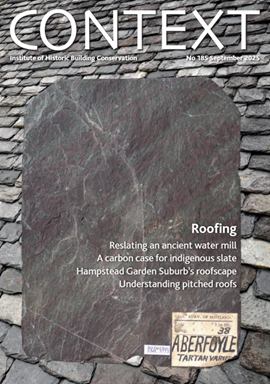
Articles range from slate to pitched roofs, and carbon impact to solar generation to roofscapes
Three reasons not to demolish Edinburgh’s Argyle House

Should 'Edinburgh's ugliest building' be saved?
IHBC’s 2025 Parliamentary Briefing...from Crafts in Crisis to Rubbish Retrofit
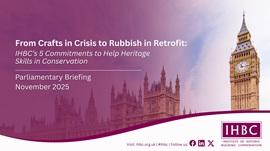
IHBC launches research-led ‘5 Commitments to Help Heritage Skills in Conservation’
How RDSAP 10.2 impacts EPC assessments in traditional buildings

Energy performance certificates (EPCs) tell us how energy efficient our buildings are, but the way these certificates are generated has changed.