





Information Delivery Manual (IDM)
An Information Delivery Manual (IDM) or Information Delivery Specification (IDS), can be used to identify discrete processes that are undertaken during the lifecycle of a built asset, and to detail the information required to carry them out.
The standards for IDM's are set out in:
- ISO 29481-1:2016, Building information models -- Information delivery manual -- Part 1: Methodology and format.
- ISO 29481-2:2012, Building information models -- Information delivery manual -- Part 2: Interaction framework.
- ISO/WD 29481-3, Building information modelling -- Information delivery manual -- Part 3: Model View Definitions.
The standards define an IDM as:
| documentation which captures the business process and gives detailed specifications of the information that a user fulfilling a particular role would need to provide at a particular point within a project |
They suggest that:
|
An IDM provides help in getting the full benefit from a BIM (building information modelling). If the required information is available in the BIM to support a construction process or use case, and the quality of information is satisfactory, then the process itself will be greatly improved. For this to happen, there needs to be a common understanding of the processes involved across the entire life cycle development of a built environment project, including the information that is required for and results from the execution of that process. This applies to any activity that results in an exchange of information and may not relate directly to a BIM, e.g. the process to arrive at a work plan or contractual agreement. |
IDM's include:
- Interaction maps: Representation of the roles and transactions relevant for a defined purpose.
- Transaction maps: Representation of a set of messages that are exchanged between participating roles for a particular purpose.
- Process maps: Representation of the relevant characteristics of a process associated with a defined business purpose.
- Exchange requirements: A defined set of information units that needs to be exchanged to support a particular business requirement at a particular process phase.
For the users of BIM, it provides an easily-understandable description of:
- Built asset lifecycle processes – where they fit and why they are relevant.
- The requirements for information to be provided for the process to be carried out successfully.
- Who the parties are who create, consume and benefit from the information.
- Additional information that may be needed from the user.
- How the information should be supported by software solutions.
- The expected end results.
IDM 's help to improve the reliability of information exchanges between the project participants, and help improve information quality, decision making, and the effectiveness.
[edit] Related articles on Designing Buildings Wiki
Featured articles and news
We're expanding our collaborative mission by launching DB Intelligence, an exclusive market research advisory panel. Built environment professionals can now get paid to share their expertise on industry trends, products and services.
Panel members receive direct financial incentives for participating in research projects like short surveys, 1-2-1 interviews and focus groups. Register today to shape the future of the construction sector.
Social media ban consultation comes to close

CIOB urges UK Government to consider social media’s role in careers guidance in ban debate.
The latest of eight Skills England apprenticeship units

The addition of battery manufacturing welcomed by ECA with a warning about the risks of fast-tracked apprenticeship units.
Building Control Independent Panel final report
A precis of a key report led by Dame Hackitt with full recommendations and link to the government response.
Guide to ISO 19650 for Architecture Firms (2026)
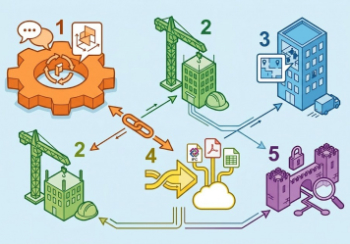
A user gives their low down.

A UK training and membership provider for mould remediation professionals.
Building Safety recap April, 2026
A short and longer run-through of the month, with links to further information and sources.

CIAT May 2026 briefing.

Independent NSI and BAFE study exploring how organisations are changing the way they buy fire safety services.

From medieval scribes to modern word art.

ECA welcomes crackdown on late payment and push for clean energy, whilst CIOB seek fixed cladding removal timeframes.
Cyber Security in the Built Environment
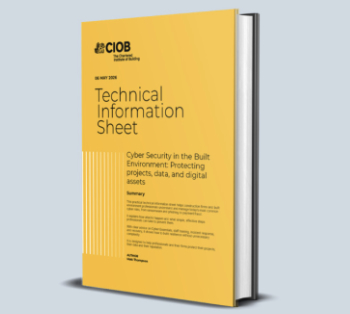
Protecting projects, data, and digital assets: A CIOB Academy TIS.
Managing competence in the built environment
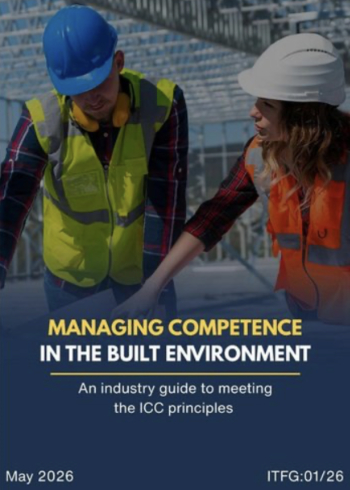
ITFG publishes new industry guide on how to meet the ICC principles.
The UK's campaign to reduce noise pollution: Mythbusting, articles and topic guides.