





Fluorescent and halogen bulb phase out
In 2023 the final stages of the phasing out procedure for certain types of bulbs will take place, with flourescent and halogen lighting products being added to the list with incandescent bulbs no longer available to buy in Europe and the UK.
These changes are primarily as a result of the Restriction of Hazardous Substances (RoHS) (in Electrical and Electronic Equipment (2012) (the RoHS regulations), aswell as Ecodesign Directive (Directive 2009/125/EC).
Contents |
[edit] 2006 incandescent
In September 2016 the manufacture of all incandescent light bulbs in Europe was banned, although residual stock continued to be available.
This was one result of the European Union's Ecodesign Directive (Directive 2009/125/EC); a framework setting mandatory ecological requirements for the sale of over 40 categories of energy-using and energy-related products. Any energy-using product (EuP) being required to reduce energy consumption and negative environmental impact by design. The main aim being to reduce energy use, but also material, water, pollution, and waste.
[edit] 2019 halogen
In September 2019 the halogen light bulb ban came into force. As with the earlier ban the manufacture of these bulbs was banned, with some exceptions for specialist applications, though the use of exsting stocks was not.
This was also a result of the European Union's Ecodesign Directive (Directive 2009/125/EC) to reduce energy consumption levels aswell as the RoHS Directive 2011/65/EU restricting the use of certain hazardous substances in electrical and electronic equipment, in particular polybrominated biphenyl flame retardants (PBB) and polybrominated diphenyl ethers (PBDE).
In Great Britain and Northern Ireland, the Restriction of the Use of Certain Hazardous Substances in Electrical and Electronic Equipment Regulations 2012 (as amended) are the underpinning legislation. However, there are differences in how they apply in Great Britain and Northern Ireland.
[edit] 2023 flourescent
In February 2023 ring formed flourescent lamps (T5 T9) and compact flourescent lamps with a plug in base (CFlni) were banned from manufacture aswell as importation.
In August 2023 flourescent lamp tubes (T5 and T8) are banned from manufacture aswell as importation
In September Halogen pins G4, GY6.35, G9) are banned from manufacture aswell as importation.
The ban on flourescent lamp is a direct result of the RoHS Directive 2011/65/EU restricting the use of certain hazardous substances in electrical and electronic equipment, in particular the low levels of Mercury contained in such bulbs.
[edit] Related articles on Designing Buildings
- Electrical and electronic equipment
- End of life potential.
- Environmental impact assessment EIA.
- Environmental plan for building design and construction.
- Glossary of electrical terms.
- Hire, reclaim and reuse scheme combats construction waste.
- How to conduct a pre-demolition audit.
- Plastic and recycling.
- Recycling explained.
- Types of plastic in construction.
- Waste and Resources Action Programme WRAP.
- Waste hierarchy.
- Waste management plan for England.
Featured articles and news

We're expanding our collaborative mission by launching DB Intelligence, an exclusive market research advisory panel. Built environment professionals can now get paid to share their expertise on industry trends, products and services.
Panel members receive direct financial incentives for participating in research projects like short surveys, 1-2-1 interviews and focus groups. Register today to shape the future of the construction sector.
Building Safety Wiki Interviews

Chief executive of the British Woodworking Federation.
Planning condition discharge in England and Wales

A brief exoplanation from a building compliance expert, with further links.
Overheating guidance and tools for building designers

Guidance for dealing with element of building fabric control that have increasing importance.
Shading for housing, a design guide

From the Good Homes Alliance and British Blind and Shutter Association.
UK Standard Skills Classification (SSC)

A shared framework for describing skills needs.
Social media ban consultation comes to close

CIOB urges UK Government to consider social media’s role in careers guidance in ban debate.
The latest of eight Skills England apprenticeship units

The addition of battery manufacturing welcomed by ECA with a warning about the risks of fast-tracked apprenticeship units.
Building Control Independent Panel final report
A precis of a key report led by Dame Hackitt with full recommendations and link to the government response.
Building Safety recap April, 2026
A short and longer run-through of the month, with links to further information and sources.

CIAT May 2026 briefing.
From medieval scribes to modern word art.

ECA welcomes crackdown on late payment and push for clean energy, whilst CIOB seek fixed cladding removal timeframes.
Cyber Security in the Built Environment
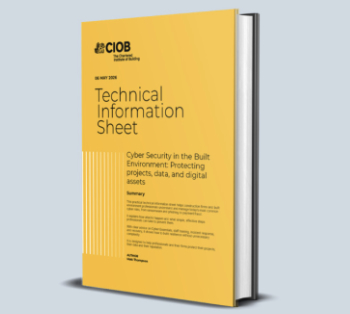
Protecting projects, data, and digital assets: A CIOB Academy TIS.
Managing competence in the built environment

ITFG publishes new industry guide on how to meet the ICC principles.