





Development management
Development management is the process of pro-actively managing development in a local area to achieve the local planning vision and objectives. It has an emphasis on the pre-application stage and delivering sustainable development, and includes the principles of ‘place-shaping' as recommended by the Lyons Inquiry into local government, ‘Place-shaping: a shared ambition for the future of local government’ published in 2007.
The introduction of development management was an attempt to change the culture of planning from the previous process of ‘development control’.
Development control was considered to place too much emphasis on processing and controlling planning applications and using enforcement powers. This was seen as a negative process that was reactive rather than proactive. Development management is intended to be more customer-focussed, positive, proactive and inclusive, developing problem-solving partnerships and delivering development that enhances social, economic and environmental conditions.
The Planning Advisory Service suggest that:
‘Development management is the term that has been coined to include the range of activities and interactions that together transform the 'control of development and the use of land' into a more positive and proactive process that:
- fits better with the ethos of spatial planning and
- better supports local authorities in their role as place shapers.
‘Ways of working need to reflect a desire to make planning consideration a tool for achieving better outcomes rather than a test of adequacy.’
Ref Planning Advisory Service, The culture of development management, 2013.
Development management policies form part of a local authority’s local plan. They are a suite of detailed policies intended to ensure that the vision and objectives set out in the local plan are achieved and helping determine which developments should be granted planning permission where site-specific provisions have not been set out in the local plan.
Development management policies are prepared by the local authority in consultation with developers and other stakeholders. Following a period of consultation, they are submitted to the Secretary of State for examination.
[edit] Find out more
[edit] Related articles on Designing Buildings Wiki
- Authority monitoring report.
- Community plan.
- Development plan.
- Development plan documents.
- Local development scheme.
- Local plan.
- Neighbourhood plan.
- NPPF.
- Planning authorities.
- Planning permission.
- Supplementary planning documents.
- The London Plan.
- What is a housing start?
[edit] External references
- Planning Advisory Service, The culture of development management, 2013.
- Place-shaping: a shared ambition for the future of local government, 2007.
Featured articles and news

We're expanding our collaborative mission by launching DB Intelligence, an exclusive market research advisory panel. Built environment professionals can now get paid to share their expertise on industry trends, products and services.
Panel members receive direct financial incentives for participating in research projects like short surveys, 1-2-1 interviews and focus groups. Register today to shape the future of the construction sector.
Building Safety Wiki Interviews

Chief executive of the British Woodworking Federation.
Planning condition discharge in England and Wales

A brief exoplanation from a building compliance expert, with further links.
Overheating guidance and tools for building designers

Guidance for dealing with element of building fabric control that have increasing importance.
Shading for housing, a design guide

From the Good Homes Alliance and British Blind and Shutter Association.
UK Standard Skills Classification (SSC)

A shared framework for describing skills needs.
Social media ban consultation comes to close

CIOB urges UK Government to consider social media’s role in careers guidance in ban debate.
The latest of eight Skills England apprenticeship units

The addition of battery manufacturing welcomed by ECA with a warning about the risks of fast-tracked apprenticeship units.
Building Control Independent Panel final report
A precis of a key report led by Dame Hackitt with full recommendations and link to the government response.
Building Safety recap April, 2026
A short and longer run-through of the month, with links to further information and sources.
CIAT May 2026 briefing.

From medieval scribes to modern word art.

ECA welcomes crackdown on late payment and push for clean energy, whilst CIOB seek fixed cladding removal timeframes.
Cyber Security in the Built Environment
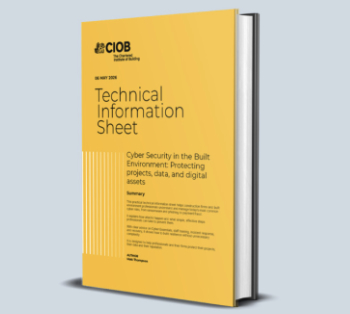
Protecting projects, data, and digital assets: A CIOB Academy TIS.
Managing competence in the built environment
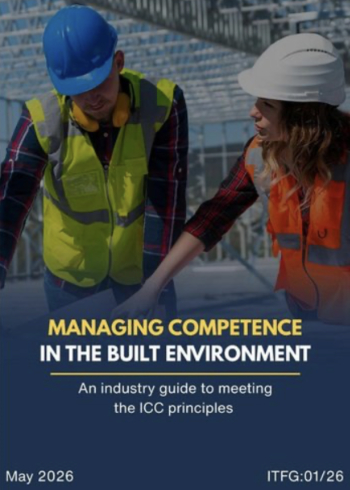
ITFG publishes new industry guide on how to meet the ICC principles.