





Bidding tactics

“Strategy without tactics is the slowest route to victory. Tactics without strategy are the noise before defeat.”
--Sun Tzu (544 BC – 496 BC)
[edit] Introduction
When a contractor or other supplier wishes to secure work for its business, it will usually submit a proposal (a ‘tender’, 'quote' or ‘bid’) to a prospective client and in so doing becomes a ‘bidder’. The bid is a detailed description of how the supplier will manage and complete the works required if chosen by the client.
This will involve bidding tactics - specific, small steps (or micro actions) the company takes in order to secure the work. These small steps combine to form a broader bid strategy (or macro action).
In the most basic sense, tactics can help companies define HOW to accomplish a goal while strategies define WHAT the goal will be. Generally, that goal will be to win the bid.
In a practical sense, the bid strategy will inform the definition of the bidding tactics. For more information see: Bid strategies.
[edit] Components of bidding tactics
Tactical decisions may come in the form of estimates or approximations of what materials, tools, personnel and other resources could be required for the project. For example, when working on a demolition project, a tactical question may be, ‘is there a need to include an estimate for a skip?’ The answer to this tactical question will be reflected in bid.
One tactic is to submit the most accurate bid possible. However, it's important not to reveal specific information, especially related to price or execution plans, to other potential bidders. Tactics may also include money saving factors that can be incorporated into the bid.
Having the ability to recognise important bidding tactics may require managerial skills and experience in the field. An effective project manager who can manage the process and make decisions on priorities, will ideally arrive at solutions that are advantageous for the project as a whole.
Bidding tactics will vary from project to project. Some of the factors that could influence how to bid (or tactical approaches) may include:
- The type of work.
- Project size and duration.
- The complexity of the project.
- The clarity and detail of the information provided.
- The type of employer: Public employers can be more process-driven and require more complex submittal procedures.
- The location of the project.
- Equipment availability: estimators should be mindful of the availability of expensive equipment across bids and projects.
- The availability of team and management: Projects may be bid with particular project team members in mind who may have specific expertise or experience.
- The number of bidders: Some projects will receive more bids than others. The odds of winning are greater on those with fewer bidders.
- Competition: only a few contractors will be likely to offer serious competition on any one bid. Being aware of their workload gives a better indication of which projects to bid for.
- The time of year.
- Whether the contractor has prior experience with a project that is similar.
- Confidence in the prices provided by subcontractors for the project.
- The state of the market - whether busy or slow.
- Whether there is an existing relationship with the employer.
- The opportunity for follow-on work from the same employer.
- Confidence in external events such as interest rates, inflation, and so on.
- How busy they are on other projects. Being busy may mean they enter higher bids, whereas if they are less busy they may enter lower bids that offer less profit.
- The amount and value of subcontracted work.
- Variations in productivity. As a trend, workers tend to be more productive when labour is readily available, whereas they are less so when labour is more scarce.
[edit] Related articles on Designing Buildings
Featured articles and news

We're expanding our collaborative mission by launching DB Intelligence, an exclusive market research advisory panel. Built environment professionals can now get paid to share their expertise on industry trends, products and services.
Panel members receive direct financial incentives for participating in research projects like short surveys, 1-2-1 interviews and focus groups. Register today to shape the future of the construction sector.
Overheating guidance and tools for building designers

Guidance for dealing with element of building fabric control that have increasing importance.
Shading for housing, a design guide

From the Good Homes Alliance and British Blind and Shutter Association.
UK Standard Skills Classification (SSC)

A shared framework for describing skills needs.
Social media ban consultation comes to close

CIOB urges UK Government to consider social media’s role in careers guidance in ban debate.
The latest of eight Skills England apprenticeship units

The addition of battery manufacturing welcomed by ECA with a warning about the risks of fast-tracked apprenticeship units.
Building Control Independent Panel final report
A precis of a key report led by Dame Hackitt with full recommendations and link to the government response.
Guide to ISO 19650 for Architecture Firms (2026)
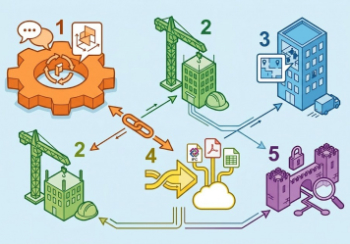
A user gives their low down.

A UK training and membership provider for mould remediation professionals.
Building Safety recap April, 2026
A short and longer run-through of the month, with links to further information and sources.

CIAT May 2026 briefing.

Independent NSI and BAFE study exploring how organisations are changing the way they buy fire safety services.

From medieval scribes to modern word art.

ECA welcomes crackdown on late payment and push for clean energy, whilst CIOB seek fixed cladding removal timeframes.
Cyber Security in the Built Environment
Protecting projects, data, and digital assets: A CIOB Academy TIS.
Managing competence in the built environment

ITFG publishes new industry guide on how to meet the ICC principles.
The UK's campaign to reduce noise pollution: Mythbusting, articles and topic guides.