





Water meter

Contents |
[edit] Introduction
A water meter is a device that can be used to measure the quantity of water that passes through a point. For example, a water meter might measure the amount of water that enters a property, or part of a property, over a defined period, and this can be used to assess consumption and calculate bills. Meters are also commonly installed to record consumption of electricity and gas.
[edit] Water meter principles
Water meters may function according to two different principles: rate of flow or volumetric.
[edit] Rate of flow meters
In devices of this kind, the flowing water rotates a propeller whose speed of rotation (rpm) is measured. A certain flow rate corresponds to a certain speed of the propeller. The propeller speed indicator can be calibrated directly, based on that calculation. A counting mechanism which totals the number of propeller revolutions displays the quantity of water consumed.
[edit] Volumetric meters
In devices of this category, a rotating container of a predetermined capacity is constantly filled with water and then emptied. The number of rotations measures the quantity of water that flows through the meter. Volumetric meters can measure low flow rates.
In a volumetric drum meter, the water enters the vessel at the central inlet and fills one of the measuring compartments. As it fills up, the weight of the water makes the drum rotate. The rotation of the drum causes the water to flow from the outlet while the next compartment begins to fill again from the central inlet.
[edit] Types of traditional water meters
The rotating impeller type of meter is frequently used for domestic water meters. There are two different types of impeller meters. In one, the impeller is immersed in the flow of water while the counting mechanism and dial are housed in a dry compartment. In the other type, the counting mechanism and dial are also immersed. The fully immersed type tends to provide a more accurate reading but its dial may become clogged.
Woltmann meters are used for the metering of larger quantities of water, especially in industry. This kind of meter is a straight length of pipe with a propeller installed. The propeller rotates and transmits its motion through a worm gear.
A different type of metering device is the Venturi meter. It is based on the principle that different flow velocities produce different amounts of suction. The Venturi meter comprises a pipe formed with a constriction.
[edit] Smart water meters
Smart water meters are fitted with wireless technology. They are typically installed in a space below the pavement that is located away from the structure.
The devices in the smart meters can transmit data immediately and remotely to customers and water companies. This can help customers monitor usage while allowing water companies to track possible problems.
[edit] Water meter requirements
In England and Wales, water usage is based on a mix of metered charging or a fixed charge based on the rateable value of the property. As of 2017, data from the Environment Agency showed 50% of households in England had a water meter fitted.
In England, domestic customers who currently pay on an unmeasured (unmetered) basis have the legal right at any time to give their water company a notice requiring them to fix charges by reference to the volume of water supplied (i.e. on a metered basis). A water company is not obliged to install a meter in response to a customer’s request if it is not reasonably practicable to do so, or if it is unreasonably expensive.
In practice, a water company can install a water meter and charge on that basis under certain circumstances typically associated with reasons for high usage or locations where more severe water management measures are required (such as those areas classified as in “serious water stress”). Under those circumstances, customers cannot refuse the installation of a meter.
[edit] Related articles on Designing Buildings Wiki
- Approved Document G.
- Flood and Water Management Act.
- Mains water.
- Meter.
- Public water supply.
- Smart meter.
- Water consumption.
- Water management.
[edit] External resources
- Citizens Advice, Changing to a water meter (Wales).
- Citizens Advice Scotland, Water meters.
- House of Commons Library, Parliament, Water meters.
- Northern Ireland Water, NI Water statement in relation to water meters.
- Ofwat, Water meters – your questions answered.
- Scottish Water, Thinking About a Water Meter?
- Welsh Water, Could you save money by being on a water meter?
Featured articles and news

We're expanding our collaborative mission by launching DB Intelligence, an exclusive market research advisory panel. Built environment professionals can now get paid to share their expertise on industry trends, products and services.
Panel members receive direct financial incentives for participating in research projects like short surveys, 1-2-1 interviews and focus groups. Register today to shape the future of the construction sector.
Planning condition discharge in England and Wales

A brief exoplanation from a building compliance expert, with further links.
Overheating guidance and tools for building designers

Guidance for dealing with element of building fabric control that have increasing importance.
Shading for housing, a design guide

From the Good Homes Alliance and British Blind and Shutter Association.
UK Standard Skills Classification (SSC)

A shared framework for describing skills needs.
Social media ban consultation comes to close

CIOB urges UK Government to consider social media’s role in careers guidance in ban debate.
The latest of eight Skills England apprenticeship units

The addition of battery manufacturing welcomed by ECA with a warning about the risks of fast-tracked apprenticeship units.
Building Control Independent Panel final report
A precis of a key report led by Dame Hackitt with full recommendations and link to the government response.
Building Safety recap April, 2026
A short and longer run-through of the month, with links to further information and sources.
CIAT May 2026 briefing.

From medieval scribes to modern word art.
ECA welcomes crackdown on late payment and push for clean energy, whilst CIOB seek fixed cladding removal timeframes.
Cyber Security in the Built Environment
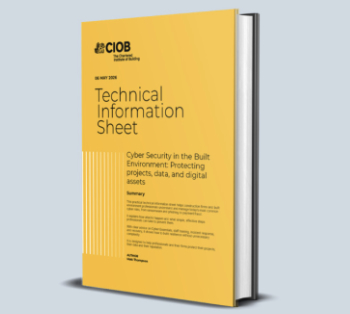
Protecting projects, data, and digital assets: A CIOB Academy TIS.
Managing competence in the built environment

ITFG publishes new industry guide on how to meet the ICC principles.
The UK's campaign to reduce noise pollution: Mythbusting, articles and topic guides.