




Travels with Baedeker
I have a battered and annotated 1885 edition of Baedeker’s Lower Egypt. The endpaper is inscribed: ‘Helen Caddick, 33 Beaufort Road, Edgbaston, January 1890’. Helen Caddick was a remarkable woman, a travel writer who, after becoming financially independent in her forties, travelled solo all over the world between 1889 and 1914, amassing vast quantities of ethno-geographic observations and photographs.
How this volume is in my possession is lost in the fog of history, but an educated guess is that my father acquired it in a job lot of second-hand Baedekers in 1938. This is because I know that many maps, plans and illustrations pillaged from an 1894 edition of Baedeker’s Greece ended up in my father’s journal of his travels in the summer of 1938.
That year, my father and two other second-year Cambridge classics students were granted bursaries by their respective colleges to travel to Greece in connection with their studies. The journal consists of 200 pages of manuscript, illustrated from said Baedeker and other sources, and with photographs taken with his folding camera. It is packed with the minutest of detail as he was obviously determined to omit nothing. It is informed by the expedition’s two guidebooks: the Baedeker, and Pausanias’s second-century Description of Greece. Many of the sites visited are described with reference to Pausanias and to the works of ancient authors, often in Greek and without translation – not unreasonable given the target audience, I guess – and to works by more recent authors, notably Byron’s Childe Harold’s Pilgrimage.
The trio set off in June from London by train to Brindisi and reached Patras by steamer four days later. Their first destination was Olympia, where ‘the calm of the sacred grove’ gave way to the realisation that the western Peloponnese was not equipped for tourists. Sourcing provisions was to be a recurring issue for their first week. The next visit was the Temple of Apollo Epicurius at Bassae, about 35 kilometres southeast of Olympia. There yet being no proper road, it was a day and a half’s hike to Andritsaena, the nearest village. The builders of the temple conveniently located it on a remote mountain-top at an elevation of 1,131 metres, and a guide was required to take them the final 450-metre climb over six kilometres of trackless wilderness.
On the way to Messene they tested Baedeker’s assurance that if you applied at the gate of a monastery before sunset you would be offered bed and board. At Voulkano, anyway, this was true. The Langada Pass over the Taygetos was another spectacular roadless adventure; after Sparta they walked the Festal Road from Heraeum to Mycenae; thence via Corinth and Eleusis to Athens, which entertained them for more than a week.
My father’s photos of the Acropolis prompted me to fish out mine from a visit 40 years later. There was one broad similarity: the very small numbers of tourists, such that most of both sets of pictures have no human figures in them whatever. The difference of emphasis is palpable, though: mine are architectural and artistic, my father’s more generally historic and literary, with emphases on the Mycenaean age and the Persian wars which, inevitably, necessitated visits to Marathon, Salamis and Plataea.
Then, via Thebes and Orchomenus to Levadia, where considerable interest was taken in the Cult of Trophonius, including drinking from the supposed mythical Springs of Lethe (forgetfulness) and Mnemosyne (remembrance), neither, apparently, with noticeable effect. Thence by bus to Delphi on the scary mountain road via the Cleft Way, where Oedipus killed his father and started all that sorry tale, and through Arachova where, on St George’s Day 1978, we saw schoolchildren in national dress dancing in the snows of Mount Parnassus.
And so home, arriving in London, after five weeks away, three days before his 21st birthday and completing the journal on 13 September. His trip was unusual for a student at that time but was insignificant compared to the intrepid exploits of Helen Caddick. Nevertheless, it is nice to feel the overlap, slight as it may be.
This article originally appeared in the Institute of Historic Building Conservation’s (IHBC’s) Context 181, published in December 2024. It was written by James Caird.
--Institute of Historic Building Conservation
Related articles on Designing Buildings Conservation.
IHBC NewsBlog
IHBC sponsors Gardens Trust event 23-4 Sept 2026
.jpeg)
'Learning from the Past, Shaping the Future’ takes place in Milton Keynes
Renovations to Frank Lloyd Wright's Fallingwater complete
.jpg)
World Heritage Preserved project opens house for tours again
Shakespeare Birthplace Trust places Hall's Croft on HAR Register
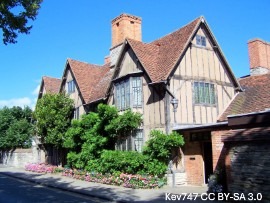
Stratford-upon-Avon home of Shakespeare's daughter is 'At Risk'
Lady Grange’s House repaired on St Kilda
.jpg)
National Trust for Scotland repairs stone cleit with link to famous island resident
Griff Rhys Jones on BBC Radio 4 Today programme
,_Green_Lane,_Derby.jpg)
The Victorian Society’s President unveiled its latest Top Ten Endangered Buildings 2026.
Need a MATE? Book your place now.
IHBC offers free webinars on applying for IHBC accreditation (Full & Associate).
UK Stained Glass Repository finds windows new homes
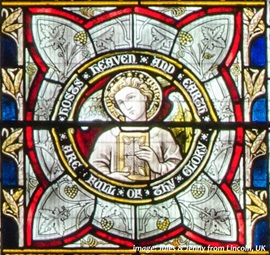
How are stained glass windows are rescued, stored and repurposed?
APPGEBE report sets high aims for quality
'Government must not sacrifice quality in drive to build 1.5m homes'
New measures protect Historic Shipwrecks from heritage crime

Underwater cultural heritage benefits from new HE guidance
How could the City of London skyline look in 6 years' time?

Visualisation shows approved planning applications as completed buildings
National Trust for Scotland calls for VAT cuts
Heritage neglect is encouraged by current policies
IHBC's 'Context' Issue 186 features Industrial Heritage
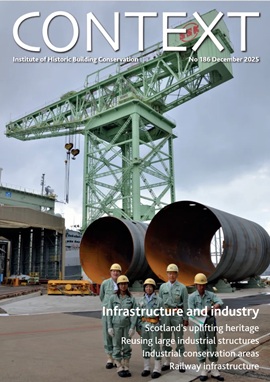
IHBC's members' journal reports on the challenges of conserving infrastructure
Book now for IHBC Annual School 2026
IHBC Annual School is taking place 18-20 June 2026 in Newcastle
RICHeS Research Infrastructure offers ‘Full Access Fund Call’
RICHeS offers a ‘Help’ webinar on 11 March
Latest IHBC Issue of Context features Roofing
Articles range from slate to pitched roofs, and carbon impact to solar generation to roofscapes
Three reasons not to demolish Edinburgh’s Argyle House

Should 'Edinburgh's ugliest building' be saved?
IHBC’s 2025 Parliamentary Briefing...from Crafts in Crisis to Rubbish Retrofit
IHBC launches research-led ‘5 Commitments to Help Heritage Skills in Conservation’
How RDSAP 10.2 impacts EPC assessments in traditional buildings

Energy performance certificates (EPCs) tell us how energy efficient our buildings are, but the way these certificates are generated has changed.