






The transformative power of BIM

With annual revenues of nearly $10 trillion, or about 6% of global GDP, the engineering and construction (E&C) industry is a cornerstone of the world’s economy. It serves almost all other industries, much of whose value creation involves buildings, infrastructure facilities, and other 'constructed assets'.
Yet, unlike other industries, E&C has been slow to adopt new technologies and has never undergone a major transformation. Consider, for example, the opportunity offered by lean process methodologies—take-up has been limited, and many companies that have adopted them have failed to apply them wholeheartedly.
In addition, construction firms now find themselves struggling to cope with ever-larger and more complex 'megaprojects', particularly in infrastructure. As a result of these setbacks and challenges, the construction industry has registered disappointing efficiency gains, and its growth in labour productivity continues to lag far behind that of other industries.
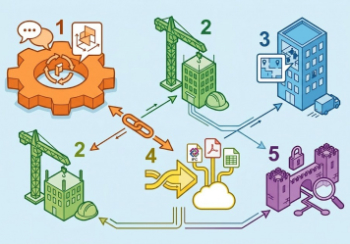
Substantial change is on the way, however, driven by digitalisation: the development and deployment of digital technologies and processes. Construction will soon be characterised by connected systems of sensors, intelligent machines, mobile devices, and new software applications—all integrated on a central platform of building information modeling (BIM).
As their adoption increases, digital technologies are enabling companies to boost productivity, manage complexity, reduce project delays and cost overruns, and enhance safety and quality.
Other industries, such as the automotive industry, underwent radical process changes earlier and are now well into their digital transformation. In E&C, digitalisation is just beginning. Given the sector’s vast size, however, even small improvements will translate into substantial benefits for companies and for society.
Within ten years, according to our estimates, full-scale digitalisation in non-residential construction will lead to annual global cost savings of $0.7 trillion to $1.2 trillion (13% to 21%) in the engineering and construction phases, and $0.3 trillion to $0.5 trillion (10% to 17%) in the operations phase.
Digitalisation will change the game fundamentally in E&C, not only enabling efficiency and quality gains along the value chain but also reshuffling the competitive league table of companies and countries.
Post originally published on bcgperspectives.com.
This article was written by Philipp Gerbert, Santiago Castagnino, Christoph Rothballer, Andreas Renz, and Rainer Filitz.
This article was also published on the Future of Construction Knowledge Sharing Platform and the WEF Agenda Blog.
--Future of Construction 15:22, 16 Jun 2017 (BST)
[edit] Find out more
[edit] Related articles on Designing Buildings Wiki
Featured articles and news

We're expanding our collaborative mission by launching DB Intelligence, an exclusive market research advisory panel. Built environment professionals can now get paid to share their expertise on industry trends, products and services.
Panel members receive direct financial incentives for participating in research projects like short surveys, 1-2-1 interviews and focus groups. Register today to shape the future of the construction sector.
Social media ban consultation comes to close

CIOB urges UK Government to consider social media’s role in careers guidance in ban debate.
The latest of eight Skills England apprenticeship units

The addition of battery manufacturing welcomed by ECA with a warning about the risks of fast-tracked apprenticeship units.
Building Control Independent Panel final report

A precis of a key report led by Dame Hackitt with full recommendations and link to the government response.
Guide to ISO 19650 for Architecture Firms (2026)
A user gives their low down.

A UK training and membership provider for mould remediation professionals.
Building Safety recap April, 2026

A short and longer run-through of the month, with links to further information and sources.

CIAT May 2026 briefing.

Independent NSI and BAFE study exploring how organisations are changing the way they buy fire safety services.

From medieval scribes to modern word art.

ECA welcomes crackdown on late payment and push for clean energy, whilst CIOB seek fixed cladding removal timeframes.
Cyber Security in the Built Environment

Protecting projects, data, and digital assets: A CIOB Academy TIS.
Managing competence in the built environment

ITFG publishes new industry guide on how to meet the ICC principles.

The UK's campaign to reduce noise pollution: Mythbusting, articles and topic guides.