





Target cost for construction
Target costs are generally associated with cost-reimbursable contracts. They introduce a mechanism enabling the contractor, and sometimes the consultant team, to share in the benefits of cost savings, but also to bear some of the client's cost when there are cost overruns. Contracting the contractor and the consultant team on a target cost basis can be an effective way of ensuring good collaboration.
The target cost is set early in the project, and then cost savings or overruns are shared based on an agreed formula. The aim is to provide a financial incentive encouraging cost control, rather than to penalise. Bonus and penalty payments are usually capped to prevent over-zealous or adversarial behaviour.
Target costs might be set for the overall project, or for specific elements of the works. Agreeing the target cost requires that the client has sufficient knowledge and experience to be able to accurately estimate the likely cost of the works and to negotiate effectively with the contractor and sometimes the consultant team.
Examples of target cost contracts include the New Engineering Contract (NEC) Engineering and Construction Contracts Option C: Target contract with activity schedule and Option D: Target contract with bill of quantities. Also the JCT Target Cost Contract, a new contract family introduced with the JCT 2024 Edition. It includes a Main Contract (TCC 2024), Sub-Contract (comprising the Sub-Contract Agreement (TCCSub/A 2024) and Conditions (TCCSub/C 2024)), and a Guide for both the Main Contract (TCC/G 2024) and Sub-Contract (TCC Sub/G 2024).
NB: According to NRM2: Detailed measurement for building works, in the context of bills of quantities, the term ‘cost target' means; '...the total expenditure for an element or
work package.'
[edit] Related articles on Designing Buildings
- Bill of quantities.
- Construction contract.
- Contract condition.
- Contract sum.
- Cost overruns.
- Cost-reimbursable contract.
- Disallowed cost.
- Fast-track construction.
- Fixed price contract.
- Force account work.
- Guaranteed maximum price.
- Lump sum contract - pros and cons.
- New Engineering Contract.
- Open-book accounting.
- Procurement route.
- Target contract.
[edit] External references
Featured articles and news

We're expanding our collaborative mission by launching DB Intelligence, an exclusive market research advisory panel. Built environment professionals can now get paid to share their expertise on industry trends, products and services.
Panel members receive direct financial incentives for participating in research projects like short surveys, 1-2-1 interviews and focus groups. Register today to shape the future of the construction sector.
Planning condition discharge in England and Wales

A brief exoplanation from a building compliance expert, with further links.
Overheating guidance and tools for building designers

Guidance for dealing with element of building fabric control that have increasing importance.
Shading for housing, a design guide

From the Good Homes Alliance and British Blind and Shutter Association.
UK Standard Skills Classification (SSC)

A shared framework for describing skills needs.
Social media ban consultation comes to close

CIOB urges UK Government to consider social media’s role in careers guidance in ban debate.
The latest of eight Skills England apprenticeship units

The addition of battery manufacturing welcomed by ECA with a warning about the risks of fast-tracked apprenticeship units.
Building Control Independent Panel final report

A precis of a key report led by Dame Hackitt with full recommendations and link to the government response.
Building Safety recap April, 2026

A short and longer run-through of the month, with links to further information and sources.

CIAT May 2026 briefing.

From medieval scribes to modern word art.

ECA welcomes crackdown on late payment and push for clean energy, whilst CIOB seek fixed cladding removal timeframes.
Cyber Security in the Built Environment
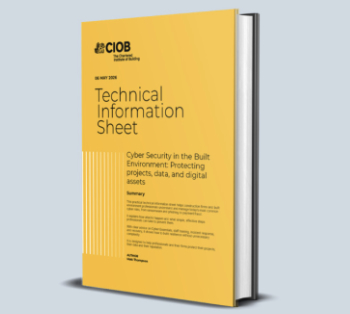
Protecting projects, data, and digital assets: A CIOB Academy TIS.
Managing competence in the built environment

ITFG publishes new industry guide on how to meet the ICC principles.

The UK's campaign to reduce noise pollution: Mythbusting, articles and topic guides.