





Kenya recycles plastic bottles into bricks stronger than concrete
A 29-year-old Kenyan entrepreneur has created blocks out of waste plastic and sand that she claims are stronger, cheaper and more durable than concrete.
Nzambi Matee, a materials science graduate who got a scholarship to study the innovative admixture in the US, set up her slab-making workshop in her mother's back garden in Nairobi, and can produce 1,500 a day.
Her company, Gjenge Makers, has sold slabs to local schools and homeowners.

[edit] Flow-up update 2023
Gjenge is a community-oriented organization whose aim is to address the need for sustainable and affordable alternative construction materials in Kenya and the Continent. Our initial output is innovations derived from recycled plastics to produce paving blocks, paving tiles, and manhole covers.
Our team ideated a rollout of a plastics collection company that would sort and sell plastic waste to other recycling companies. Having collected more waste faster than the recycling companies could uptake, this original idea was pivoted, and a decision was made to do value addition to these plastics hence the decision to manufacture alternative building products emerged. Thus, Gjenge Makers was born.
Our mission is to innovate solutions to create beautiful and sustainable alternative construction products for Kenya and the African continent with the aim of providing sustainable and affordable alternative building materials whilst creating job opportunities for youths and women by promoting recycling and upcycling culture in Kenya and Africa.
We collect waste plastics and process it using the latest cutting-edge technologies to mix the recycled plastic with sand to form a mixture which we mold into our various products.
Gjenge Makers has cut a niche as a manufacturing trailblazer in the provision of beautiful and sustainable alternative building materials.
For further information visit https://www.gjenge.co.ke/about
[edit] Original GCR article 2021
The UN Environment Programme's (UNEP) named her 2020's Young Champion of the Earth in Africa.
Surprisingly, the plastic slabs are up to five times heavier than concrete ones owing to the lack of air pockets, but she says they are more flexible, durable and have a higher melting point.
The plastic pavers are 30% cheaper than traditional concrete ones, come in different colours and are certified by the Kenya Bureau of Standards.
Gjenge Makers offers three types of slabs: a light option for footpaths, a mid-tier paver for commercial projects and a heavy duty alternative for roads.
Matee has a material science degree and previously worked in Kenya's oil industry as an engineer, but quit to found Gjenge Makers. She obtained a scholarship to the University of Colorado Boulder to work on the ratios of sand to plastic in Gjenge Makers' bricks.
Nzambi Matee said to the UNEP: "Plastic is a material that is misused and misunderstood. The potential is enormous, but it's after life can be disastrous."
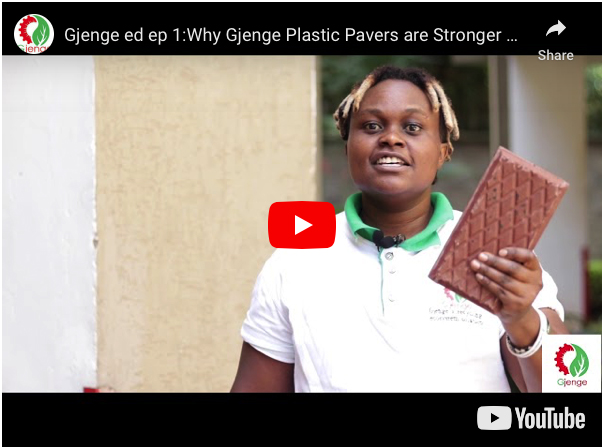
This article originally appeared on Global Construction Review. Images courtesy of Gjenge Makers. Republished on the CIAT news and blog site as "Kenyan start up recycles plastic bottles into bricks stronger than concrete" dated February 15 2021.
--CIAT
[edit] Related articles on Designing Buildings.
- Glass reinforced plastic GRP.
- Glass fibre reinforced plastic.
- Polycarbonate plastic.
- Plastic cladding.
- Plastic and recycling.
- Plastic coating market.
- Plastic in construction.
- Plastic in concrete.
- Recycled plastic bridges.
- Recycled waste plastic in construction.
- The K-briq a circular product.
- Types of plastic in construction.
- Wood plastic composites market for construction.
Featured articles
Check out some of the best features and news from Designing Buildings as well as key stories from around the web.

The Building Safety Regulator announces a call for evidence.

Government approach could undermine delivery and regeneration.
World's first mass timber data centre.

The overlooked environmental aspect of data centre development.
Introduction to radon awareness

New technical information sheet published by CIOB.

Updated supplier guide can help electrical contractors engage with NHP.

CIAT confirm the winners of the 2026 architectural technology awards.

Government launches a one stop shop for flood preparedness.

Sir Edwin Lutyens: Britain's greatest architect? Book review.

CIOB publishes free template to help assess and manage risks.
ECA's reflections on Party Conference season

Burnham wants to be confident of winning before asking for a fresh mandate.
New Chief Construction and Scientific Adviser

Sergio Cavalaro, Professor of Infrastructure Systems at Loughborough University.
Building safety levy for England

CIAT publish estimator tool for members.
Comments
[edit] To make a comment about this article, or to suggest changes, click 'Add a comment' above. Separate your comments from any existing comments by inserting a horizontal line.