





Soil compaction
Soil compaction is the removal of pore spaces within soil structures and drainage channels between soil structures. This inhibits root penetration and the movement of air and water in soil. Ref The HS2 London-West Midlands Environmental Statement, Glossary of terms and list of abbreviations, DETR 2013.
Soil compaction can be purposeful (intentional) or consequential (unintentional) such as settlement that might occur due to vehicle movement.
Intentional soil compaction produces an increase in soil density and a decrease in air volume without producing a decrease in water content. It can improve shear strength, stiffness, bearing capacity and stability, reducing settlement and frost heave. This may be necessary in the construction of bases for highways, embankments and so on, or to create a suitable level base for the construction of a building. Existing soil can be compacted, or layers of new soil can be compacted, taking a site to the required level.
For effective compaction to take place, there must be a mixture of particle sizes so that smaller particles can fill the voids between larger particles. Soils with smooth, spherical particles are easier to compact than soils with irregular particles, although their load-bearing capacity can be lower.
Soils are typically categorised as cohesive soils, granular soils or mixed soils. Cohesive soils can be compacted effectively by impact, such as by rammers or sheepsfoot rollers (tamping rollers). Granular soils can be compacted effectively by vibratory plates and smooth-drum vibratory rollers.
The use of vibrating or oscillating rollers is sometimes referred to as dynamic compaction.
Excessive compaction can lead to soils breaking down and separating. This can cause compacted layers to weaken.
See also: Vibro-compaction.
[edit] Related articles on Designing Buildings Wiki
- Bearing capacity.
- Excavation.
- Geophysical survey.
- Geotechnical engineering.
- Ground conditions.
- Ground heave.
- Ground improvement techniques.
- Ground investigation.
- Ground investigation.
- Groundworks.
- Insitu testing of soils.
- Made ground.
- Soil report.
- Trial pit.
- Types of plant.
- Types of soil.
- Vibro-compaction.
Featured articles and news

We're expanding our collaborative mission by launching DB Intelligence, an exclusive market research advisory panel. Built environment professionals can now get paid to share their expertise on industry trends, products and services.
Panel members receive direct financial incentives for participating in research projects like short surveys, 1-2-1 interviews and focus groups. Register today to shape the future of the construction sector.
Building Safety Wiki Interviews

Chief executive of the British Woodworking Federation.
Planning condition discharge in England and Wales

A brief exoplanation from a building compliance expert, with further links.
Overheating guidance and tools for building designers

Guidance for dealing with element of building fabric control that have increasing importance.
Shading for housing, a design guide

From the Good Homes Alliance and British Blind and Shutter Association.
UK Standard Skills Classification (SSC)

A shared framework for describing skills needs.
Social media ban consultation comes to close

CIOB urges UK Government to consider social media’s role in careers guidance in ban debate.
The latest of eight Skills England apprenticeship units

The addition of battery manufacturing welcomed by ECA with a warning about the risks of fast-tracked apprenticeship units.
Building Control Independent Panel final report
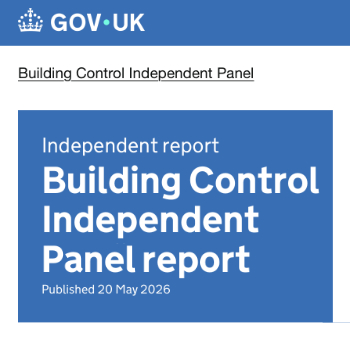
A precis of a key report led by Dame Hackitt with full recommendations and link to the government response.
Building Safety recap April, 2026
A short and longer run-through of the month, with links to further information and sources.

CIAT May 2026 briefing.

From medieval scribes to modern word art.

ECA welcomes crackdown on late payment and push for clean energy, whilst CIOB seek fixed cladding removal timeframes.
Cyber Security in the Built Environment
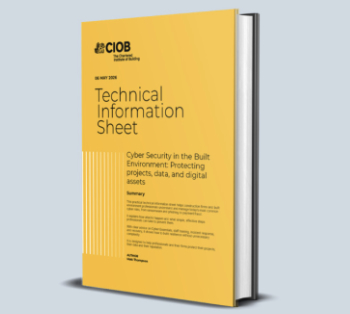
Protecting projects, data, and digital assets: A CIOB Academy TIS.
Managing competence in the built environment
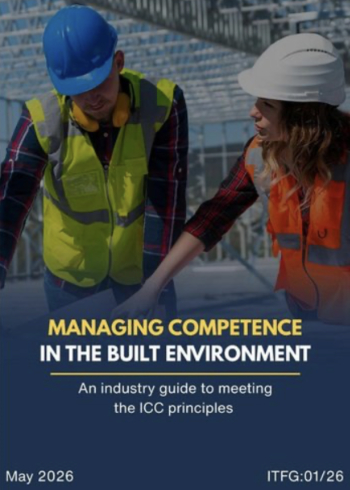
ITFG publishes new industry guide on how to meet the ICC principles.