





Site layout planning for daylight IP 23 12
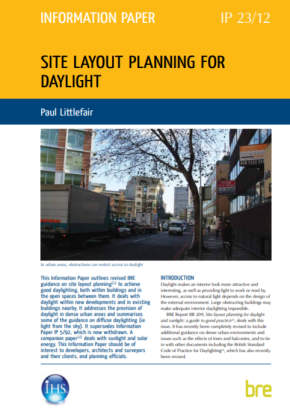
Site layout planning for daylight (IP 23/12) was written by Paul Littlefair and published by BRE on 16 October 2012. It superseded IP5/92 which was withdrawn.
Daylight makes an interior look more attractive and interesting, as well as providing light to work or read by. However, access to natural light depends on the design of the external environment. Large obstructing buildings may make adequate interior daylighting impossible
This 6-page Information Paper outlines revised BRE guidance on site layout planning to achieve good daylighting, both within buildings and in the open spaces between them. It deals with daylight within new developments and in existing buildings nearby. It addresses the provision of daylight in dense urban areas and summarises some of the guidance on diffuse daylighting (ie light from the sky rather than direct from the sun).
This Information Paper should be of interest to developers, architects, surveyors, clients, and planning officials.
Its contents are:
- Introduction.
- Daylight within a new development.
- Existing buildings.
- Trees and hedges.
- Conclusions.
- References.
It is available at: https://www.brebookshop.com/details.jsp?id=327076
See also: Site layout planning for daylight and sunlight.
[edit] Related articles on Designing Buildings Wiki
- 7 ways better lighting can improve your health.
- BRE articles on Designing Buildings Wiki.
- BRE Expert Collection 6 Daylight and shading.
- Building Research Establishment.
- EN 17037 Daylight in buildings.
- Health and wellbeing impacts of natural and artificial lighting.
- Light obstruction notice.
- Light pollution.
- Lighting and energy efficiency.
- Lighting and health infographic.
- Lighting of construction sites.
- Natural light.
- Passive building design.
- Right to light.
- Site layout planning for daylight and sunlight.
- Solar gain in buildings.
- Use of lighting to improve health and wellbeing.
Featured articles
Check out some of the best features and news from Designing Buildings as well as key stories from around the web.

Government approach could undermine delivery and regeneration.
World's first mass timber data centre.

The overlooked environmental aspect of data centre development.
Introduction to radon awareness

New technical information sheet published by CIOB.

Updated supplier guide can help electrical contractors engage with NHP.

CIAT confirm the winners of the 2026 architectural technology awards.

Government launches a one stop shop for flood preparedness.

Sir Edwin Lutyens: Britain's greatest architect? Book review.

CIOB publishes free template to help assess and manage risks.
ECA's reflections on Party Conference season

Burnham wants to be confident of winning before asking for a fresh mandate.
New Chief Construction and Scientific Adviser

Sergio Cavalaro, Professor of Infrastructure Systems at Loughborough University.
Building safety levy for England

CIAT publish estimator tool for members.

Water sector faces a growing crisis that could slow the delivery of vital infrastructure.