





Nationally Significant Infrastructure Projects
Nationally Significant Infrastructure Projects are projects of a certain type, over a certain size or significance, and as such considered by the Government to be of national importance and as a result permission should to be given at the National level, by the responsible Government minister at thetime (the ‘Secretary of State’).
These projects apply for permission directly to the Planning Inspectorate, rather than the local authority, using a different form and process which is set out in the Planning Act 2008 and referred to as a Development Consent Order (DCO). The Infrastructure Planning Commission (IPC) was originally formed in 2008 to carry out this work regardig NSIPs, however under the under the Localism Act 2011 it was abolished. Since April 2012 the Infrastructure Planning Unit which is within the Planning Inspectorate (PINS) has been responsible for operating the planning process for NSIPs.
Under The Planning Act 2008, nationally significant infrastructure projects (NSIPs) fall into five general categories; Energy; Transport; Water; Waste Water and Waste and can include projects as diverse as electricity generation, rail freight interchanges, reservoirs and hazardous waste facilities.
Scoping Requests are made at the pre-planning stage and are sent to the various relevant consultation bodies invloved in the process. Acceptance for Examination describes the stage confirming an application has been accepted for examination under Section 56 of the Planning Act 2008. A Rule 6 Notice refers to a letter from the Planning Inspectorate giving Notice of the Preliminary Meeting concerning the matter. The Rule 8 Notice refers to a letter or notice from the Planning Inspectorate confirme dthe procedural decisions made following the preliminary meeting and formally opening the examination stage of the process. At this stage statutory parties that have not made a relevant representation are asked if they wish to become an Interested Party.
The Planning Inspectorate are required to publish monthly updates Performance updates, these updates also include the number of NSIPs current in the systems. In September 2022 the inspectorate had 'a high number of Nationally Significant Infrastructure Projects (NSIPs) at various stages. They include 70 national infrastructure schemes where we are providing advice before submission, 10 applications being considered by us and 12 proposals where we have completed our recommendations and the Secretary of State’s decision is awaited. These are vital to the ongoing support by The Planning Inspectorate to the country’s economic recovery."
In February 2023 the Government published the policy paper "Nationally Significant Infrastructure: action plan for reforms to the planning process" calling for a overhaul of the existing system.
[edit] Related articles on Designing Buildings
- Breaking Barriers in Infrastructure - perspectives from the profession
- Crossrail 2.
- Development Consent Order.
- Engineers make policy decisions a reality.
- Environmental Impact Assessment.
- Environmental Statement.
- Generation nuclear.
- Instrumentation operated in the national interest.
- Is a bridge needed between Scotland and Northern Ireland?
- Listed building consent.
- Localism Act.
- Major Projects Authority.
- National Infrastructure Plan.
- National Infrastructure Planning Reform Programme.
- Nationally Significant Infrastructure Project initiatives reach milestone.
- Permission for mining or working of minerals.
- Planning Act 2008.
- Planning permission.
- Safeguarding land.
- Wind farm.
Featured articles and news
The sad story of Derby Hippodrome
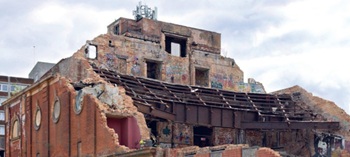
An historic building left to decay.

ECA, JIB and JTL back Fabian Society call to invest in skills for a stronger built environment workforce.

Women's Contributions to the Built Environment.
Calls for the delayed Circular Economy Strategy

Over 50 leading businesses, trade associations and professional bodies, including CIAT, and UKGBC sign open letter.
The future workforce: culture change and skill

Under the spotlight at UK Construction Week London.

A landmark moment for postmodern heritage.
A safe energy transition – ECA launches a new Charter

Practical policy actions to speed up low carbon adoption while maintaining installation safety and competency.
Frank Duffy: Researcher and Practitioner

Reflections on achievements and relevance to the wider research and practice communities.
The 2026 Compliance Landscape: Fire doors

Why 'Business as Usual' is a Liability.
Cutting construction carbon footprint by caring for soil

Is construction neglecting one of the planet’s most powerful carbon stores and one of our greatest natural climate allies.
ARCHITECTURE: How's it progressing?

Archiblogger posing questions of a historical and contextual nature.
The roofscape of Hampstead Garden Suburb

Residents, architects and roofers need to understand detailing.
Homes, landlords. tenants and the new housing standards

What will it all mean?