






Electrostatic filters
Illustrated Guide to Ventilation (BG 2/2009), compiled by Kevin Pennycook and published by BSRIA in 2009, states: ‘Electrostatic filters or electronic air cleaners can be highly efficient in filtering out particulate contaminants like smoke, dust and pollen. There are three basic types: ionisation plate, charged media non-ionising, and the charged media-ionising type. The most common type of electrostatic precipitator is the ionising type. Thin wires suspended in the air stream are charged with a high positive voltage. The positive ions created in the ionising field become attached to particles which then pass into the collecting plate section. This section consists of a series of parallel plates, with alternative plates positively charged and the other plates at ground potential. The electric field forces the charged particles on to the oppositely charged plates. The retention of particles on the collector plates is by a combination of electrical and intermolecular adhesion. To improve the overall efficiency, a filter is often placed downstream of the collector plates to capture large agglomerated particles shed from the plates.’
--BSRIA
[edit] Related articles on Designing Buildings
Featured articles and news

We're expanding our collaborative mission by launching DB Intelligence, an exclusive market research advisory panel. Built environment professionals can now get paid to share their expertise on industry trends, products and services.
Panel members receive direct financial incentives for participating in research projects like short surveys, 1-2-1 interviews and focus groups. Register today to shape the future of the construction sector.
Building Safety Wiki Interviews

Chief executive of the British Woodworking Federation.
Planning condition discharge in England and Wales

A brief exoplanation from a building compliance expert, with further links.
Overheating guidance and tools for building designers

Guidance for dealing with element of building fabric control that have increasing importance.
Shading for housing, a design guide

From the Good Homes Alliance and British Blind and Shutter Association.
UK Standard Skills Classification (SSC)

A shared framework for describing skills needs.
Social media ban consultation comes to close

CIOB urges UK Government to consider social media’s role in careers guidance in ban debate.
The latest of eight Skills England apprenticeship units

The addition of battery manufacturing welcomed by ECA with a warning about the risks of fast-tracked apprenticeship units.
Building Control Independent Panel final report
A precis of a key report led by Dame Hackitt with full recommendations and link to the government response.
Building Safety recap April, 2026
A short and longer run-through of the month, with links to further information and sources.

CIAT May 2026 briefing.

From medieval scribes to modern word art.

ECA welcomes crackdown on late payment and push for clean energy, whilst CIOB seek fixed cladding removal timeframes.
Cyber Security in the Built Environment
Protecting projects, data, and digital assets: A CIOB Academy TIS.
Managing competence in the built environment
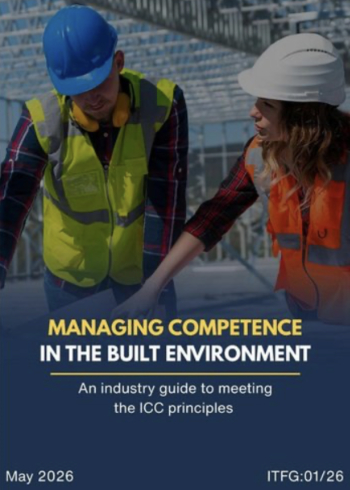
ITFG publishes new industry guide on how to meet the ICC principles.