





Computational fluid dynamics in building design: An introduction FB 69
BRE (Building Research Establishment) is an independent, research-based consultancy, testing and training organisation, operating in the built environment and associated industries.
Computational fluid dynamics in building design: An introduction (FB 69) was written by Richard Chitty and Chunli Cao and published on 15 September 2014.
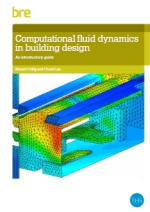
Computational fluid dynamics (CFD) is a tool that can be used in the design of buildings to simulate aspects of a building's thermal and ventilation performance, fire engineering, its impact on the local environment and so on. For more information see: Computational fluid dynamics.
FB 69 sets out the background to the CFD methodology for non-experts such as building control bodies and other regulatory authorities and discusses the current capabilities and limitations of CFD for building design.
The process of reviewing CFD predictions can be dependent on identifying ‘schoolboy’ errors, such as supersonic wind speeds, using simple sanity checks based on experience of the real world. Visualisation methods often mask the difference between qualitative simulations to demonstrate the feasibility of a concept and quantitative simulations required to prove the functionality of different aspects of design.
The 32-page guide explains best practice, focussing on fire safety, ventilation, thermal comfort and wind movement around buildings.
Its contents include:
- Introduction.
- Computational fluid dynamics explained.
- Computational fluid dynamics in use.
- Fire safety design.
- Ventilation and thermal comfort.
- Wind loading.
- Micro-climate around buildings.
- Case study 1: Fire simulation.
- Case study 2: Natural ventilation.
- References.
[edit] Related articles on Designing Buildings Wiki
- A Practical Guide to Building Thermal Modelling.
- BRE articles on Designing Buildings Wiki.
- BRE Buzz articles on Designing Buildings Wiki.
- BRE Buzz.
- Building Research Establishment.
- Computational fluid dynamics.
- Conventions for calculating linear thermal transmittance and temperature factors.
- Dynamic thermal modelling of closed loop geothermal heat pump systems.
- Heat transfer.
- Indoor air velocity.
- Integrating CFD into the design process.
- Mass transfer.
- The design of temporary structures and wind adjacent to tall buildings.
- The thermal behaviour of spaces enclosed by fabric membranes (Thesis).
- Thermal dynamic analysis.
Featured articles
Check out some of the best features and news from Designing Buildings as well as key stories from around the web.

The Building Safety Regulator announces a call for evidence.

Government approach could undermine delivery and regeneration.
World's first mass timber data centre.

The overlooked environmental aspect of data centre development.
Introduction to radon awareness

New technical information sheet published by CIOB.

Updated supplier guide can help electrical contractors engage with NHP.

CIAT confirm the winners of the 2026 architectural technology awards.

Government launches a one stop shop for flood preparedness.

Sir Edwin Lutyens: Britain's greatest architect? Book review.

CIOB publishes free template to help assess and manage risks.
ECA's reflections on Party Conference season

Burnham wants to be confident of winning before asking for a fresh mandate.
New Chief Construction and Scientific Adviser

Sergio Cavalaro, Professor of Infrastructure Systems at Loughborough University.
Building safety levy for England

CIAT publish estimator tool for members.