





Chain of custody in design and construction
Over recent years there has been much discussion regarding The chain of custody for sustainable timber and how this chain of custody can be achieved for clients seeking a sustainable building using timbers from a sustainable source.
The chain of custody was developed in order to raise Industry awareness of the depletion of our natural resources within the worlds rain forests, especially hard wood timbers and over recent times some soft woods as well.
For a contractor to demonstrate to a client that they can identify and manage through a document trail exactly where timber was coming from, a system needed to be established to track and prove through documentary evidence that supplies are from suitable resources and regions of the world. This also included timer merchants and shippers, who are the 'middle men' when dealing with purchasing timber.
Clients can require all timber in the construction of a new building to be supplied with a chain of custody certification trail from its source in the forest, via a saw mill, merchant and contractor to its final installation within the building.This can require a great deal of investigation work.
WWF are able to provide information on companies with the necessary chain of custody certification to allow the movement of products produced from well managed forests. See WWF Practical Guidance on CoC certification and FSC Chain of Custody Certification.
As the 'chain' needs to be passed from the source to the client without any breaks in that chain, the contractor must also have the necessary certification.
Organisation such as PEFC (Programme for the Endorsement of Forest Certification) are able to assist contractors with achieving certification for the chain of custody, providing a management service for accreditation. If a contractor already has ISO 14001 accreditation, then the management processes are already in place for the control of the documentation necessary to manage the chain of custody. It is then a case of changing those management procedures and documents under ISO14001 within the company organisation to suit the tracking and logging of those timber materials being used for a particular site.
[edit] Related articles on Designing Buildings Wiki
- A traceability framework for the construction supply chain.
- Action programme for responsible and ethical sourcing.
- BES 6001 Responsible sourcing of construction products.
- BREEAM recognised responsible sourcing certification schemes.
- BREEAM Responsible Sourcing of Materials.
- Confederation of Timber Industries.
- Environmental plan.
- European Union Timber Regulation.
- Forests.
- Forest ownership.
- Forest Stewardship Council.
- Legally harvested and traded timber.
- Point of supply.
- Programme for the Endorsement of Forest Certification.
- Sustainability.
- Sustainable materials.
- Sustainable timber.
- Sustainably procuring tropical hardwood.
- Timber.
- Traceability.
[edit] External references
- WWF: Practical Guidance on CoC certification.
- FSC: Chain of Custody Certification.
- Programme for the Endorsement of Forest Certification.
Featured articles and news

We're expanding our collaborative mission by launching DB Intelligence, an exclusive market research advisory panel. Built environment professionals can now get paid to share their expertise on industry trends, products and services.
Panel members receive direct financial incentives for participating in research projects like short surveys, 1-2-1 interviews and focus groups. Register today to shape the future of the construction sector.
Planning condition discharge in England and Wales

A brief exoplanation from a building compliance expert, with further links.
Overheating guidance and tools for building designers

Guidance for dealing with element of building fabric control that have increasing importance.
Shading for housing, a design guide

From the Good Homes Alliance and British Blind and Shutter Association.
UK Standard Skills Classification (SSC)

A shared framework for describing skills needs.
Social media ban consultation comes to close

CIOB urges UK Government to consider social media’s role in careers guidance in ban debate.
The latest of eight Skills England apprenticeship units

The addition of battery manufacturing welcomed by ECA with a warning about the risks of fast-tracked apprenticeship units.
Building Control Independent Panel final report
A precis of a key report led by Dame Hackitt with full recommendations and link to the government response.
Guide to ISO 19650 for Architecture Firms (2026)
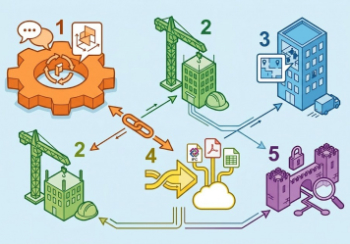
A user gives their low down.

A UK training and membership provider for mould remediation professionals.
Building Safety recap April, 2026
A short and longer run-through of the month, with links to further information and sources.

CIAT May 2026 briefing.

Independent NSI and BAFE study exploring how organisations are changing the way they buy fire safety services.

From medieval scribes to modern word art.

ECA welcomes crackdown on late payment and push for clean energy, whilst CIOB seek fixed cladding removal timeframes.
Cyber Security in the Built Environment
Protecting projects, data, and digital assets: A CIOB Academy TIS.
Managing competence in the built environment
ITFG publishes new industry guide on how to meet the ICC principles.

The UK's campaign to reduce noise pollution: Mythbusting, articles and topic guides.
Comments
In the context of design and construction, the chain of custody refers to the documentation and tracking of materials, products, and information throughout the entire project lifecycle. It ensures that the origin, handling, and transfer of materials and information are properly recorded and maintained. The chain of custody is crucial for maintaining quality, accountability, and compliance with regulations. Here's how the chain of custody is relevant in design and construction:
1. Material Procurement: The chain of custody starts with the procurement of construction materials. It involves verifying the source and authenticity of materials, ensuring compliance with specifications and regulations, and maintaining records of suppliers and their certifications. This helps prevent the use of substandard or non-compliant materials.
2. Material Transportation and Storage: As materials are transported to the construction site, the chain of custody includes tracking their movement and storage conditions. This ensures that materials are handled properly, protected from damage, and kept in suitable environmental conditions.
3. Subcontractors and Suppliers: The chain of custody extends to subcontractors and suppliers involved in the construction project. It includes documenting the chain of custody for materials, components, and equipment provided by subcontractors, ensuring they meet the required standards and specifications.
4. Construction Documentation: Throughout the construction process, documentation plays a crucial role in maintaining the chain of custody. It involves recording project plans, specifications, change orders, inspections, and test results. Documentation ensures transparency, helps track decisions and actions, and provides a record of the construction process.
5. Quality Assurance and Control: The chain of custody includes quality assurance and control processes to verify compliance with standards and specifications. This may involve inspections, testing, and documentation of results to ensure that the constructed elements meet the required quality and safety standards.
6. Handover and Commissioning: At the completion of the construction project, the chain of custody includes the handover and commissioning process. This involves documenting the transfer of responsibility, warranties, maintenance manuals, and any other relevant information to the owner or operator of the facility.
7. Documentation Management: Managing and preserving the chain of custody documentation is essential for future reference, maintenance, and potential legal requirements. This includes proper storage, indexing, and retention of documents and records related to the design and construction process.
By maintaining a strong chain of custody, design and construction professionals can enhance project transparency, ensure compliance, track materials and information, and provide a solid foundation for quality control and accountability. It facilitates efficient project management, reduces risks, and supports long-term asset management.