





A technical guide to district heating (FB 72)
BRE (Building Research Establishment) is an independent, research-based consultancy, testing and training organisation, operating in the built environment and associated industries.
On 2 December 2014, BRE published A technical guide to district heating (FB 72) by Robin Wiltshire, Jonathan Williams and Paul Woods.
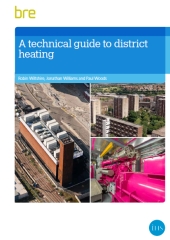
District heating (DH) allows centralised heat sources to be connected to distributed heat consumers. Typically it comprises; one or more energy centres, the pipe network, and connections to consumers. The high heat loads compared to individual, independent systems allow economies of scale and smoother demand, leading to more efficient operation of the energy centre. It also allows the use of heat sources that would not be viable at a smaller scale.
FB 72 presents comprehensive information outlining system and component design, operation and maintenance. The 54 page guide is largely an update of Good Practice Guide 234, Guide to community heating and CHP, but it has been extended to emphasise the importance of other low-carbon sources of heat other than combined heat and power (CHP) including thermal renewable energy.
The guide focuses on technical rather than financial issues and will be useful for anyone involved in the technical aspects of district heating networks, whether on new or refurbishment schemes.
Its contents include:
- Executive summary.
- Introduction.
- What is district heating?
- System design.
- Component design.
- Operations and maintenance.
- References.
- Relevant standards, codes of practice and publications.
[edit] Find out more
[edit] Related articles on Designing Buildings Wiki
- BRE articles on Designing Buildings Wiki.
- BRE Buzz articles on Designing Buildings Wiki.
- BSRIA guide to heat interface units.
- Building Research Establishment.
- Combined heat and power.
- Community energy network.
- Geothermal energy.
- Heat interface units.
- Heat meter.
- Heat Networks Investment Project HNIP.
- Municipal energy - briefing sheet.
- National heat map.
- Water source heat map.
- What can government do about district heating.
Featured articles
Check out some of the best features and news from Designing Buildings as well as key stories from around the web.

CIOB celebrates positive Ofsted report.

The Building Safety Regulator announces a call for evidence.

Government approach could undermine delivery and regeneration.
World's first mass timber data centre.

The overlooked environmental aspect of data centre development.
Introduction to radon awareness

New technical information sheet published by CIOB.

Updated supplier guide can help electrical contractors engage with NHP.

CIAT confirm the winners of the 2026 architectural technology awards.

Government launches a one stop shop for flood preparedness.

Sir Edwin Lutyens: Britain's greatest architect? Book review.

CIOB publishes free template to help assess and manage risks.
ECA's reflections on Party Conference season

Burnham wants to be confident of winning before asking for a fresh mandate.
New Chief Construction and Scientific Adviser

Sergio Cavalaro, Professor of Infrastructure Systems at Loughborough University.