






BSRIA guide to heat interface units
In December 2015, BSRIA launched a new BSRIA Guide, Heat Interface Units BG 62/2105 written by Reginald Brown with the help of an industry steering group. It is intended for use by specifiers, designers and installers of heating systems served by communal or district heat networks.
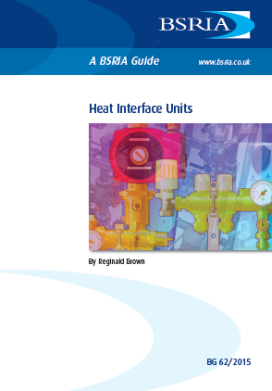
The guide defines heat interface units (HIU) as ‘…the means of connection of the consumer’s heating and hot water systems to a heat network and may include isolation and control valves, heat exchangers, pumps and metering devices.’
The guide focuses on the application and installation of direct and indirect heat interface units for residential and small commercial applications within district and communal heat networks. It suggests that installing a HIU linked to a district or communal heat network rather than a conventional boiler can have significant economic and environmental benefits, but that successful operation depends on appropriate system design and specification, and competent installation and maintenance.
The contents of the guide include:
- Introduction.
- Definitions.
- Efficient use of heat networks.
- Designing for HIU’s.
- Heating systems using direct HIU’s.
- Heating systems using indirect HIU’s.
- Domestic hot water.
- Heat metering.
- Acceptance testing.
- Regulations.
- Appendices.
It does not deal with economic assessment, selection of heat sources or detailed design. Guidance on the selection of heat sources and the design and implementation of heat networks is provided by CIBSE’s 2015 Heat Networks: Code of Practice for the UK(CIBSE/ADE CP1), and BSRIA/UKDEA BG 69/2016 (available early 2016).
The BSRIA Heat Interface Units guide is also available to buy as part of a set with CIBSE/ADE CP1.
Catherine England, BSRIA Marketing Officer, said, “Heat networks are not a new idea. However, over the past 20 years there is increasing recognition that heat networks, enabled by the use of HIUs, particularly those associated with combined heat and power systems in urban areas, are a key element of a low carbon future.”
--BSRIA
[edit] Find out more
[edit] Related articles on Designing Buildings Wiki
- A technical guide to district heating (FB 72).
- Allowable solutions.
- Big growth in district heating markets - now and on the horizon.
- Biomass boiler.
- CHP boiler.
- Combined heat and power.
- District energy networks
- Domestic micro-generation.
- Geothermal energy.
- Heat exchanger.
- Heat interface unit.
- Heat Networks Investment Project HNIP.
- Heat pump.
- National heat map.
- Renewable energy.
- Smart cities.
- Types of domestic boiler.
- Water source heat map.
Featured articles
Check out some of the best features and news from Designing Buildings as well as key stories from around the web.

Government launches a one stop shop for flood preparedness.

Sir Edwin Lutyens: Britain's greatest architect? Book review.

CIOB publishes free template to help assess and manage risks.
ECA's reflections on Party Conference season

Burnham wants to be confident of winning before asking for a fresh mandate.
New Chief Construction and Scientific Adviser

Sergio Cavalaro, Professor of Infrastructure Systems at Loughborough University.
Building safety levy for England

CIAT publish estimator tool for members.

Water sector faces a growing crisis that could slow the delivery of vital infrastructure.
Undervaluing our industrial past

Heritage value changes as taste for building styles changes.
Changing expectations around competence and compliance

New information sheet from CIAT.
Grenfell investigation files passed to CPS

Angela Rayner apologises on behalf of the British state.

Electrical contractors need to understand the practical implications.

The real barrier to getting more value from digital technology.