






U-value conventions in practice: Worked examples using BR 443
BRE (Building Research Establishment) is an independent, research-based consultancy, testing and training organisation, operating in the built environment and associated industries.
U-value conventions in practice: Worked examples using BR 443 was written by Sean Doran and published by BRE on 13 Jan 2012. The 36 page publication helps designers develop a better understanding of how to calculate U-values and kappa-values for use in calculation tools. See also Conventions for U-value calculations (2006 edition) BR 443.
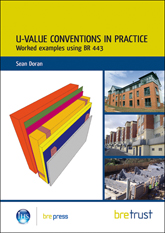
U-values, (sometimes referred to as thermal transmittances) measured in W/m²K represent how effective elements of a buildings fabric are as insulators. That is, how effective they are at preventing heat from transmitting between the inside and outside of a building. The lower the U-value of an element of a building's fabric, the more slowly heat is able to transmit through it, and so the better it performs as an insulator.
Kappa values (sometimes referred to as thermal mass values) measured in kJ/m2K represent the heat capacity per square metre of a material. This is used to quantify the thermal mass of building elements such as walls and floors. The higher the kappa-value, the greater the thermal mass, that is the more heat the element is able to store.
These values are integral to the use of energy calculation tools such as the Standard Assessment Procedure (SAP) and the Simplified Building Energy Model (SBEM), which support Part L of the Building Regulations, Conservation of Fuel and Power. As a result, it is important that they are calculated reliably.
U-value conventions in practice:
- Supports the Building Regulations Part L and other legislation on the energy performance of buildings.
- Helps raise an awareness of and understanding of U-values and kappa-values.
- Encourages a unified, consistent approach to calculating U-values and kappa-values.
- Explains calculation methods using worked examples for wall, roof and floor designs.
- Supports training programmes for practitioners carrying out energy assessments and using U-value calculation software.
- Provides guidance about calculating U-values using standard simplified methods.
Its contents include:
- Introduction.
- Summary outline of the U-value calculation method.
- The worked examples.
- References and further reading.
[edit] Related articles on Designing Buildings
- Approved document L.
- BRE articles on Designing Buildings Wiki.
- Building regulations.
- Building Research Establishment.
- Conventions for calculating linear thermal transmittance and temperature factors.
- Conventions for U-value calculations (2006 edition) BR 443.
- Energy performance certificate.
- Insulation.
- Kappa value.
- PA ratio.
- Simplified Building Energy Model.
- Standard Assessment Procedure.
- Thermal bridge.
- Thermal mass.
- U value.
- What do design professionals need to know about U-value calculation conventions?
Featured articles
Check out some of the best features and news from Designing Buildings as well as key stories from around the web.

New guidance for professional practice, cultural change and regulation in social housing.

The heritage of nuclear and conventional power stations.
New measures to stop people being ripped off

Government to protect families from cowboy builders and aggressive bailiffs.

New Futurebuild showcase brings an innovation-first approach.
National Planning Policy Framework
Understanding the 2026 changes.
ECA's public affairs priorities

Member consultation opens to shape priorities for 2027 to 2030.

Dutyholder responsibilities from 1 July 2026.
Where performance meets practice

The Building Envelope Stage at UKCW Birmingham.

CIAT publishes briefing on planning reforms.
Leaders in Learning for Practice Network

Call for conservation leaders in learning to register interest in new network.
The importance of early engagement

Construction lessons from the Trillium HealthWorks Experience Centre.
Mayors are to be given planning call in powers
Mayors across England will be able to make the most important planning decisions.
Comments