




RIBA Conservation Guide

RIBA Conservation Guide, Marion Barter, Anna Joynt, David McDonald, Andrew Shepherd, RIBA Publishing, 2024, 264pp, 168 illustrations, paperback.
Historic England defines conservation as ‘the objective of sustaining heritage values’ (Conservation Policies, Principles and Guidance, 2015). Conservation aims to protect and enhance heritage assets and includes a philosophical, social, practical and technical approach. It requires multidisciplinary collaboration in decision-making and implementation. The aim of the RIBA Conservation Guide is to assist conservation professionals who have the responsibility to implement conservation through managing change, protecting and enhancing heritage assets. As Jane Price states in the foreword, the book aims to ‘inspire and inform’.
The method adopted by the authors is to educate, using as reference the international guidance and national legislative framework that underpins conservation in practice. The chapters are designed to provide an overview of the education and training guidelines of the International Council on Monuments and Sites (ICOMOS), the Unesco charters and conventions, the UK National Planning Policy Framework (NPPF), and their implementation in conservation. The book takes a 21st-century perspective, drawing attention to the emerging interest in climate change and retrofit. Its limited size prevents it from being a comprehensive guide on all aspects of conservation, but it is useful for conservation accreditation in any discipline, and complements previously published books, including Bernard Feilden’s Conservation of Historic Buildings.
The authors, who are all educators on the RIBA conservation course, are experienced conservation professionals from diverse disciplines. Indeed, the publication reflects the RIBA course that supports architects in their preparation for conservation accreditation. Each author provides their own perspectives, experiences and interpretation of the ICOMOS guidelines within a UK context, enriched with case studies. The well-illustrated publication has a consistently clear and accurate narrative.
Marion Barter, a heritage consultant, introduces the understanding of heritage significance, history and identity, setting and context, and the need for documenting the conservation works and making these accessible to a wider audience using digital technologies.
Andrew Shepherd, a lecturer and architect, delves into the diagnostic analysis of defects, buildings’ structural integrity and fabric’s performance. He emphasises the practicalities of repair and ‘maintenance plans’ that prevent further damage and reduce cost.
David McDonald, a conservation consultant and IHBC chair, explains the importance of the ‘strategic documents’ (condition survey, conservation and management plan, statement of significance, schedule of works) in ‘making balanced judgements’ and taking informed decisions. He acknowledges the significance of ‘constructive collaboration’ of multi-disciplinary professionals: experts in conservation.
Anna Joynt, an accredited conservation architect, shares her experiences on climate-change mitigation, exploring ‘repair and retrofit’ scenarios, providing evidence, and guidance that focuses on the user’s comfort and traditional methods.
The RIBA Conservation Guide will benefit architects and other professionals from related disciplines who are preparing for conservation accreditation. It is intended for postgraduate conservation courses and is suitable for undergraduate courses in architecture and other disciplines that include conservation theory and practice in their curriculum.
This article originally appeared as ‘To inspire and inform’ in the Institute of Historic Building Conservation’s (IHBC’s) Context 183, published in March 2025. It was written by Maria Yioutani-Iacovides, course director of BSc architectural engineering, University of Salford, and conservation architect.
--Institute of Historic Building Conservation
Related articles on Designing Buildings Conservation.
IHBC NewsBlog
IHBC sponsors Gardens Trust event 23-4 Sept 2026
.jpeg)
'Learning from the Past, Shaping the Future’ takes place in Milton Keynes
Renovations to Frank Lloyd Wright's Fallingwater complete
.jpg)
World Heritage Preserved project opens house for tours again
Shakespeare Birthplace Trust places Hall's Croft on HAR Register
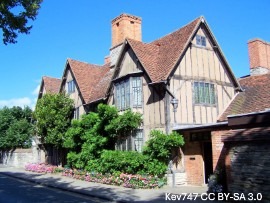
Stratford-upon-Avon home of Shakespeare's daughter is 'At Risk'
Lady Grange’s House repaired on St Kilda
.jpg)
National Trust for Scotland repairs stone cleit with link to famous island resident
Griff Rhys Jones on BBC Radio 4 Today programme
,_Green_Lane,_Derby.jpg)
The Victorian Society’s President unveiled its latest Top Ten Endangered Buildings 2026.
Need a MATE? Book your place now.

IHBC offers free webinars on applying for IHBC accreditation (Full & Associate).
UK Stained Glass Repository finds windows new homes
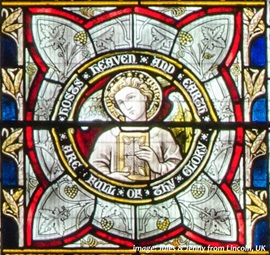
How are stained glass windows are rescued, stored and repurposed?
APPGEBE report sets high aims for quality
'Government must not sacrifice quality in drive to build 1.5m homes'
New measures protect Historic Shipwrecks from heritage crime

Underwater cultural heritage benefits from new HE guidance
How could the City of London skyline look in 6 years' time?

Visualisation shows approved planning applications as completed buildings
National Trust for Scotland calls for VAT cuts

Heritage neglect is encouraged by current policies
IHBC's 'Context' Issue 186 features Industrial Heritage
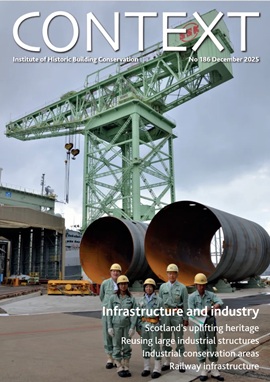
IHBC's members' journal reports on the challenges of conserving infrastructure
Book now for IHBC Annual School 2026
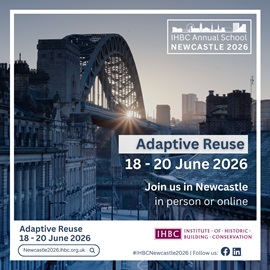
IHBC Annual School is taking place 18-20 June 2026 in Newcastle
RICHeS Research Infrastructure offers ‘Full Access Fund Call’
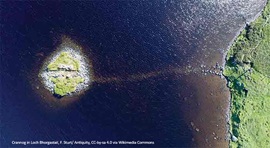
RICHeS offers a ‘Help’ webinar on 11 March
Latest IHBC Issue of Context features Roofing
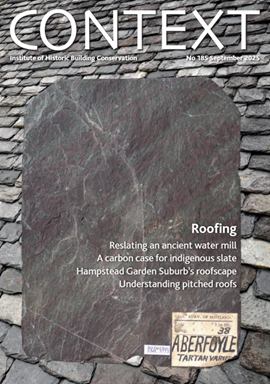
Articles range from slate to pitched roofs, and carbon impact to solar generation to roofscapes
Three reasons not to demolish Edinburgh’s Argyle House

Should 'Edinburgh's ugliest building' be saved?
IHBC’s 2025 Parliamentary Briefing...from Crafts in Crisis to Rubbish Retrofit
IHBC launches research-led ‘5 Commitments to Help Heritage Skills in Conservation’
How RDSAP 10.2 impacts EPC assessments in traditional buildings

Energy performance certificates (EPCs) tell us how energy efficient our buildings are, but the way these certificates are generated has changed.