






Low pit lifts
Contents |
[edit] Introduction
Lifts are required in a great variety of settings and buildings. This has led to the need for installations that can be accommodated in environments that may have previously been unable to house a lift. A low pit lift offers a solution to the problem of previously unsuitable locations, allowing for the installation of lifts in more settings.

[edit] Low pit lift uses
The standard design of lifts requires a pit which allows space for the mechanical element of the installation. In the past, if a setting was unable to provide suitable space for a pit, the installation of the lift would not have been possible.
This inability to provide a pit may be likely in:
- Updates to listed buildings
- Shopping centres
- Homes
- Public buildings
- Educational buildings
A low pit lift or a pitless lift can allow for improved disabled access in buildings which may have been impossible to navigate previously.
[edit] Limitations
While low pit lifts have a huge range of applications, it is worth noting that they are limited in the speed they can travel, which is restricted to 0.15m/s according to a notified body certification.
[edit] Benefits
Low pit lifts have many benefits which have made them popular for a number of applications:
- Listed buildings often have plenty of rules and regulations to meet before they are able to make changes or updates to the building itself. This means that the excavation required for the installation of a regular lift may cause too much disruption to the original structure. However, a low pit lift can be installed with a pit as shallow as 120mm.
- The installation of a lift can often be disruptive, particularly during the pit excavation. This is significantly reduced when installing a pitless or low pit lift. For this reason, the low pit lift is often a popular choice for shopping centres and educational buildings, as disruption to business or learning is minimised.
- Lifts are often installed in homes, particularly when access is needed for an individual with mobility issues. Home installations are often restricted in terms of space, so a low pit lift can fit into a smaller space which may not be able to accommodate a standard lift.
[edit] Related articles on Designing Buildings Wiki
- Lifts and Escalators: A Quality Perspective.
- Lifts for Buildings.
- Disabled Access Lifts.
- The World’s Fastest Lifts.
- Considerations When Installing a Residential Lift.
- Updating Listed Buildings.
--Nathan Massey 14:25, 11 Jul 2017 (BST)
Featured articles and news
We're expanding our collaborative mission by launching DB Intelligence, an exclusive market research advisory panel. Built environment professionals can now get paid to share their expertise on industry trends, products and services.
Panel members receive direct financial incentives for participating in research projects like short surveys, 1-2-1 interviews and focus groups. Register today to shape the future of the construction sector.
Building Safety Wiki Interviews

Chief executive of the British Woodworking Federation.
Planning condition discharge in England and Wales

A brief exoplanation from a building compliance expert, with further links.
Overheating guidance and tools for building designers

Guidance for dealing with element of building fabric control that have increasing importance.
Shading for housing, a design guide

From the Good Homes Alliance and British Blind and Shutter Association.
UK Standard Skills Classification (SSC)

A shared framework for describing skills needs.
Social media ban consultation comes to close

CIOB urges UK Government to consider social media’s role in careers guidance in ban debate.
The latest of eight Skills England apprenticeship units

The addition of battery manufacturing welcomed by ECA with a warning about the risks of fast-tracked apprenticeship units.
Building Control Independent Panel final report

A precis of a key report led by Dame Hackitt with full recommendations and link to the government response.
Building Safety recap April, 2026
A short and longer run-through of the month, with links to further information and sources.
CIAT May 2026 briefing.

From medieval scribes to modern word art.

ECA welcomes crackdown on late payment and push for clean energy, whilst CIOB seek fixed cladding removal timeframes.
Cyber Security in the Built Environment
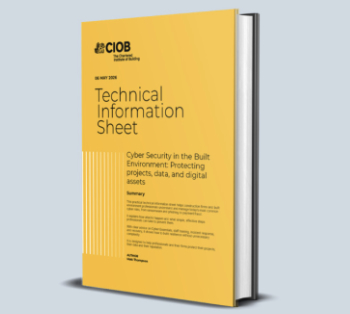
Protecting projects, data, and digital assets: A CIOB Academy TIS.
Managing competence in the built environment
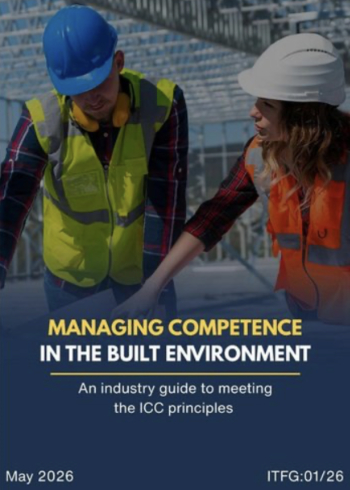
ITFG publishes new industry guide on how to meet the ICC principles.