





John Soane's Cabinet of Curiosities

John Soane’s Cabinet of Curiosities: reflections on an architect and his collection, Bruce Boucher, Yale University Press, 2024, 224 pages, 155 colour and black and white illustrations, hardback.
Anyone who has visited Sir John Soane’s Museum and found themselves wondering how this intriguing and delightful but sometimes perplexing assortment of objects came about, will enjoy this book. Just to leaf through it is a seductive experience: it is beautifully produced with many colour plates of works in the collection, as one might expect. But among them are single, and even more striking, double-page colour photographs of interiors which vividly convey the sense of being there in the rooms, with their rich colours and mirrors, views from one space to the next, and objects either massed together or selectively shown grouped in niches and corners.
There is no single key to unlocking Soane’s motivation, writes Bruce Boucher, a former director of the museum. In a series of short but well-written chapters, he discusses the collection, beginning with an overview of Soane’s life and career. He follows with a chapter about the growth of the collection and its evolving display, with reference to the history of collecting and, of particular interest as comparisons, to contemporary private museums such as those of Charles Townley and Thomas Hope.
Boucher then devotes five chapters to specific themes: the so-called ‘Etruscan’ vases (now classified as Grecian), a collecting interest shared by Soane’s contemporaries; the fascination with ruins; the gothic, evoked by Soane’s creation of a Monk’s Parlour; the celebration of Shakespeare and Hogarth as British Worthies; contemporary sculptures, many by friends and fellow-Academicians; and the paintings, with their unique layered display on hinged screens.
Although there have been short essays about Soane as a collector, this is the first book-length treatment of the subject. It does not attempt to encompass the sheer variety of the collection, which ranges from antique gemstones and cameos, natural curiosities such as elephant’s teeth to an Egyptian sarcophagus, Renaissance majolica and Napoleonic relics and medals, as well as architectural models, books and drawings of many periods, besides Soane’s own designs.
Nevertheless, the five themes cover the most important strands in the collection and provide detailed examples of why particular works were acquired, often for very personal reasons, while also giving many insights into the strategies behind the creation of the museum, which became far more than a record of the architect’s life and works. Most house museums present us with a series of domestic spaces where the owner and his family lived, but the Soane Museum seems to invite us to roam inside the architect’s head, to experience his aesthetic and intellectual interests, memories of his friendships and the roots of his architectural style: ‘studies for my own mind’ was the enigmatic phrase Soane himself used about his arrangement of the collection.
Soane bequeathed the house and its contents to the nation. In an epilogue, Boucher discusses the fate of the bequest after Soane’s death in 1837, a story which will be of particular interest to readers of Context. Probably unaware of the potential problems that might occur in opening a private museum to the public, Soane’s bequest required his trustees to maintain the museum exactly as it was at his death. Yet museumification gradually set in: items were moved from their original positions to improve circulation, vitrines were placed in the centre of rooms, a new picture gallery was added at the back and a public lavatory was constructed in a recess originally occupied by a carefully selected group of sculptures.
After visitors complained about poor visibility, electric lighting was installed, destroying the deliberately shadowy atmosphere of areas such as the crypt. There was even talk of reorganising the collection along conventional chronological lines, but fortunately lack of funds and the outbreak of the second world war put paid to this. During wartime, the collections were evacuated, but the buildings were damaged and inadequately repaired, leaving the museum in a parlous state. Yet gradually, the Soane Museum was repaired and conserved in a series of initiatives started by Sir John Summerson, who became curator in 1945, and his successors Peter Thornton, a fortunate appointment in view of his expertise in restoring historic interiors, Margaret Richardson and others. They have restored Soane’s interiors to their original proportions and colour schemes, including the re-creation of lost rooms.
Further, the acquisition of the two houses on either side, one which had been let for income, and the other left by Soane to his grandchildren, enabled not only the return of several more of Soane’s fine interiors to public access, but also the introduction of modern museum facilities such as a shop, conservation studios and spaces for exhibitions and study, so that it now has an important role in the pursuit of architectural history as well as being a successful public attraction.
As Boucher concludes, the idea of the museum as a systematic, impersonally organised collection of objects is only one way of looking at art history and we can now consider different types of museums as archaeological sites worthy of exploration: ‘in this way, one can say that the twenty-first century has finally caught up with Sir John Soane.’
This article originally appeared as ‘Catching up with Soane’ in the Institute of Historic Building Conservation’s (IHBC’s) Context 181, published in December 2024. It was written by Julian Treuherz, art historian and curator.
--Institute of Historic Building Conservation
Related articles on Designing Buildings Conservation.
IHBC NewsBlog
IHBC sponsors Gardens Trust event 23-4 Sept 2026
.jpeg)
'Learning from the Past, Shaping the Future’ takes place in Milton Keynes
Renovations to Frank Lloyd Wright's Fallingwater complete
.jpg)
World Heritage Preserved project opens house for tours again
Shakespeare Birthplace Trust places Hall's Croft on HAR Register
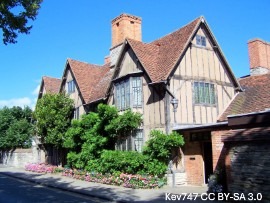
Stratford-upon-Avon home of Shakespeare's daughter is 'At Risk'
Lady Grange’s House repaired on St Kilda
.jpg)
National Trust for Scotland repairs stone cleit with link to famous island resident
Griff Rhys Jones on BBC Radio 4 Today programme
,_Green_Lane,_Derby.jpg)
The Victorian Society’s President unveiled its latest Top Ten Endangered Buildings 2026.
Need a MATE? Book your place now.

IHBC offers free webinars on applying for IHBC accreditation (Full & Associate).
UK Stained Glass Repository finds windows new homes
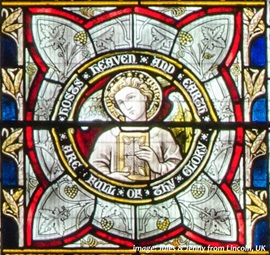
How are stained glass windows are rescued, stored and repurposed?
APPGEBE report sets high aims for quality
'Government must not sacrifice quality in drive to build 1.5m homes'
New measures protect Historic Shipwrecks from heritage crime

Underwater cultural heritage benefits from new HE guidance
How could the City of London skyline look in 6 years' time?

Visualisation shows approved planning applications as completed buildings
National Trust for Scotland calls for VAT cuts
Heritage neglect is encouraged by current policies
IHBC's 'Context' Issue 186 features Industrial Heritage
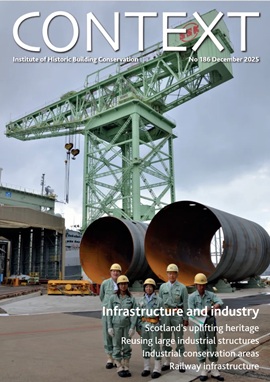
IHBC's members' journal reports on the challenges of conserving infrastructure
Book now for IHBC Annual School 2026
IHBC Annual School is taking place 18-20 June 2026 in Newcastle
RICHeS Research Infrastructure offers ‘Full Access Fund Call’
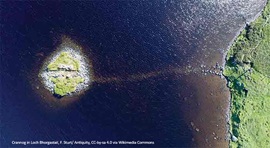
RICHeS offers a ‘Help’ webinar on 11 March
Latest IHBC Issue of Context features Roofing
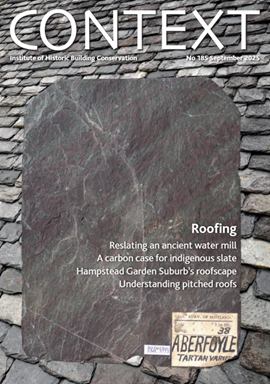
Articles range from slate to pitched roofs, and carbon impact to solar generation to roofscapes
Three reasons not to demolish Edinburgh’s Argyle House

Should 'Edinburgh's ugliest building' be saved?
IHBC’s 2025 Parliamentary Briefing...from Crafts in Crisis to Rubbish Retrofit
IHBC launches research-led ‘5 Commitments to Help Heritage Skills in Conservation’
How RDSAP 10.2 impacts EPC assessments in traditional buildings

Energy performance certificates (EPCs) tell us how energy efficient our buildings are, but the way these certificates are generated has changed.