





Industrial heritage in the Ruhr
The Ruhr Valley is inspirational for its strategic and creative approach to the region’s industrial heritage, and a marked difference to the fate of industrial landscapes in the UK.

|
| The Oberhausen Gasometer has been converted into a spectacular exhibition space by an IBA Emscher Park project. Photo John Pendlebury. |
I have long wanted to visit the industrial heritage of the Ruhrgebiet (Ruhr area) and finally got the chance in 2023. Long famous for an imaginative approach to industrial heritage, as well as the sheer scale of what has been retained, my trip to the Ruhr region did not disappoint. The extent of the industrial heritage that survives in the Ruhr is astonishing, the early decision to retain these structures remarkable. The differences with the fate of industrial landscapes in the UK is pronounced.
The inevitability of the deindustrialisation of the Ruhr seems to have been grasped from the 1970s. That the material legacies of industry should be retained and actively used in constituting both the future identity of the Ruhr Valley, as well as forming part of an economic future, began to be debated in the 1980s. Though not a matter of total consensus, this developed enough traction to lead to substantial programmes of action in the 1990s and 2000s, the continuation of which we can see today.
The overarching framework which enabled and exemplified a positive and proactive approach to industrial heritage was the International Building Exhibition (IBA) Emscher Park that ran for a decade from 1989 and executed 117 landscape planning and urban development projects over 800 square kilometres. Along with the physical interventions to conserve and reuse was a transformational greening of the area. At the heart of the approach was a wish to create a new identity for the region in a conscious effort at restructuring.
This was not only about physically and culturally rehabilitating old landscapes but about creating a new future that used these legacies culturally and economically. Landmarks symbolising industrial design were reimagined as landmarks of a positive future. The programme was initiated and supported by the state of North Rhine-Westphalia, although the role of IBA was to coordinate, not to fund and undertake all the individual projects, which were assisted by a wide range of local, federal and EU funds.
One of the flagship projects arising from the IBA was the world heritage site at Zollverein Coal Mine Industrial Complex in Essen, which Peter de Figueiredo writes about on page 14. Today it is second only to Cologne Cathedral as a destination for visitors to the region with 1.5 million visits a year.
Equally spectacular is Landschaftspark, Duisburg-Nord, a former ironworks that ceased production in 1985. A major headache and potential contamination problem, its owners, Thyssen, were unwilling to pay for demolition and site remediation. Rival campaigns argued for landmark status and demolition. Again, the IBA was instrumental in enabling a positive way forward and led to the state purchasing the site, although initially demolition remained an option. Ultimately it was concluded that most options involving demolition would be considerably more expensive than preservation, and the final decision to preserve the site was made in 1992 by Duisburg City Council. The ironworks thus remains as a centrepiece of the park, with structures creatively used, for example, as climbing walls or for scuba diving.
A personal highlight was the breathtaking ascent to the top of one of the blast furnaces, an open and free viewing platform in the park. In 2010 the park was recording 770,000 visitors a year. Above all, beyond these spectacular sites, it should be emphasised that this is a landscape of (post-) industry, extending across the Ruhr Valley. This is recognised by the Route Industriekultur that connects sites across the region through a 400-kilometre route, including 27 anchor points with particular historical significance and tourist appeal, 17 viewpoints and 13 settlements.
What has been achieved in the Ruhr Valley contrasts markedly with what one often sees in the UK, where industrial heritage has often been equated with the early seeds of the Industrial Revolution. We can see this represented by world heritage sites such as Ironbridge or Derwent Valley Mills. While also noting the world heritage sites Blaenavon Industrial Landscape and the Slate Landscape of north-west Wales, representing later, mass industrial processes, it often seems that legacies from the nineteenth and twentieth centuries have determinedly been removed from the landscape. One recent case is the brutalist Dorman Long Coal in Middlesbrough, listed and then delisted a few days later.
Seen from this perspective, the transformation of the Ruhr is a phenomenal achievement, rightly used as an internationally celebrated example of inspiration and good practice. Yet challenges and questions remain. For example, despite the sustained attention and resourcing industrial heritage has received, managing the sheer quantity, or profusion,[1] of protected heritage is very difficult, especially in times of more austere public finances. There are questions of what represents an appropriate ‘authentic’ approach to conservation on sites where individual components were often designed to only last 30 years. The social consensus associated with the transformation from industrial to postindustrial region, as represented in the Ruhr Museum, has also been questioned.[2] However, there is perhaps nowhere on earth quite like the Ruhr Valley, which should be a source of inspiration for all who are interested or concerned with the legacies of industrialisation.
Acknowledgements
CONSIDER is funded under the European Union’s Horizon 2020 Research and Innovation Programme. Many thanks to Sebastian Scholz of Stiftung Zollverein who both acted as my host for CONSIDER and provided useful comments on this article.
Notes and references
- [1] Macdonald, S et al (2020) ‘Too many things to keep for the future?’, in Harrison, R, DeSilvey, C and Holtorf, C et al Heritage Futures: comparative approaches to natural and cultural heritage practices, UCL Press, London.
- [2] Berger, S (2019) ‘Industrial Heritage and the Ambiguities of Nostalgia for an Industrial Past in the Ruhr Valley, Germany’, Labor: Studies in Working- Class History.
This article originally appeared in the Institute of Historic Building Conservation’s (IHBC’s) Context 186, published in December 2025. It was written by John Pendlebury, emeritus professor of urban conservation, Newcastle University. His most recent book, with Jules Brown, is Conserving the Historic Environment (2021).
--Institute of Historic Building Conservation
Related articles on Designing Buildings Conservation.
IHBC NewsBlog
IHBC sponsors Gardens Trust event 23-4 Sept 2026
.jpeg)
'Learning from the Past, Shaping the Future’ takes place in Milton Keynes
Renovations to Frank Lloyd Wright's Fallingwater complete
.jpg)
World Heritage Preserved project opens house for tours again
Shakespeare Birthplace Trust places Hall's Croft on HAR Register
Stratford-upon-Avon home of Shakespeare's daughter is 'At Risk'
Lady Grange’s House repaired on St Kilda
.jpg)
National Trust for Scotland repairs stone cleit with link to famous island resident
Griff Rhys Jones on BBC Radio 4 Today programme
,_Green_Lane,_Derby.jpg)
The Victorian Society’s President unveiled its latest Top Ten Endangered Buildings 2026.
Need a MATE? Book your place now.

IHBC offers free webinars on applying for IHBC accreditation (Full & Associate).
UK Stained Glass Repository finds windows new homes
How are stained glass windows are rescued, stored and repurposed?
APPGEBE report sets high aims for quality
'Government must not sacrifice quality in drive to build 1.5m homes'
New measures protect Historic Shipwrecks from heritage crime

Underwater cultural heritage benefits from new HE guidance
How could the City of London skyline look in 6 years' time?

Visualisation shows approved planning applications as completed buildings
National Trust for Scotland calls for VAT cuts
Heritage neglect is encouraged by current policies
IHBC's 'Context' Issue 186 features Industrial Heritage
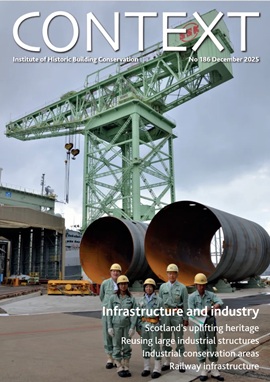
IHBC's members' journal reports on the challenges of conserving infrastructure
Book now for IHBC Annual School 2026
IHBC Annual School is taking place 18-20 June 2026 in Newcastle
RICHeS Research Infrastructure offers ‘Full Access Fund Call’
RICHeS offers a ‘Help’ webinar on 11 March
Latest IHBC Issue of Context features Roofing
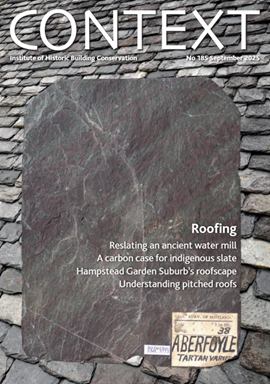
Articles range from slate to pitched roofs, and carbon impact to solar generation to roofscapes
Three reasons not to demolish Edinburgh’s Argyle House

Should 'Edinburgh's ugliest building' be saved?
IHBC’s 2025 Parliamentary Briefing...from Crafts in Crisis to Rubbish Retrofit
IHBC launches research-led ‘5 Commitments to Help Heritage Skills in Conservation’
How RDSAP 10.2 impacts EPC assessments in traditional buildings

Energy performance certificates (EPCs) tell us how energy efficient our buildings are, but the way these certificates are generated has changed.