





Historic England and infrastructure
While poorly planned infrastructure can do much damage to heritage, new projects can offer opportunities for benefits to the historic environment and local communities.

|
| Work on a major infrastructure project enabled Upminster Tithe Barn to be restored (Photo: National Highways). |
Infrastructure, the physical structures and facilities needed to keep an economy functioning efficiently, have long been the subject of intense scrutiny by successive governments of all political persuasions. Heritage considerations sometimes seem to be some way down the list of priorities, yet the efforts to adapt and conserve the best of the UK’s historic infrastructure, such as canals, railways, bridges and power stations, are internationally celebrated, as shown by the globally renowned engineering marvel, the Forth Bridge, having been inscribed as a world heritage site in 2015.
In my daily work I get to take a national perspective on Historic England’s NSIP work and get engaged in the detail of some projects, so I can see the shifting picture of how key infrastructure projects are being managed. As a statutory consultee for NSIPs, Historic England plays an integral role in delivering this national priority, while simultaneously seeking to both minimise harm to the historic environment and look for opportunities for enhancement. We shape our engagement and advice in the light of a recognition that the country needs to improve and expand infrastructure in a wide range of areas, whether it is the generation and transmission of renewable energy to decarbonise the power system, or delivering increased capacity for national water resources.
Experience has clearly shown that the best results occur when cross-disciplinary and interorganisational teamwork is well developed. Historic England provides timely and constructive advice to infrastructure providers across England to help them deliver sustainable projects, but willing partners in national agencies, national and local government, consultants and local communities are essential for positive outcomes. It is all about effective communication and negotiation; heritage expertise helps to de-risk project proposals.
While poorly planned infrastructure can do much damage to heritage, new projects can offer important opportunities for benefits for the historic environment and for local communities. For example, work on the Lower Thames Crossing has included the use of National Highways’ designated funds, and Historic England’s specialist advice and grant contribution, to restore the Upminster Tithe Barn. This remarkable structure has been renewed with traditional thatching skills, ensuring its continued survival as a cherished community asset. It was also an ideal venue for the recent signing of a memorandum of understanding between National Highways and Historic England in June. The rescued heritage asset can now be removed from the heritage at risk register.
This article originally appeared in the Institute of Historic Building Conservation’s (IHBC’s) Context 186, published in December 2025. It was written by Luke Wormald, Historic England’s head of infrastructure and head of the east region, with oversight of advice on development proposals, planning policies and heritage at risk.
--Institute of Historic Building Conservation
Related articles on Designing Buildings Conservation.
IHBC NewsBlog
IHBC sponsors Gardens Trust event 23-4 Sept 2026
.jpeg)
'Learning from the Past, Shaping the Future’ takes place in Milton Keynes
Renovations to Frank Lloyd Wright's Fallingwater complete
.jpg)
World Heritage Preserved project opens house for tours again
Shakespeare Birthplace Trust places Hall's Croft on HAR Register
Stratford-upon-Avon home of Shakespeare's daughter is 'At Risk'
Lady Grange’s House repaired on St Kilda
.jpg)
National Trust for Scotland repairs stone cleit with link to famous island resident
Griff Rhys Jones on BBC Radio 4 Today programme
,_Green_Lane,_Derby.jpg)
The Victorian Society’s President unveiled its latest Top Ten Endangered Buildings 2026.
Need a MATE? Book your place now.

IHBC offers free webinars on applying for IHBC accreditation (Full & Associate).
UK Stained Glass Repository finds windows new homes
How are stained glass windows are rescued, stored and repurposed?
APPGEBE report sets high aims for quality
'Government must not sacrifice quality in drive to build 1.5m homes'
New measures protect Historic Shipwrecks from heritage crime

Underwater cultural heritage benefits from new HE guidance
How could the City of London skyline look in 6 years' time?

Visualisation shows approved planning applications as completed buildings
National Trust for Scotland calls for VAT cuts

Heritage neglect is encouraged by current policies
IHBC's 'Context' Issue 186 features Industrial Heritage
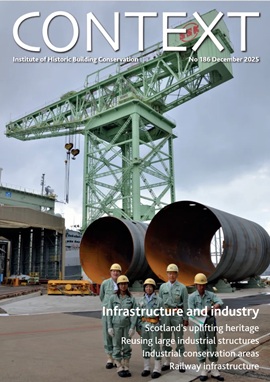
IHBC's members' journal reports on the challenges of conserving infrastructure
Book now for IHBC Annual School 2026

IHBC Annual School is taking place 18-20 June 2026 in Newcastle
RICHeS Research Infrastructure offers ‘Full Access Fund Call’
RICHeS offers a ‘Help’ webinar on 11 March
Latest IHBC Issue of Context features Roofing
Articles range from slate to pitched roofs, and carbon impact to solar generation to roofscapes
Three reasons not to demolish Edinburgh’s Argyle House

Should 'Edinburgh's ugliest building' be saved?
IHBC’s 2025 Parliamentary Briefing...from Crafts in Crisis to Rubbish Retrofit
IHBC launches research-led ‘5 Commitments to Help Heritage Skills in Conservation’
How RDSAP 10.2 impacts EPC assessments in traditional buildings

Energy performance certificates (EPCs) tell us how energy efficient our buildings are, but the way these certificates are generated has changed.