





Designing out unintended consequences when applying solid wall insulation FB 79
BRE (Building Research Establishment) is an independent, research-based consultancy, testing and training organisation, operating in the built environment and associated industries.
On 31 March 2016, BRE published Designing out unintended consequences when applying solid wall insulation (FB 79), written by Colin King and Caroline Weeks.
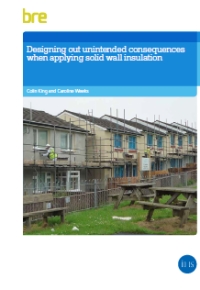
The guide points out that around 80% of the existing housing stock will still be in use in 2050, and so if we are to achieve targets to reduce carbon emissions, it is important that efforts are made to improve the performance of these buildings. Refurbishing solid walls with externally or internally applied insulation can help reduce heat loss, but it can also cause problems such as condensation and mould growth if it is not installed correctly.
FB 79 provides advice about how to assess potential risks and reduce the likelihood of long-term problems, including:
- Surveying and assessing risk and existing ventilation.
- Detailed design.
- Quality assurance on site.
- Adopting an integrated approach.
The 24 page guide is intended for surveyors, designers and installers, but it will also be useful for clients and householders, helping ensure expectations are realistic as they commission an appropriate team of professionals to undertake installation.
Its contents are:
- Introduction and background.
- Types of unintended consequences.
- Causes of potential problems with solid wall insulation.
- Tackling the causes of unintended consequences.
- Conclusions.
- References.
[edit] Related articles on Designing Buildings Wiki
- BRE and Willmott Dixon project to retrofit of a 1920s semi-detached house.
- BRE articles on Designing Buildings Wiki.
- BRE Buzz articles on Designing Buildings Wiki.
- Building Research Establishment BRE.
- Cavity wall insulation.
- Cold bridge.
- Condensation.
- Floor insulation.
- Insulation specification.
- Insulation.
- Roof insulation.
- Solid wall insulation.
- Solid Wall Insulation: Unlocking demand and driving up standards.
- U-value.
- Wall insulation and moisture risk.
[edit] External references:
- Reducing thermal bridging at junctions when designing and installing solid wall insulation (FB 61).
- Conventions for calculating linear thermal transmittance and temperature factors (BR 497, 2nd edn).
- Understanding dampness (BR 466).
- Thermal insulation: avoiding risks (BR 262).
- Fire performance of external thermal insulation for walls of multi-storey buildings (BR 135, 3rd edn).
Featured articles
Check out some of the best features and news from Designing Buildings as well as key stories from around the web.

Government approach could undermine delivery and regeneration.
World's first mass timber data centre.

The overlooked environmental aspect of data centre development.
Introduction to radon awareness

New technical information sheet published by CIOB.

Updated supplier guide can help electrical contractors engage with NHP.

CIAT confirm the winners of the 2026 architectural technology awards.

Government launches a one stop shop for flood preparedness.

Sir Edwin Lutyens: Britain's greatest architect? Book review.

CIOB publishes free template to help assess and manage risks.
ECA's reflections on Party Conference season

Burnham wants to be confident of winning before asking for a fresh mandate.
New Chief Construction and Scientific Adviser

Sergio Cavalaro, Professor of Infrastructure Systems at Loughborough University.
Building safety levy for England

CIAT publish estimator tool for members.

Water sector faces a growing crisis that could slow the delivery of vital infrastructure.