




Gov UK Connectivity Tool
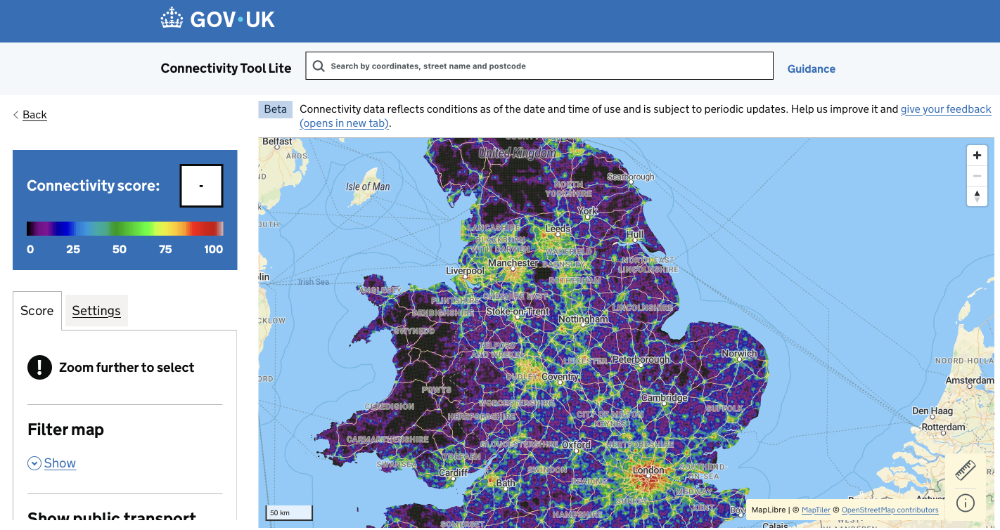
The Connectivity Tool refers to a government provided tool to help built environment professionals to understand how sustainably located a place is and the transport interventions needed to support it.
The Connectivity Tool helps built environment professionals and others to understand the connectivity of places in England and Wales. You can use the tool to:
- display how any location in England and Wales is connected to everyday services by walking, driving, cycling and public transport
- plot new transport routes to understand how these would affect an area’s connectivity
There is also a limited version of the tool (Connectivity Tool Lite) that anyone can access.
The Connectivity Tool is available to built environment professionals in the public or private sector.
If you you’re a built environment professional, you can request access to the tool by emailing [email protected].
Anyone can use the Connectivity Tool Lite version of the tool.
https://connectivity-tool-lite.dft.gov.uk/app
To use the Connectivity Tool you will need to:
- have been granted access to the tool
- be signed into GOV.UK One Login
Your GOV.UK One Login must be under your work email address.
If you don’t have a GOV.UK One Login under your work email address, you will need to create one.
[edit] Related articles on Designing Buildings
Featured articles
Check out some of the best features and news from Designing Buildings as well as key stories from around the web.

CIOB celebrates positive Ofsted report.

The Building Safety Regulator announces a call for evidence.

Government approach could undermine delivery and regeneration.
World's first mass timber data centre.

The overlooked environmental aspect of data centre development.
Introduction to radon awareness

New technical information sheet published by CIOB.

Updated supplier guide can help electrical contractors engage with NHP.

CIAT confirm the winners of the 2026 architectural technology awards.

Government launches a one stop shop for flood preparedness.

Sir Edwin Lutyens: Britain's greatest architect? Book review.

CIOB publishes free template to help assess and manage risks.
ECA's reflections on Party Conference season

Burnham wants to be confident of winning before asking for a fresh mandate.
New Chief Construction and Scientific Adviser

Sergio Cavalaro, Professor of Infrastructure Systems at Loughborough University.