





Climate Emergency Design Guide
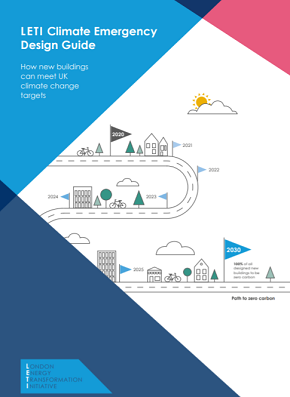
The London Energy Transformation Initiative (LETI) is a network of built environment professionals working together to put the UK on the path to zero carbon. In January 2020, LETI published Climate Emergency Design Guide: How new buildings can meet UK climate change targets in response to the growing climate emergency.
The guide outlines requirements for new buildings to ensure climate change targets are met. It sets out a journey towards a net zero carbon future and is aimed at developers, landowners, designers, policy makers and the supply chain.
- Operational energy.
- Embodied carbon.
- The future of heat.
- Demand response.
- Data disclosure.
It includes requirements for four key building types:
- Small-scale residential.
- Medium/large scale residential.
- Commercial offices.
- Schools.
The guide will evolve over time, reflecting changes in carbon budgets, technologies and the capability of industry. Design teams will be able to register their projects as LETI pioneer projects and share their knowledge with other design teams.
Peter Clegg, Senior Partner at Feilden Clegg Bradley Studios said: “Following the recent declarations of climate and biodiversity crises, a new sense of urgency has emerged within the environmental movement in architecture. It is characterised by an awareness of embodied as well as operational energy. It is focused on cradle to cradle lifecycle assessment of our buildings, and it is driven by the passion and enthusiasm of a new generation of architects and engineers who are determined to make change happen. The London Energy Transformation Initiative sits at the heart of this movement and their guide provides an inspirational ‘call to action’ for everyone in the built environment.”
Hywel Davies, Technical Director at CIBSE said: “Delivering zero carbon buildings is a huge challenge. LETI has taken a major step to help the industry to work out how this is to be done for new buildings.”
You can download the guide at: https://www.leti.london/cedg
[edit] Related articles on Designing Buildings
- Architects Declare.
- A zero-carbon UK by 2050?
- BREEAM.
- Carbon footprint.
- Carbon negative.
- Carbon neutral.
- CIBSE Case Study: Walgreens net zero energy drugstore.
- Climate Change Act.
- Climate emergency.
- LETI publishes Climate Emergency Retrofit Guide.
- Low or zero carbon technologies.
- Nearly zero-energy building.
- Net zero carbon 2050.
- Net zero carbon building.
- Passivhaus.
- PHribbon tool calculates embodied carbon of designs.
- Stagnation point.
- What we need for the journey to net-zero carbon emissions.
- Zero Bills Home.
- Zero carbon homes.
- Zero carbon non domestic buildings.
Featured articles
Check out some of the best features and news from Designing Buildings as well as key stories from around the web.

Government launches a one stop shop for flood preparedness.

Sir Edwin Lutyens: Britain's greatest architect? Book review.

CIOB publishes free template to help assess and manage risks.
ECA's reflections on Party Conference season

Burnham wants to be confident of winning before asking for a fresh mandate.
New Chief Construction and Scientific Adviser

Sergio Cavalaro, Professor of Infrastructure Systems at Loughborough University.
Building safety levy for England

CIAT publish estimator tool for members.

Water sector faces a growing crisis that could slow the delivery of vital infrastructure.
Undervaluing our industrial past

Heritage value changes as taste for building styles changes.
Changing expectations around competence and compliance

New information sheet from CIAT.
Grenfell investigation files passed to CPS

Angela Rayner apologises on behalf of the British state.

Electrical contractors need to understand the practical implications.

The real barrier to getting more value from digital technology.