





BROOF, DROOF, CROOF and FROOF
BROOF, DROOF, CROOF and FROOF refer to different fire rating classifications for roofs according to the European classification system BS EN 13501-5 from the highest to the lowest rating since the national classification system BS 476-3:2004 no longer applied after 2019 and the new Approved Regulations Part B.
BROOF(t4): Refers to the highest rating and indicates the roof system prevents fire penetration for at least 60 minutes and restricts flame spread. It inticates superior resistance to external fire spread, penetration, and burning droplets and is essential for compliance in UK building regulations, often required for flat roofs, terraces, and high-rise developments.
- No penetration of roof system within 60 minutes
- In preliminary test, after withdrawal of the test flame, specimens burn for less than 5 minutes
- In preliminary test, flame spread less than 0.38 m across region of burning
CROOF(t4): The intermediate rating which indicates no fire penetration within 30 minutes, with limited flame spread.
- No penetration of roof system within 30 minutes
- In preliminary test, after withdrawal of the test flame, specimens burn for less than 5 minutes
- In preliminary test, flame spread less than 0.38 m across region of burning
DROOF(t4): The lower rating indicates the system is penetrated within 30 minutes in certain tests, but not in others.
- Roof system is penetrated within 30 minutes but is not penetrated in the preliminary test
- In preliminary test, after withdrawal of the test flame, specimens burn for less than 5 minutes
- In preliminary test, flame spread less than 0.38 m across region of burning
EROOF (t4)
- Roof system is penetrated within 30 minutes but is not penetrated in the preliminary test
- Flame spread is not controlled
FROOF(t4): The lowest rating.
- No performance determined
The Independent Review of Building Regulations and Fire Safety, that followed the Grenfell fire, chaired by Judith Hackitt, reviewed the Building Regulations 2010, and concluded that a more robust regulatory system was neede. As a result the Building (Amendment) Regulations 2018 were issued. The most significant change being the complete ban of combustible materials in external walls and the Approved Document B (ADB) on fire safety, which affected roofing. This is where national classification system BS 476-3:2004, no longer applies but replaced by the European classification system BS EN 13501-5 and the five European class ratings: BROOF(t4), CROOF(t4), DROOF(t4), EROOF(t4) and FROOF(t4).
[edit] Related articles on Designing Buildings
- Blue roof.
- Cold roof.
- Designing out fire risk in roof voids.
- Existing guidance on fire compartmentation in roof voids.
- Flat roof.
- Green roof.
- Metal roofing.
- Pitched roof.
- Shingle roofing.
- Slate roofing.
- Solar panels, pitched roofs and risk of fire spread.
- Tile roofing.
- Thatch roofing.
- Types of roof.
- Warm roof.
Featured articles and news

We're expanding our collaborative mission by launching DB Intelligence, an exclusive market research advisory panel. Built environment professionals can now get paid to share their expertise on industry trends, products and services.
Panel members receive direct financial incentives for participating in research projects like short surveys, 1-2-1 interviews and focus groups. Register today to shape the future of the construction sector.
Planning condition discharge in England and Wales

A brief exoplanation from a building compliance expert, with further links.
Overheating guidance and tools for building designers

Guidance for dealing with element of building fabric control that have increasing importance.
Shading for housing, a design guide

From the Good Homes Alliance and British Blind and Shutter Association.
UK Standard Skills Classification (SSC)

A shared framework for describing skills needs.
Social media ban consultation comes to close

CIOB urges UK Government to consider social media’s role in careers guidance in ban debate.
The latest of eight Skills England apprenticeship units

The addition of battery manufacturing welcomed by ECA with a warning about the risks of fast-tracked apprenticeship units.
Building Control Independent Panel final report
A precis of a key report led by Dame Hackitt with full recommendations and link to the government response.
Guide to ISO 19650 for Architecture Firms (2026)
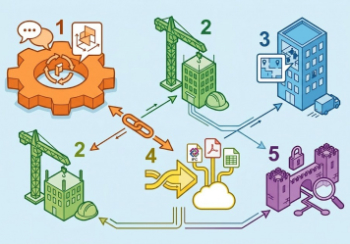
A user gives their low down.

A UK training and membership provider for mould remediation professionals.
Building Safety recap April, 2026
A short and longer run-through of the month, with links to further information and sources.
CIAT May 2026 briefing.

Independent NSI and BAFE study exploring how organisations are changing the way they buy fire safety services.
From medieval scribes to modern word art.

ECA welcomes crackdown on late payment and push for clean energy, whilst CIOB seek fixed cladding removal timeframes.
Cyber Security in the Built Environment
Protecting projects, data, and digital assets: A CIOB Academy TIS.
Managing competence in the built environment

ITFG publishes new industry guide on how to meet the ICC principles.
The UK's campaign to reduce noise pollution: Mythbusting, articles and topic guides.