





Traditional Brickwork: construction, repair and maintenance

Traditional Brickwork: construction, repair and maintenance, Terrence Lee, Crowood Press, 2022, 192 pages, over 400 colour and black-and- white illustrations, paperback.
This academic but practical book follows on neatly from the review of two books in Context 176: Nicholas Barbon: developing London 1667–1698 and Bricks of Victorian London: a social and economic history.
Lee teaches, trains and lectures in the field of traditional brickwork, and carries out practical brickwork conservation projects. As a conservation bricklayer, he concentrates on handmade, low-fired brick and lime mortars, so does not venture into the realm of machine-cut, high-fired bricks and Portland cement. The first three chapters of the book describe the types, manufacture and characteristics of traditional brick until the end of the 18th century. They are very useful as a background to all brick construction until industrialisation, and the use of new forms of binder on the high-fired manufactured brick.
The first chapter describes types and sizes of brick up to the end of the 18th century, with an emphasis on bonds and different pointing and jointing, the colours of brick and methods of construction. Each example is accompanied by an excellent illustration – either a photograph or a line drawing. The second chapter covers the actual methods of manufacture, including ground moulding, bench moulding, slop moulding and sand moulding. The innovation of the ‘frog’ is described and illustrated, followed by different methods of firing bricks, with marvellously clear contemporary illustrations from L’Art du Tuilier et du Briquetier (1763).
The characteristics of traditional brick are described in the third chapter as a guide to dating brick through size, colour and scrutiny of surface markings. Chapter 4 covers the knowledge and skills required for the conservation of brickwork, including illustrated examples of poorly executed work, and explores the philosophical conflict between ‘authenticity’ and functional repair from the point of view of the craftsperson/ conservator.
The hand of a master craftsman follows in the description of tools and equipment. Jointing and pointing, accurate measuring and cutting, and a variety of tools used in bricklaying are described and illustrated. Those needed for gauged brickwork – the investment of a lifetime – are shown with clarity. Lee ventures into power tools that can assist the process, such as electric whisks and hammer drills. Materials used in brickwork come next, including a long section on the varieties of lime, their availability and suitability. The chapter ends with an assessment of pigments and pozzolanic additives.
Other chapters feature a well-constructed table on the assessment of traditional brickwork, the vulnerability inherent in brickwork – both in manufacture and construction – and a practical guide to construction and repair. The comprehensive step-by-step guide is easy to follow through the clarity of the photographs. The skill and technique required for accurate construction of gauged arches is the subject of Chapter 10, which includes the rubbing of bricks to form voussoirs. Also included are the functional and decorative methods of pointing, colour washing and the Frenchman pointing tool, followed by guidance on the maintenance of traditional brickwork, including a table of troubleshooting. The volume ends with two very helpful sections: a timeline of brickwork between the 11th and 18th centuries, and a glossary of terms relating to construction, materials, tools, and techniques.
Throughout the book, Lee’s own practical and academic knowledge shine through, making this a descriptive and easy-to-use guide that should be well-thumbed by all conservation professionals and conservation craftspeople.
This article originally appeared as ‘Master craftsman’ in the Institute of Historic Building Conservation’s (IHBC’s) Context 179, published in March 2024. It was written by Harriet Devlin.
--Institute of Historic Building Conservation
Related articles on Designing Buildings Conservation.
IHBC NewsBlog
IHBC sponsors Gardens Trust event 23-4 Sept 2026
.jpeg)
'Learning from the Past, Shaping the Future’ takes place in Milton Keynes
Renovations to Frank Lloyd Wright's Fallingwater complete
.jpg)
World Heritage Preserved project opens house for tours again
Shakespeare Birthplace Trust places Hall's Croft on HAR Register
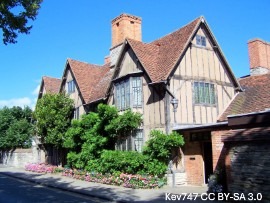
Stratford-upon-Avon home of Shakespeare's daughter is 'At Risk'
Lady Grange’s House repaired on St Kilda
.jpg)
National Trust for Scotland repairs stone cleit with link to famous island resident
Griff Rhys Jones on BBC Radio 4 Today programme
,_Green_Lane,_Derby.jpg)
The Victorian Society’s President unveiled its latest Top Ten Endangered Buildings 2026.
Need a MATE? Book your place now.

IHBC offers free webinars on applying for IHBC accreditation (Full & Associate).
UK Stained Glass Repository finds windows new homes
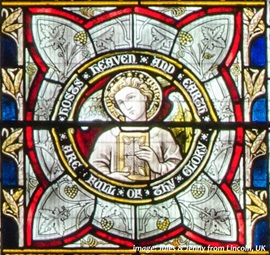
How are stained glass windows are rescued, stored and repurposed?
APPGEBE report sets high aims for quality
'Government must not sacrifice quality in drive to build 1.5m homes'
New measures protect Historic Shipwrecks from heritage crime

Underwater cultural heritage benefits from new HE guidance
How could the City of London skyline look in 6 years' time?

Visualisation shows approved planning applications as completed buildings
National Trust for Scotland calls for VAT cuts

Heritage neglect is encouraged by current policies
IHBC's 'Context' Issue 186 features Industrial Heritage
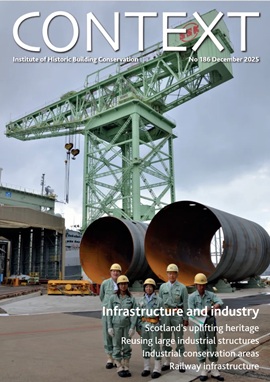
IHBC's members' journal reports on the challenges of conserving infrastructure
Book now for IHBC Annual School 2026

IHBC Annual School is taking place 18-20 June 2026 in Newcastle
RICHeS Research Infrastructure offers ‘Full Access Fund Call’

RICHeS offers a ‘Help’ webinar on 11 March
Latest IHBC Issue of Context features Roofing
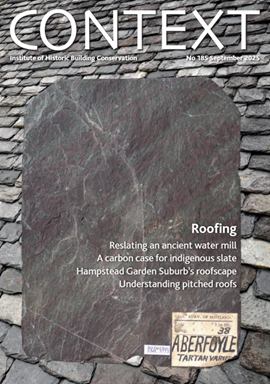
Articles range from slate to pitched roofs, and carbon impact to solar generation to roofscapes
Three reasons not to demolish Edinburgh’s Argyle House

Should 'Edinburgh's ugliest building' be saved?
IHBC’s 2025 Parliamentary Briefing...from Crafts in Crisis to Rubbish Retrofit
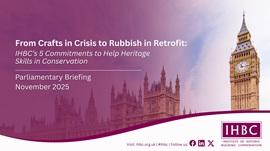
IHBC launches research-led ‘5 Commitments to Help Heritage Skills in Conservation’
How RDSAP 10.2 impacts EPC assessments in traditional buildings

Energy performance certificates (EPCs) tell us how energy efficient our buildings are, but the way these certificates are generated has changed.