




Pad foundation
Foundations provide support for structures, transferring their load to layers of soil or rock that have sufficient bearing capacity and suitable settlement characteristics. They can be used to help to prevent settlement and other movements of structures and can permit construction on ground that might otherwise have insufficient bearing capacity.
There are a very wide range of foundation types suitable for different applications, depending on considerations, for example:
- The nature of the load requiring support.
- Ground conditions.
- The presence of water.
- Accessibility.
- Sensitivity to noise and vibration.
- Proximity to other structures and loading
- Project time-frames.
Very broadly, foundations can be categorised as shallow foundations or deep foundations. Shallow foundations are typically used where the loads imposed by a structure are low relative to the bearing capacity of the surface soils. Deep foundations (more than 3 m from the surface) may be necessary where the bearing capacity of the surface soils is insufficient to support loads imposed.
Pad foundations are generally shallow foundations, but can be deep depending on the ground conditions. They are a form of spread foundation formed by rectangular, square, or sometimes circular concrete ‘pads’ that support localised single-point loads such as structural columns, groups of columns or framed structures. This load is then spread by the pad to the bearing layer of soil or rock below. Pad foundations can also be used to support ground beams.

They are generally of a uniform thickness, but sometimes the upper face may be sloped or stepped. Their plan shape will depend on the nature of the applied load and the allowable bearing capacity of the layers below. Their thickness must be sufficient to distribute the load across the plan shape. They are generally reinforced on all but the smallest structures, with the reinforcement allowing higher loads to be imposed and the construction of shallower pads which require less excavation and use less concrete.
The arrangement of pad foundations will vary depending on the nature of the structure they are supporting, the loads imposed, the allowable bearing capacity of the layers below and the space available on site. They may be:
- A series of discrete, well-separated pads.
- Balanced base pads that support more than one point load.
- Continuous pads, where there are a number of point loads close together.
- Pad and beam, where a series of pads support a continuous beam.
Pad foundations can be selected as they do not require much excavation, and are generally suitable where the bearing capacity of ground is sufficient at relatively low depths. However, they can be large in plan shape and may not be effective against differential settlement, uplift forces or wind forces.
See also: How to design pad foundations.
See also: Types of pad foundation.
NB High Speed Rail (Crewe – Manchester) Environmental Statement, Glossary, abbreviations and references, published by the Department for Transport in 2022, defines pad foundations as: ‘A foundation structure that spreads the imposed loads over a sufficient area to reduce stress on foundation material. Often described as shallow foundations.’
[edit] Related articles on Designing Buildings
- Compensated foundation.
- Continuous flight auger piles.
- Driven piles.
- Footings.
- Foundations.
- Geothermal pile foundations.
- Ground anchor.
- Groundworks.
- How deep should foundations be?
- How to design a pad foundation.
- Micropiles.
- Padstone.
- Piers.
- Pile foundations.
- Raft foundation.
- Screw piles.
- Slab.
- Strip foundation.
- Temporary works.
- Trench fill foundation.
- Types of pad foundation.
- Types of raft foundation
IHBC NewsBlog
IHBC sponsors Gardens Trust event 23-4 Sept 2026
.jpeg)
'Learning from the Past, Shaping the Future’ takes place in Milton Keynes
Renovations to Frank Lloyd Wright's Fallingwater complete
.jpg)
World Heritage Preserved project opens house for tours again
Shakespeare Birthplace Trust places Hall's Croft on HAR Register

Stratford-upon-Avon home of Shakespeare's daughter is 'At Risk'
Lady Grange’s House repaired on St Kilda
.jpg)
National Trust for Scotland repairs stone cleit with link to famous island resident
Griff Rhys Jones on BBC Radio 4 Today programme
,_Green_Lane,_Derby.jpg)
The Victorian Society’s President unveiled its latest Top Ten Endangered Buildings 2026.
Need a MATE? Book your place now.

IHBC offers free webinars on applying for IHBC accreditation (Full & Associate).
UK Stained Glass Repository finds windows new homes

How are stained glass windows are rescued, stored and repurposed?
APPGEBE report sets high aims for quality

'Government must not sacrifice quality in drive to build 1.5m homes'
New measures protect Historic Shipwrecks from heritage crime

Underwater cultural heritage benefits from new HE guidance
How could the City of London skyline look in 6 years' time?

Visualisation shows approved planning applications as completed buildings
National Trust for Scotland calls for VAT cuts

Heritage neglect is encouraged by current policies
IHBC's 'Context' Issue 186 features Industrial Heritage

IHBC's members' journal reports on the challenges of conserving infrastructure
Book now for IHBC Annual School 2026

IHBC Annual School is taking place 18-20 June 2026 in Newcastle
RICHeS Research Infrastructure offers ‘Full Access Fund Call’

RICHeS offers a ‘Help’ webinar on 11 March
Latest IHBC Issue of Context features Roofing
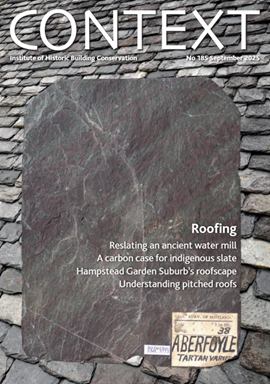
Articles range from slate to pitched roofs, and carbon impact to solar generation to roofscapes
Three reasons not to demolish Edinburgh’s Argyle House

Should 'Edinburgh's ugliest building' be saved?
IHBC’s 2025 Parliamentary Briefing...from Crafts in Crisis to Rubbish Retrofit

IHBC launches research-led ‘5 Commitments to Help Heritage Skills in Conservation’
How RDSAP 10.2 impacts EPC assessments in traditional buildings

Energy performance certificates (EPCs) tell us how energy efficient our buildings are, but the way these certificates are generated has changed.
Comments
[edit] To make a comment about this article, click 'Add a comment' above. Separate your comments from any existing comments by inserting a horizontal line.