





Low VOC Adhesives Market
The total size of the low VOC adhesives market was USD 47.6 billion in 2021 and it will grow at a compound annual growth rate of 6.1% to reach USD 81.1 billion by 2030.
The paper and packaging industry is the main user of low VOC adhesives, holding over 30%, then come the building & construction and automotive & transportation sectors. This is because of the increasing requirement and use of ecological and sustainable packaging products for example corrugated boxes and cases and cartons. In addition, the FDA supports low VOC adhesives for the packaging of food.
Water-based adhesive technology is the market dominator, owing to its advantages over solvent-based adhesives for example easy applicability, user-friendliness, low activation temperatures, low health risks, and lack of toxic fumes.
Most of the water-based adhesives use polyvinyl acetate resin. The use of water-based adhesives comprises paper lamination, corrugating, bags and sacks, envelopes, folding cartons, graphic arts, cores and cups, woodworking, and labelling and flooring.
Polyvinyl acetate is a key synthetic resin in low VOC adhesive formulations. Its properties lead to high performance and versatility as well as being environmentally-friendly. Polyvinyl acetate is mainly used in the packaging and paper industry as a low-odour, low-toxic adhesive for bonding cotton, corrugated carton, wood, and paper.
The APAC low VOC adhesives market will grow at its highest rate in the years to come. This is due to the fact that countries, for example China, India, and South Korea, accompanied by other South-eastern countries of the region are encouraging manufacturers to set up production units of low VOC adhesives.
[edit] Related articles on Designing Buildings
Featured articles and news

We're expanding our collaborative mission by launching DB Intelligence, an exclusive market research advisory panel. Built environment professionals can now get paid to share their expertise on industry trends, products and services.
Panel members receive direct financial incentives for participating in research projects like short surveys, 1-2-1 interviews and focus groups. Register today to shape the future of the construction sector.
Overheating guidance and tools for building designers

Guidance for dealing with element of building fabric control that have increasing importance.
Shading for housing, a design guide

From the Good Homes Alliance and British Blind and Shutter Association.
UK Standard Skills Classification (SSC)

A shared framework for describing skills needs.
Social media ban consultation comes to close

CIOB urges UK Government to consider social media’s role in careers guidance in ban debate.
The latest of eight Skills England apprenticeship units

The addition of battery manufacturing welcomed by ECA with a warning about the risks of fast-tracked apprenticeship units.
Building Control Independent Panel final report
A precis of a key report led by Dame Hackitt with full recommendations and link to the government response.
Guide to ISO 19650 for Architecture Firms (2026)
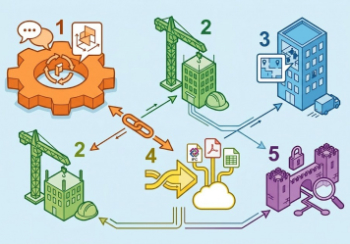
A user gives their low down.

A UK training and membership provider for mould remediation professionals.
Building Safety recap April, 2026
A short and longer run-through of the month, with links to further information and sources.

CIAT May 2026 briefing.

Independent NSI and BAFE study exploring how organisations are changing the way they buy fire safety services.

From medieval scribes to modern word art.

ECA welcomes crackdown on late payment and push for clean energy, whilst CIOB seek fixed cladding removal timeframes.
Cyber Security in the Built Environment
Protecting projects, data, and digital assets: A CIOB Academy TIS.
Managing competence in the built environment

ITFG publishes new industry guide on how to meet the ICC principles.
The UK's campaign to reduce noise pollution: Mythbusting, articles and topic guides.