





Integrated project delivery (IPD)
Integrated project delivery (IPD) is a project delivery model built around a collaborative alliance of stakeholders who each share risk and reward. It involves the key project stakeholders (the client, architect, contractor, and so on) entering into a single contract that encourages collaboration, optimises results, reduces waste and maximises efficiency and expertise.
The stakeholders collectively determine project goals, budgets, allocation of risk and compensation. The contract typically specifies the separate responsibilities of the stakeholders but enshrines collective responsibility for the project’s successful delivery.
The IPD contract agreement is typically signed by a ‘leadership team’ comprising the client, lead designer/architect and contractor. They are primarily responsible for delivering the project to the budget, schedule and quality specified by the client. Subcontractors and other stakeholders may agree to become ‘risk/reward partners’ (or they can be contracted on conventional sub-contract agreements).
Risk/reward partners agree to be reimbursed on a cost plus overhead and profit basis if the project performs well. The profit is fixed as a lump sum amount at the point at which the contract amount is negotiated and agreed by the stakeholders. The risk/reward partners may lose some or all of their profit if the project falls behind the budget or schedule, and the contract will lay out the terms of this loss. It is usual for the client to agree to pay for the project at cost if all profit is lost, thereby allowing stakeholders to limit their losses purely to the profit they would otherwise have earned on the project.
The benefit of the IPD method is that the contract removes barriers to collaboration and innovation, combining incentives for the project team as a whole rather than having them seek increased profits from the project individually. Instead of individual successes or failures, the overall outcomes determine the collective rewards.
By openly sharing the project goals, risk and rewards, this can result in a more dependable flow of information between the main parties, leading to a sharing of knowledge and technology. In addition, the project can benefit from being able to adopt lean construction principles, overlapping design and construction phases, and so on.
[edit] Related articles on Designing Buildings
- Collaborative practices.
- Consortium.
- Construction contract.
- Construction manager at-risk.
- Construction management contract.
- Construction project.
- Design and build.
- Integrated project insurance (IPI) model
- Integrated project team.
- Integrated supply team.
- Just-in-time manufacturing.
- Joint venture.
- Kanban.
- Lean construction.
- Managing the procurement process.
- Partnership.
- Procurement route.
- Tender process.
Featured articles and news

We're expanding our collaborative mission by launching DB Intelligence, an exclusive market research advisory panel. Built environment professionals can now get paid to share their expertise on industry trends, products and services.
Panel members receive direct financial incentives for participating in research projects like short surveys, 1-2-1 interviews and focus groups. Register today to shape the future of the construction sector.
Building Safety Wiki Interviews

Chief executive of the British Woodworking Federation.
Planning condition discharge in England and Wales

A brief exoplanation from a building compliance expert, with further links.
Overheating guidance and tools for building designers

Guidance for dealing with element of building fabric control that have increasing importance.
Shading for housing, a design guide

From the Good Homes Alliance and British Blind and Shutter Association.
UK Standard Skills Classification (SSC)

A shared framework for describing skills needs.
Social media ban consultation comes to close

CIOB urges UK Government to consider social media’s role in careers guidance in ban debate.
The latest of eight Skills England apprenticeship units

The addition of battery manufacturing welcomed by ECA with a warning about the risks of fast-tracked apprenticeship units.
Building Control Independent Panel final report
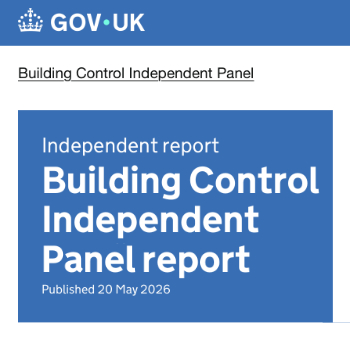
A precis of a key report led by Dame Hackitt with full recommendations and link to the government response.
Building Safety recap April, 2026
A short and longer run-through of the month, with links to further information and sources.

CIAT May 2026 briefing.

From medieval scribes to modern word art.

ECA welcomes crackdown on late payment and push for clean energy, whilst CIOB seek fixed cladding removal timeframes.
Cyber Security in the Built Environment
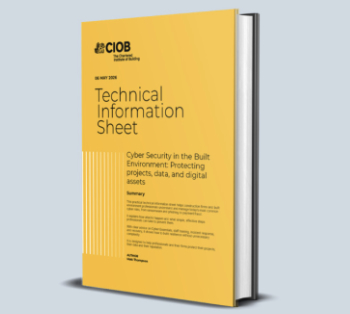
Protecting projects, data, and digital assets: A CIOB Academy TIS.
Managing competence in the built environment
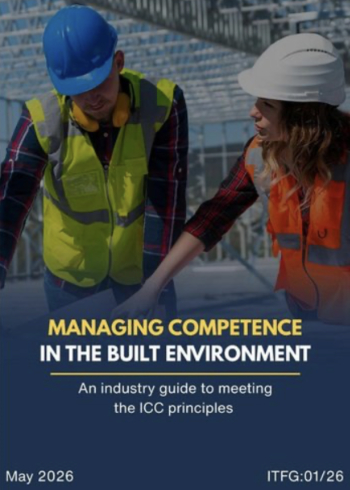
ITFG publishes new industry guide on how to meet the ICC principles.