





Edge AI hardware Market
The global edge AI hardware market registered transactions of 532.4 million units in 2018 and is expected to reach 1,681.8 million units by the end of the forecast period (2027) with a CAGR of 21.72%.
Growth in Artificial Intelligence (AI) has created huge opportunities for semiconductor companies. Edge AI processing involves low latency which is an advantage and hence is contributing to growth of the market. Edge AI processing helps reduce data travelling time so that companies can analyse data on a real-time basis. AI hardware is the core enabler for various solutions such as facial recognition and virtual assistants managing homes. Edge AI hardware is used in various industries such as oil and gas, mining, transportation, and power utilities.
The key players profiled in the edge AI hardware market are – Intel Corporation (US), Samsung Electronics Co., Ltd. (South Korea), Google Inc. (US), NVIDIA Corporation (US), Qualcomm (US), MediaTek Inc. (Taiwan), Xilinx Inc. (US), and Microsoft Corporation (US). These players contribute a major share in the growth of edge AI hardware market. The other prominent companies in the edge AI hardware market include Huawei Technologies Co., Ltd. (China), Imagination Technologies Limited (UK), and Cambricon Technologies (China) among others.
The global Industry is segmented into size, type, component, voltage, application and region. By type the segment is further classified into skid mounted and mobile Edge AI hardware. By component, the segment is further classified into switchgear, bus bar, HVAC systems, transformer, frequency drives, monitoring and control systems and others. By voltage, the segment, is further classified into low voltage and medium voltage.
Due to a rise in phishing activities, COVID-19 has substantially increased the adoption of cloud infrastructure and services. In addition, COVID-19 has significantly increased security budgets, which has resulted in a large increase in cloud infrastructure and services. According to the findings of a study conducted by Microsoft and published in August 2020, 36% of the total 800 respondents said that the budget for cybersecurity had risen as a consequence of the pandemic outbreak. Additionally, 42 percent of those who answered the survey said that the company altered its personnel by adding more security experts.
[edit] Related articles on Designing for Buildings
- Artificial intelligence.
- Artificial intelligence and civil engineering.
- Artificial intelligence and surveying.
- Artificial intelligence for smarter, safer buildings.
- Artificial intelligence in buildings.
- BSRIA publishes Artificial Intelligence in Buildings white paper.
- Building automation and control systems.
- Global building automation.
- Internet of things.
- Predictive analytics.
Featured articles and news
The future workforce: culture change and skill

Under the spotlight at UK Construction Week London.

A landmark moment for postmodern heritage.
A safe energy transition – ECA launches a new Charter

Practical policy actions to speed up low carbon adoption while maintaining installation safety and competency.
Frank Duffy: Researcher and Practitioner

Reflections on achievements and relevance to the wider research and practice communities.
The 2026 Compliance Landscape: Fire doors

Why 'Business as Usual' is a Liability.
Cutting construction carbon footprint by caring for soil

Is construction neglecting one of the planet’s most powerful carbon stores and one of our greatest natural climate allies.
ARCHITECTURE: How's it progressing?

Archiblogger posing questions of a historical and contextual nature.
The roofscape of Hampstead Garden Suburb

Residents, architects and roofers need to understand detailing.
Homes, landlords. tenants and the new housing standards

What will it all mean?
The Architectural Technology podcast: Where it's AT

Catch-up on the latest episodes.
Edmundson Apprentice of the Year award 2026

Entries now open for this Electrical Contractors' Association award.

Traditional blue-grey slate from one of the oldest and largest UK slate quarries down in Cornwall.

There are plenty of sources with the potential to be redeveloped.
Change of use legislation breaths new life into buildings

A run down on Class MA of the General Permitted Development Order.
Solar generation in the historic environment
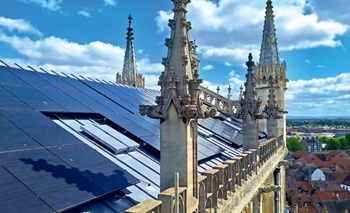
Success requires understanding each site in detail.