





Arts and Crafts Architecture: 'Beauty's Awakening'

Arts and Crafts Architecture: ;Beauty's Awakening' Julian Holder, Crowood Press, 2021, 176 pages, colour and black and white illustrations, hardback.
Architectural historians have often struggled to define the principles on which arts-and-crafts architecture have been based. The first serious attempt was made by Peter Davey, whose book ‘Arts and Crafts Architecture: the search for earthly paradise’ was published in 1982. Since then there have been monographs of leading figures such as Philip Webb, CFA Voysey, Baillie Scott, CR Ashbee and Ernest Gimson, and recently Alec Hamilton’s revealing book ‘Arts and Crafts Churches’. Now Julian Holder provides an ambitious overview of the movement, exploring its origins, ethics, politics and philosophy, and the buildings themselves.
Part of the problem faced by writers has been how to relate the architecture and the broader arts-and-crafts movement. Holder tackles the point head on by arguing that architects were the dominant figures, many – such as Ashbee, Gimson and Sidney Barnsley – moving on to embrace craftsmanship, including furniture making, silversmith and metal working. He places William Morris, who trained as an architect, along with Webb, Edward Prior, WR Lethaby, MH Baillie-Scott and Gimson as key figures. Another problem is that since the arts and crafts were a set of ideas and not a style, it is not always easy to identify the products of the movement.
A strength of the book is its structure, which helps the reader to understand the complex background to the movement, before describing the architecture. Each of the chapters contains a case study, which analyses a particular building in some detail with plans and many well-chosen photographs. These help to identify the qualities of each of the major architects. Baillie-Scott is credited for conceptualising each room of a house as a work of art, and for working closely with craftsmen in every aspect from the furniture and fabrics down to the metalwork and stained glass. Prior is praised for his inventiveness and his feeling for textural effect in the use of materials based on the local vernacular. Lutyens is featured, but Holder questions whether he should be, given his stylistic eclecticism.
The most original and compelling chapter is the final one, which is titled ‘The Garden City Movement: arts and crafts for all’. This makes the case that the movement’s greatest achievement was the part it played in the establishment of garden cities, the Housing Act 1919 and the introduction of town planning in Britain. To make his point he traces links between William Morris’ utopian ideas and Ebenezer Howard’s ‘Tomorrow: a peaceful path to real reform’, and how these ideas were to influence government housing policy after the first world war and the huge programme of council housing that was to follow.
The only issue that might disappoint some readers, and which is not obvious from its title, is that the book focuses almost entirely on the arts and crafts in England (to have included Scotland, Wales and Northern Ireland would have required a somewhat larger volume). But for those who are happy to stick with the English story, this is a valuable and very readable addition to the growing literature on the arts-and-crafts movement.
This article originally appeared as ‘A set of ideas, not a style’ in the Institute of Historic Building Conservation’s (IHBC’s) Context 174, published in December 2022. It was written by Peter de Figueiredo, reviews editor for Context .
--Institute of Historic Building Conservation
Related articles on Designing Buildings
IHBC NewsBlog
IHBC sponsors Gardens Trust event 23-4 Sept 2026
.jpeg)
'Learning from the Past, Shaping the Future’ takes place in Milton Keynes
Renovations to Frank Lloyd Wright's Fallingwater complete
.jpg)
World Heritage Preserved project opens house for tours again
Shakespeare Birthplace Trust places Hall's Croft on HAR Register
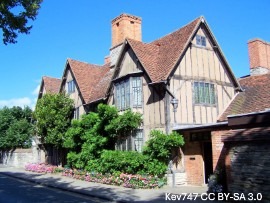
Stratford-upon-Avon home of Shakespeare's daughter is 'At Risk'
Lady Grange’s House repaired on St Kilda
.jpg)
National Trust for Scotland repairs stone cleit with link to famous island resident
Griff Rhys Jones on BBC Radio 4 Today programme
,_Green_Lane,_Derby.jpg)
The Victorian Society’s President unveiled its latest Top Ten Endangered Buildings 2026.
Need a MATE? Book your place now.

IHBC offers free webinars on applying for IHBC accreditation (Full & Associate).
UK Stained Glass Repository finds windows new homes
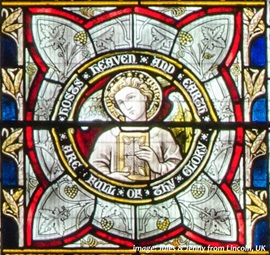
How are stained glass windows are rescued, stored and repurposed?
APPGEBE report sets high aims for quality
'Government must not sacrifice quality in drive to build 1.5m homes'
New measures protect Historic Shipwrecks from heritage crime

Underwater cultural heritage benefits from new HE guidance
How could the City of London skyline look in 6 years' time?

Visualisation shows approved planning applications as completed buildings
National Trust for Scotland calls for VAT cuts
Heritage neglect is encouraged by current policies
IHBC's 'Context' Issue 186 features Industrial Heritage

IHBC's members' journal reports on the challenges of conserving infrastructure
Book now for IHBC Annual School 2026

IHBC Annual School is taking place 18-20 June 2026 in Newcastle
RICHeS Research Infrastructure offers ‘Full Access Fund Call’
RICHeS offers a ‘Help’ webinar on 11 March
Latest IHBC Issue of Context features Roofing
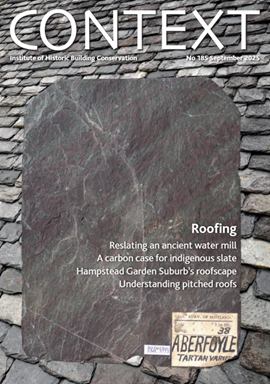
Articles range from slate to pitched roofs, and carbon impact to solar generation to roofscapes
Three reasons not to demolish Edinburgh’s Argyle House

Should 'Edinburgh's ugliest building' be saved?
IHBC’s 2025 Parliamentary Briefing...from Crafts in Crisis to Rubbish Retrofit
IHBC launches research-led ‘5 Commitments to Help Heritage Skills in Conservation’
How RDSAP 10.2 impacts EPC assessments in traditional buildings

Energy performance certificates (EPCs) tell us how energy efficient our buildings are, but the way these certificates are generated has changed.
Comments
[edit] To make a comment about this article, or to suggest changes, click 'Add a comment' above. Separate your comments from any existing comments by inserting a horizontal line.