





Jubilee clips
|
| Jubilee® is a registered trade mark of L Robinson & Co (Gillingham) Limited. |
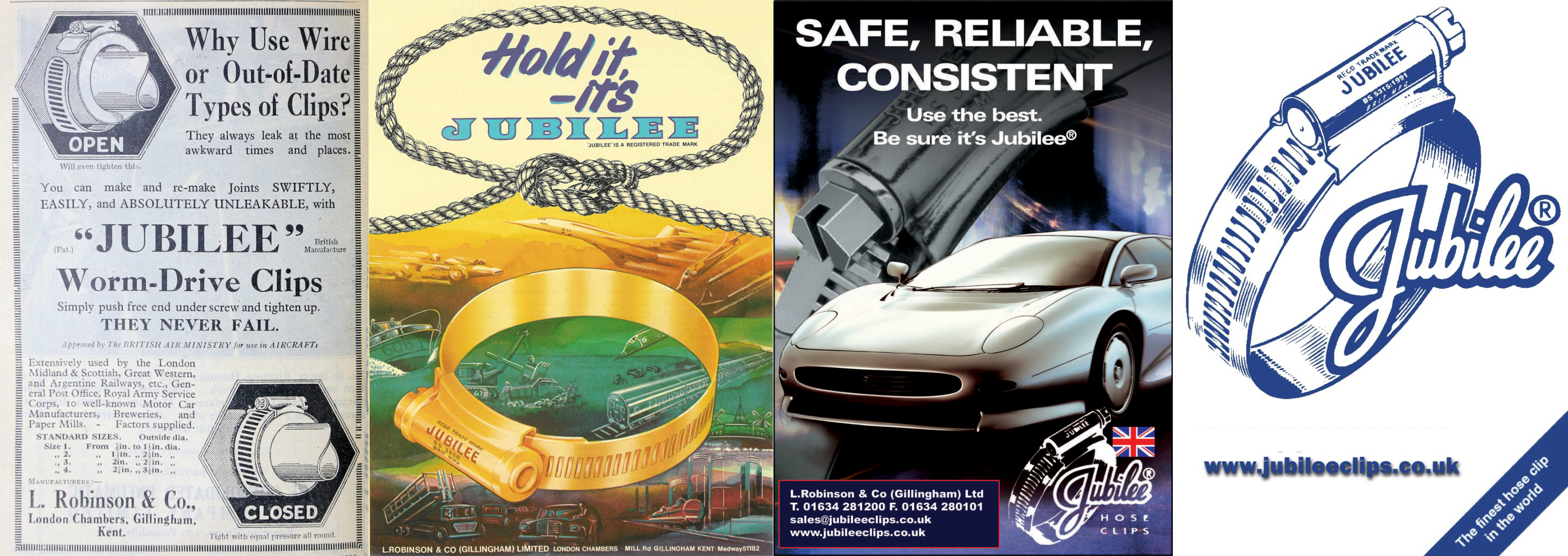
The Jubilee clip is a brand name that is often used instead of the technical name worm drive hose clamp, which is a type of ring clamp used to join hoses tightly. It has a steel band with teeth and a screw to tighten and loosen the grip of the clip. These are also sometimes called hose clamps, or just hose clips, it is not known why the name Jubilee was used for the original company but various theories exist such as it being the local street name of the inventor.
The Jubilee® worm drive hose clip was invented in April 1921 and patented by Commander Lumley Robinson, the founder of L Robinson and Company. It was during his time in the Royal Navy, which included spending several hours in the sea when his ship sank, during World War I, that he saw the need for a new and better way to attach hoses to pipes.
After leaving the Navy and spending time testing his ideas in a friend's workshop, Commander Lumley invented the first Jubilee clip, which quite quickly became a commercial success. When World War II broke out the Jubilee clip was seen as an important contribution to the war effort. The Commander sadly died just before the war started and the Ministry wanted to take over the firm, in response his widow, decided to run the company herself, which she did, throughout the war, supplying clips to the services.
After the war ended Ms. Lumley-Robinson continued to run the company herself along with her youngest son. The company continued to grow, expanding across Europe and beyond. It continues to be successful and Jubilee clips are a staple piece of equipment for many industries from aeronautics to automobiles and service engineers to plumbers. Today, it is run by the great-grandson of the original inventor, making him the fourth generation of the family to hold the position of managing director.

[edit] External links
For more information about the founders of the original Jubilee clips visit https://www.jubileeclips.co.uk/about-us/history/
[edit] Related articles on Designing Buildings
- Adhesives.
- Clamp.
- Construction equipment.
- Construction tools.
- Cramp.
- Crimp.
- Fixings.
- Fixtures.
- Ground anchor.
- Industrial fasteners market.
- Rivet.
- Soil nailing.
- Staples.
- Strap.
- The history of nails.
- Timber.
- Types of bolts.
- Types of fixings.
- Types of nails.
- Types of nuts.
- Types of screws.
- Types of washer.
- Welding.
Featured articles
Check out some of the best features and news from Designing Buildings as well as key stories from around the web.

Sir Edwin Lutyens: Britain's greatest architect? Book review.

CIOB publishes free template to help assess and manage risks.
ECA's reflections on Party Conference season

Burnham wants to be confident of winning before asking for a fresh mandate.
New Chief Construction and Scientific Adviser

Sergio Cavalaro, Professor of Infrastructure Systems at Loughborough University.
Building safety levy for England

CIAT publish estimator tool for members.

Water sector faces a growing crisis that could slow the delivery of vital infrastructure.
Undervaluing our industrial past

Heritage value changes as taste for building styles changes.
Changing expectations around competence and compliance

New information sheet from CIAT.
Grenfell investigation files passed to CPS

Angela Rayner apologises on behalf of the British state.

Electrical contractors need to understand the practical implications.

The real barrier to getting more value from digital technology.

Your guide to The Construction Reset at UKCW Birmingham.