






Happiness at work
Contents |
[edit] The cost of misery... does happiness pay?
Workplaces for everyone, a holistic approach to employee well-being.

There is compelling evidence that it pays to invest in your employees’ happiness. Research findings are clear that happier employees are more productive, which improves your bottom line. Your happiest employees are 65% more energised at work, spend twice as much time on-task, and intend to stay in their job 4 times longer, according to iOpener Institute. This event was held on 5 December 2023.
But what does being happy at work actually mean? Why is happiness considered the antidote to poor performance? Isn’t happiness just a fuzzy concept? Should workforce happiness be on your agenda in the current tough economic climate? What does making happy employees mean in real terms for business leaders and managers?
This event brought participants up to speed with all aspects behind workforce happiness – its theory, its value and its challenges – for managers, teams and individuals. And to present practical solutions that you’ll be able to implement straight away with your teams.
[edit] The iOpener Institute

Speaker: Katie Demain, Global Partner and Change Expert, iOpener Institute
With a background in journalism, Katie spent many years leading teams of journalists to countries to compile economic reports for western media e.g. The Economist, Newsweek, USA Today, Sunday Observer, etc. In doing so, she moved from country to country, visited thousands of organisations and interviewed their leaders. She was thus able to formulate her own understanding of happy organisational cultures and effectiveness, which in turn shaped her interest in becoming an expert in the Science of Happiness at Work. Now, as an Executive Education Consultant and Executive Coach, Katie works with organisations and business schools worldwide to make positive shifts in happiness happen.
She is fluent in French and Spanish and holds a BA in European Business Management.
[edit] Slides available
Katie has very kindly allowed her presented material to be made available for viewing.
The slides on Slideshare are now available in our APM resources area and also embedded below for reference.
APM Body of Knowledge 7th edition reference:
1.2.1: Environment
2.1: Interpersonal Skills
4.3: Human Resource Management
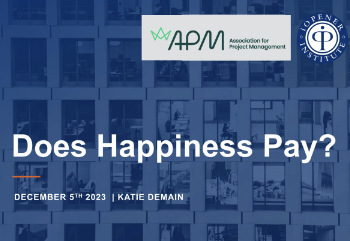
This article appears on in the APM news and blog site as "Does happiness pay?" dated December 7, 2023 and shared by Katie Demain, Global Partner and Change Expert, iOpener Institute.
--Association for Project Management
[edit] Related articles on Designing Buildings
- APM articles.
- Building Places that Work for Everyone.
- Employee experience.
- Designing for employee wellbeing.
- Employee assistance programme EAP.
- Employee handbook.
- Enhancing wellbeing, productivity and projects with work life balance.
- Largest-ever UK data survey on employee diversity.
- Project teams for the future built environment.
- To attract the right talent, offering flexibility and work-life balance will be essential.
- Well-being and Regeneration: Reflections from Carpenters Estate.
Featured articles
Check out some of the best features and news from Designing Buildings as well as key stories from around the web.

Your guide to The Construction Reset at UKCW Birmingham.

Accommodating the Victorian and Edwardian working woman. Book review.
Rethinking passive fire protection in design

PFP demands the same level of design rigour as structure or services.

38% of Gen Zs feel safe when a fire door is wedged open.
Stunning images from around the world

Shortlist for CIOB’s Art of Building photography competition.

Guidance for conversion of traditional pre-1919 stone buildings.
Industrial heritage in the Ruhr

A marked difference to the fate of industrial landscapes in the UK.

Communities will be able to build their own clean energy.
Why diversity and inclusion matters for SMEs

CIOB’s D&I Charter shows how practical changes can support long-term growth.
Cut electricity bills to power growth

Coalition sends joint letter to the Chancellor.

Gasholders: a history in pictures. Book review.
Recognition, influence and growth
SocEnv identifies three strategic pillars in new strategy to 2045.