






The career of a land or building surveyor
Contents |
[edit] Introduction
The role of a land or building surveyor is to provide professional property and construction advice. The role of a surveyor includes overseeing the design and development of land or new buildings, as well as maintaining and restoring existing developments.
Land and building survey work entails covering a wide range of properties and developments, which often includes surveying and advising at various stages of construction and development. Here is what to expect in each role:
[edit] Building surveyor
A building surveyor is trained to understand and interpret building laws. They are able to assess building plans to check if they comply with the building regulations. They will hold an accredited degree in building surveying, and be registered with a professional body.
Their role will include interacting with other professionals such as architects, engineers and builders, to ensure that buildings are designed and constructed in accordance with the building regulations. They will analyse a construction based on building legislation law and technical codes, and diagnose any possible design issues, or problematic construction techniques and materials.
A surveyor will analyse the construction at various stages of its development, from the construction of foundations through to completion. As for pre-existing constructions, a surveyor will carry out an inspection to determine if the building still meets stipulated standards. If not, they can assess what work will need to be carried out to meet requirements, or set in motion the steps for the building to be demolished.
[edit] Land surveyor
A land surveyor will check an area of land prior to any development work. They will hold a degree in surveying technology or onsite surveying, and be registered with a professional body.
A land surveyor works in an office setting as well as in out in the field. When checking a land area, a land surveyor will use a variety of devices to help them scan and map the area. These devices record data via satellite and GPS to locate boundaries and record other data required for the survey. Once back in the office, this information is transferred onto a computer to accurately map out the area digitally in two and three dimensions. Once mapped, a land surveyor will work with architects and engineers assigned to the project to assess the next steps in development.
If you decide to study to become a land or building surveyor, check which universities offer the course you require, or consider online study options. If you have concerns about study fees, a government student loan can be applied for, to help cover the cost of the course. The loan will accumulate interest only when the course of study has ended, and at a much more reasonable interest rate than a conventional loan.
https://www.modricsurveying.co.uk/
[edit] Related articles on Designing Buildings Wiki
Featured articles and news

We're expanding our collaborative mission by launching DB Intelligence, an exclusive market research advisory panel. Built environment professionals can now get paid to share their expertise on industry trends, products and services.
Panel members receive direct financial incentives for participating in research projects like short surveys, 1-2-1 interviews and focus groups. Register today to shape the future of the construction sector.
Planning condition discharge in England and Wales

A brief exoplanation from a building compliance expert, with further links.
Overheating guidance and tools for building designers

Guidance for dealing with element of building fabric control that have increasing importance.
Shading for housing, a design guide

From the Good Homes Alliance and British Blind and Shutter Association.
UK Standard Skills Classification (SSC)

A shared framework for describing skills needs.
Social media ban consultation comes to close

CIOB urges UK Government to consider social media’s role in careers guidance in ban debate.
The latest of eight Skills England apprenticeship units

The addition of battery manufacturing welcomed by ECA with a warning about the risks of fast-tracked apprenticeship units.
Building Control Independent Panel final report

A precis of a key report led by Dame Hackitt with full recommendations and link to the government response.
Building Safety recap April, 2026

A short and longer run-through of the month, with links to further information and sources.

CIAT May 2026 briefing.

From medieval scribes to modern word art.

ECA welcomes crackdown on late payment and push for clean energy, whilst CIOB seek fixed cladding removal timeframes.
Cyber Security in the Built Environment
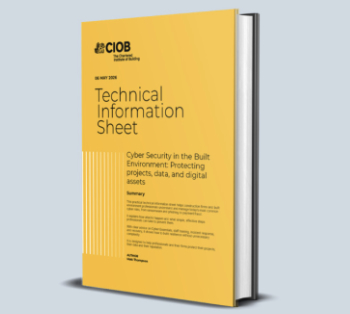
Protecting projects, data, and digital assets: A CIOB Academy TIS.
Managing competence in the built environment

ITFG publishes new industry guide on how to meet the ICC principles.

The UK's campaign to reduce noise pollution: Mythbusting, articles and topic guides.