





Backward integration
[edit] Introduction
Backward integration is a form of vertical integration which involves a company buying some or all of its raw material suppliers from the upper side, irrespective of whether this is a single business or the entire supply chain. Such an action can avoid dependency on suppliers, maintains a constant supply of material, controls costs and improves profit margins, and can increase efficiency and competitiveness.
So, for example, a developer working on a large infrastructure contract likely to take many years to complete may find it economically viable to buy a small, local brickworks to ensure a constant supply of bricks at a reasonable cost.
Backward integration is often achieved by acquisition of, or merger with, the businesses further up the supply chain. As well as gaining a competitive advantage, the process can be used to make it more difficult for new companies to enter the market.
[edit] Forward integration
The opposite of backward integration is forward integration involving acquiring or merging with companies in the lower supply chain. This means the company seeking forward integration is looking to buy the distributors of its products or the retail stores that sell them. This can give a manufacturer better control in supplying its product to consumers as well as a better position to receive first-hand product feedback.
[edit] Related articles on Designing Buildings Wiki
Featured articles and news

We're expanding our collaborative mission by launching DB Intelligence, an exclusive market research advisory panel. Built environment professionals can now get paid to share their expertise on industry trends, products and services.
Panel members receive direct financial incentives for participating in research projects like short surveys, 1-2-1 interviews and focus groups. Register today to shape the future of the construction sector.
Planning condition discharge in England and Wales

A brief exoplanation from a building compliance expert, with further links.
Overheating guidance and tools for building designers

Guidance for dealing with element of building fabric control that have increasing importance.
Shading for housing, a design guide

From the Good Homes Alliance and British Blind and Shutter Association.
UK Standard Skills Classification (SSC)

A shared framework for describing skills needs.
Social media ban consultation comes to close

CIOB urges UK Government to consider social media’s role in careers guidance in ban debate.
The latest of eight Skills England apprenticeship units

The addition of battery manufacturing welcomed by ECA with a warning about the risks of fast-tracked apprenticeship units.
Building Control Independent Panel final report
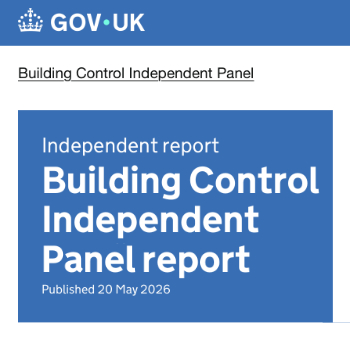
A precis of a key report led by Dame Hackitt with full recommendations and link to the government response.
Building Safety recap April, 2026
A short and longer run-through of the month, with links to further information and sources.

CIAT May 2026 briefing.

From medieval scribes to modern word art.

ECA welcomes crackdown on late payment and push for clean energy, whilst CIOB seek fixed cladding removal timeframes.
Cyber Security in the Built Environment
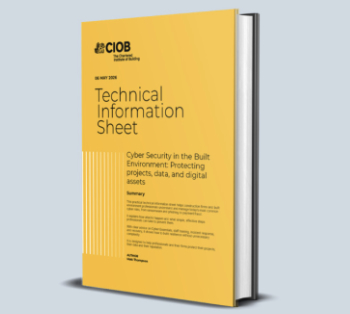
Protecting projects, data, and digital assets: A CIOB Academy TIS.
Managing competence in the built environment
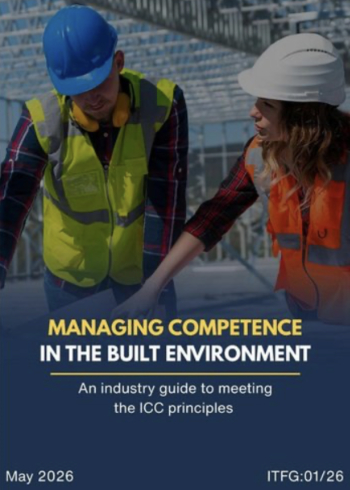
ITFG publishes new industry guide on how to meet the ICC principles.

The UK's campaign to reduce noise pollution: Mythbusting, articles and topic guides.