





Pointing brickwork

When masonry structures are first constructed, mortar is applied as a thick paste which sets hard as it cures, creating a tight seal between bricks and blocks to prevent air and moisture entering into the construction. Depending on the age of the building, the type of masonry, and the nature of the overall wall construction, mortar used for pointing will be either lime mortar or cement mortar.
The finished profile of the mortar joint at is external surface is known as ‘pointing’. This profile can be varied depending on exposure or to create a specific visual effect.
The most common pointing profiles are:
- Flush: The mortar is finished off flush with the face of the masonry units.
- Recessed or raked: Mortar is pressed back from the face of the masonry units by 5 mm or more. This creates a shadow gap between the masonry units.
- Beaded, concave, half round or bucket handle: A more rounded type of pointing with a concave edge. This can look aesthetically pleasing, but it may damage more easily than other profiles.
- Struck or weatherstruck: Similar to flush except the upper edge is pressed back inside the face to create a sloping profile. This is time-consuming and requires practice, but the effect can be aesthetically pleasing.
- Rubbed: Also known as keyed or grooved, this is a rounded groove formed in the middle of the pointing using a suitable tool.
- V-pointing: Similar to rubbed but with a sharp inward V-groove rather than rounded.
- Tuckpointing: Using two colours of mortar (one similar to the colour of the masonry, used at the edges) to give the impression that the joints are very thin.
- Penny roll: A recessed line is created in the middle of the joint to give a tidier impression when the joints are wide or degraded.
- Strap or ribbon: A neat strip of mortar sits proud of the face of the masonry. This can be used to give a neater impression when joints are degraded.
Generally, mortar is structurally weaker than the blocks or bricks it bonds, creating a sacrificial layer that is more easily repaired than defects would be in the bricks or blocks themselves. As a result, mortar joints can decay over time, due to weathering, frost damage, and so on. When this happens, repointing is undertaken to renew them. For more information see: Repointing.
[edit] Related articles on Designing Buildings
Featured articles
Check out some of the best features and news from Designing Buildings as well as key stories from around the web.
Why construction can't afford to ignore the skills gap.
Building Safety Regulator, 19 August

Gill Kernick appointed Independent Chair of Residents’ Panel.
Connecting knowledge, technology and conservation
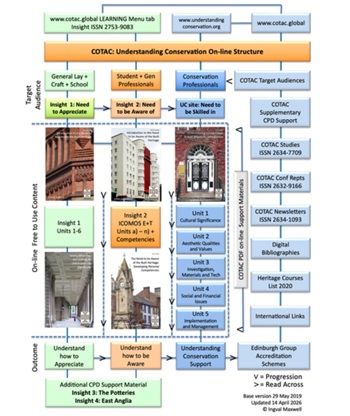
Building competence for the future of built heritage.
Building Regulations and Building Safety Act
CIOB publishes free advice for non-domestic clients.
Building Safety Newsletter from MHCLG.
An extraordinary record of steel engineering worldwide.

Households living near new pylons to save on bills.

ECA warns growth must not outpace grid capacity or skills.
The role of the client and decision making

CIOB response to built environment professions call for evidence.
Construction's sustainability reporting revolution
Tracking upfront embodied carbon with digital tools.
ECA welcomes procurement reforms

Public spending must back British jobs and skills.
Campaigning for Edinburgh: the Cockburn Association 1875-2049

The role of the civic voice in protecting character. Book review.