




The cost-benefit to the NHS arising from preventative housing interventions (FB82)
BRE (Building Research Establishment) is an independent, research-based consultancy, testing and training organisation, operating in the built environment and associated industries.
In 2014 a ‘Bletchley Day’ workshop was organised by Care & Repair England. BRE was tasked with considering ways to demonstrate the investment value of home adaptations and modifications.
BRE researched some of the cost-benefits to the NHS of undertaking preventative home interventions for households with a long-term sickness or disability, where the risks of accidents in their home are worse than the national average. This identified the need for preventative work in around 3 million households who have a long-term sickness and disability. This work would make their homes safer and warmer and so would reduce the likelihood of NHS treatment and the need for a Disabled Facilities Grant (DFG) adaptation required as a result of injury.
On 29 April 2016, BRE published The cost-benefit to the NHS arising from preventative housing interventions (FB82) by Helen Garrett, Mike Roys, Selina Burris and Simon Nicol.
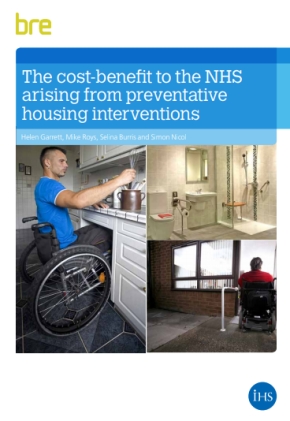
It will be of particular interest to all government departments responsible for health and housing, Public Health England, the NHS, local authorities, social housing providers, Age UK, Home Improvement Agencies, the Chartered Institute of Housing and the Chartered Institute of Environmental Health and students of public health and housing.
The contents of the publication are:
- Foreword.
- Executive summary.
- Introduction.
- Research background.
- Literature and methodological review.
- Home interventions to reduce the risks of HHSRS hazards.
- A new cost-benefit model using the cost of poor housing approach.
- Estimating the reduction in cost to the NHS of home interventions.
- Additional costs to society of not adapting homes for the disabled and vulnerable.
- Conclusions.
- Literature review.
- References.
[edit] Related articles on Designing Buildings Wiki
- A measure of net well-being that incorporates the effect of housing environmental impacts.
- Accessibility in the built environment.
- BRE articles on Designing Buildings Wiki.
- BRE Buzz articles on Designing Buildings Wiki.
- BRE Buzz.
- Building Research Establishment.
- Creating strong communities – measuring social sustainability in new housing development.
- Decent Homes for Ageing Well.
- Decent homes standard.
- Homes and ageing in England.
- Lifetime homes.
- Lifetime neighbourhoods.
- Quantifying the health benefits of the Decent Homes programme FB 64.
- The cost of poor housing to the NHS.
- The design of extra care housing for older people and its impact on wellbeing: The East Sussex perspective.
- The full cost of poor housing.
- The full cost of poor housing in Wales.
- The real cost of poor housing.
- What's the condition of your housing stock?
[edit] External references
Featured articles
Check out some of the best features and news from Designing Buildings as well as key stories from around the web.

Government approach could undermine delivery and regeneration.
World's first mass timber data centre.

The overlooked environmental aspect of data centre development.
Introduction to radon awareness

New technical information sheet published by CIOB.

Updated supplier guide can help electrical contractors engage with NHP.

CIAT confirm the winners of the 2026 architectural technology awards.

Government launches a one stop shop for flood preparedness.

Sir Edwin Lutyens: Britain's greatest architect? Book review.

CIOB publishes free template to help assess and manage risks.
ECA's reflections on Party Conference season

Burnham wants to be confident of winning before asking for a fresh mandate.
New Chief Construction and Scientific Adviser

Sergio Cavalaro, Professor of Infrastructure Systems at Loughborough University.
Building safety levy for England

CIAT publish estimator tool for members.

Water sector faces a growing crisis that could slow the delivery of vital infrastructure.