




Summoned by bells

|
| Sir John Betjeman at St Pancras Station. |
The title of Sir John Betjeman’s biographical poem refers not only to Christian worship but also to his love of church architecture. From Cornwall to Camden he appreciated churches of all periods, editing in 1958 the Collins Guide to Parish Churches. But it was Victorian churches that he particularly admired and often celebrated in his writing and poetry. Indeed, it can be said that he has made his own contribution to the intangible heritage and significance of some individual buildings such as St Saviour’s Church in Highbury.
Betjeman describes his approach to the church by trolley bus: ‘Threads and buses and standards with plane trees volleying by/ And, more peculiar still, that ever-increasing spire/ Bulges over the housetops, polychromatic and high’. In those few words he captures perfectly the time, architecture and contribution of William White’s Grade I 1865/6 church to the townscape of Highbury.
He is best known for his poetry, architectural writing and numerous radio and television programmes, which ranged from the much-praised BBC film ‘Metro- Land’ to more obscure topics such as abandoned railway lines. But these should not distract us from his role as a campaigner.
Betjeman was a founder member and first secretary of the Victorian Society at its inception in 1958. It should be remembered that at the end of the 1950s and into the 1960s, Victorian architecture was generally considered to be of little worth by members of the public and much of the architectural establishment. An exception to this was Nikolaus Pevsner who, like Betjeman, was a founder member of the Victorian Society. As a campaigning organisation, the society suffered a major setback in failing to save the Euston Arch in London.
However, Betjeman came into his own in the fight to save nearby St Pancras Station and the attached Midland Hotel. Travellers who use the magnificent station today as the start of their rail journey to Europe may well think it extraordinary that it was ever under threat. In the 1970s Betjeman successfully led the campaign to save Liverpool Street Station from redevelopment. More recently, plans have been submitted for major redevelopment at the station. The baton has been passed on to Victorian Society president Griff Rhys Jones, who has taken the lead in objecting to the latest proposals.
Betjeman did not confine his campaigning to London’s major railway stations. He would seek to defend all types of buildings and areas which he saw were under threat, including churches. He was a committee member of the SPAB, which commemorates him in an award given for the repair and conservation of places of worship. It is fitting that there is a sculpture of him in St Pancras Station, which captures his spirit, enthusiasm and humour.
If there is one word that encapsulates Betjeman’s approach to his writing, programme-making and conserving the historic environment, it is probably ‘passion’. As it happens, it is a word that was used many times at the Heritage Alliance’s Heritage Day, which I attended on behalf of the IHBC. Passion was, according to many of the speakers, the defining characteristic that makes us do what we do. The theme of the event was creativity in heritage, and the second most common requirement for people in the sector identified in the event was ‘patience’. If I were to add a third ‘p’, it would be perseverance.
Passion, perseverance and patience make a catchy threesome. No doubt we can all think of cases where all these came into play, whether it was preventing inappropriate development, saving a building at risk or seeing through a challenging regeneration project. There is yet another ‘p’ which should be applied to IHBC members and that is ‘professional’. I will not be the first commentator to note that ‘professional’, with its many characteristics, including competence and analytical skills, may be at odds with the passion that accompanies a campaigning role, but that is a topic for another discussion.
This article originally appeared as ‘Summoned by bells’ in the Institute of Historic Building Conservation’s (IHBC’s) Context 184, published in June 2025. It was written by David McDonald chair@ihbc.org.uk.
--Institute of Historic Building Conservation
Related articles on Designing Buildings Conservation.
IHBC NewsBlog
IHBC sponsors Gardens Trust event 23-4 Sept 2026
.jpeg)
'Learning from the Past, Shaping the Future’ takes place in Milton Keynes
Renovations to Frank Lloyd Wright's Fallingwater complete
.jpg)
World Heritage Preserved project opens house for tours again
Shakespeare Birthplace Trust places Hall's Croft on HAR Register
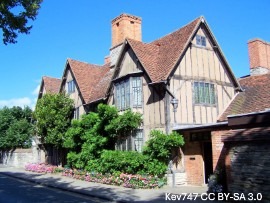
Stratford-upon-Avon home of Shakespeare's daughter is 'At Risk'
Lady Grange’s House repaired on St Kilda
.jpg)
National Trust for Scotland repairs stone cleit with link to famous island resident
Griff Rhys Jones on BBC Radio 4 Today programme
,_Green_Lane,_Derby.jpg)
The Victorian Society’s President unveiled its latest Top Ten Endangered Buildings 2026.
Need a MATE? Book your place now.
IHBC offers free webinars on applying for IHBC accreditation (Full & Associate).
UK Stained Glass Repository finds windows new homes
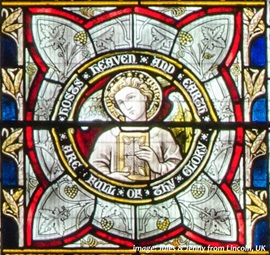
How are stained glass windows are rescued, stored and repurposed?
APPGEBE report sets high aims for quality
'Government must not sacrifice quality in drive to build 1.5m homes'
New measures protect Historic Shipwrecks from heritage crime

Underwater cultural heritage benefits from new HE guidance
How could the City of London skyline look in 6 years' time?

Visualisation shows approved planning applications as completed buildings
National Trust for Scotland calls for VAT cuts
Heritage neglect is encouraged by current policies
IHBC's 'Context' Issue 186 features Industrial Heritage
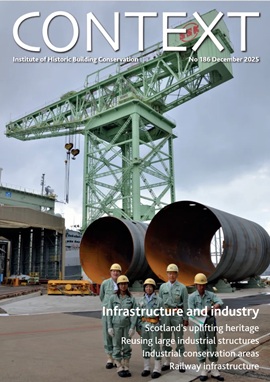
IHBC's members' journal reports on the challenges of conserving infrastructure
Book now for IHBC Annual School 2026
IHBC Annual School is taking place 18-20 June 2026 in Newcastle
RICHeS Research Infrastructure offers ‘Full Access Fund Call’
RICHeS offers a ‘Help’ webinar on 11 March
Latest IHBC Issue of Context features Roofing
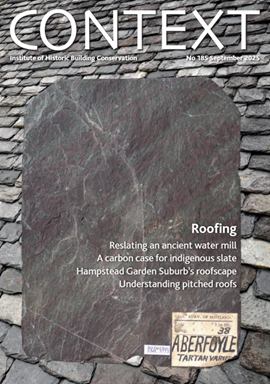
Articles range from slate to pitched roofs, and carbon impact to solar generation to roofscapes
Three reasons not to demolish Edinburgh’s Argyle House

Should 'Edinburgh's ugliest building' be saved?
IHBC’s 2025 Parliamentary Briefing...from Crafts in Crisis to Rubbish Retrofit
IHBC launches research-led ‘5 Commitments to Help Heritage Skills in Conservation’
How RDSAP 10.2 impacts EPC assessments in traditional buildings

Energy performance certificates (EPCs) tell us how energy efficient our buildings are, but the way these certificates are generated has changed.