






New test to provide access to the Experienced Worker Assessment for electricians without qualifications

The Electrotechnical Skills Partnership (TESP) has confirmed the availability of a new knowledge test that enables suitable candidates without a prior Level 2 qualification to establish their eligibility to undertake the Experienced Worker Assessment (EWA).
This new test, EAL's Electrical Underpinning Knowledge and Understanding Tests (Entry for Experienced Worker Route) (Level 3 equivalent), also known as the EWA Entry Test, is currently on offer from just two EALapproved providers, NICEIC and NAPIT.
To qualify for these EWA tests, candidates should typically be qualified supervisors or experienced workers with substantial industry experience who never formally completed a full Level 2 or 3 electrical theory qualification.
TESP has emphasised that this new test is not a short cut into the EWA. It is a Level 3 equivalent test and not suitable for individuals with limited or narrowly focused experience.
Once a candidate has passed the EWA Entry Test, they will have a maximum of six months to enrol onto the EWA.
Further information is available on TESP's dedicated Experienced Worker Assessment website. ECA Members can access the free Education & Skills Helpline for advice and support with this new test.
This article appears on the eCA news and blog site as "New test will provide access to the Experienced Worker Assessment for electricians without qualifications" dated 29 July, 2025.
--ECA
[edit] Related articles on Designing Buildings
- Build UK.
- CDM.
- Construction apprenticeships.
- Construction Industry Training Board.
- Construction Skills Certification Scheme cards
- CSCS verification app.
- ECA articles.
- Gangmaster.
- Glazier.
- Health and safety.
- Industry placement CSCS card to help learners into construction.
- New route to CSCS cards for built environment professionals.
- New test to provide access to the Experienced Worker Assessment for electricians without qualifications.
- NSCC.
- Safety helmet colours.
- Site inspector.
- TESP calls for industry mentors.
- Understanding mental health in the built environment.
Featured articles and news

We're expanding our collaborative mission by launching DB Intelligence, an exclusive market research advisory panel. Built environment professionals can now get paid to share their expertise on industry trends, products and services.
Panel members receive direct financial incentives for participating in research projects like short surveys, 1-2-1 interviews and focus groups. Register today to shape the future of the construction sector.
Building Safety Wiki Interviews

Chief executive of the British Woodworking Federation.
Planning condition discharge in England and Wales

A brief exoplanation from a building compliance expert, with further links.
Overheating guidance and tools for building designers

Guidance for dealing with element of building fabric control that have increasing importance.
Shading for housing, a design guide

From the Good Homes Alliance and British Blind and Shutter Association.
UK Standard Skills Classification (SSC)

A shared framework for describing skills needs.
Social media ban consultation comes to close

CIOB urges UK Government to consider social media’s role in careers guidance in ban debate.
The latest of eight Skills England apprenticeship units

The addition of battery manufacturing welcomed by ECA with a warning about the risks of fast-tracked apprenticeship units.
Building Control Independent Panel final report
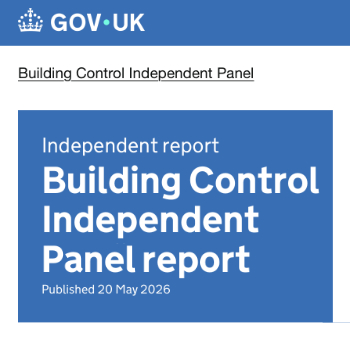
A precis of a key report led by Dame Hackitt with full recommendations and link to the government response.
Building Safety recap April, 2026
A short and longer run-through of the month, with links to further information and sources.

CIAT May 2026 briefing.

From medieval scribes to modern word art.

ECA welcomes crackdown on late payment and push for clean energy, whilst CIOB seek fixed cladding removal timeframes.
Cyber Security in the Built Environment
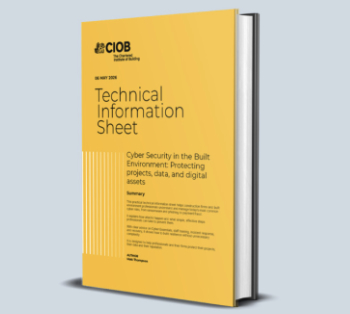
Protecting projects, data, and digital assets: A CIOB Academy TIS.
Managing competence in the built environment
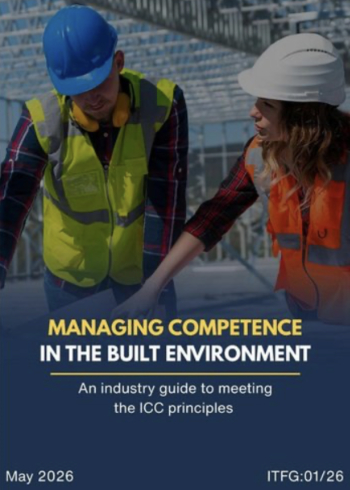
ITFG publishes new industry guide on how to meet the ICC principles.