





Maintenance contract
A contract is 'a promise or set of promises which the law will enforce'. That is, there is reciprocity of undertaking passing between the promisor and the promisee.
Maintenance is the process of ensuring that assets retain a good appearance and operate at optimum efficiency.
In the world of the consumer, a maintenance contract may be taken out for cars and appliances such as TVs, washing machines, computers, refrigerators and other equipment. The idea is that the consumer pays a fee (usually monthly) to ensure their equipment is regularly maintained, thereby securing maximum service life and reducing the risk of breakdowns.
A maintenance contract – renewed annually or for a longer fixed term – may also be taken out by landlords and other property owners. This may involve paying a monthly fee to a service provider to cover servicing (e.g central heating) and repairs (e.g roof leaks) as they arise. The emphasis is usually on preventative maintenance so that the building’s fabric, equipment and technology remain in good order. A technical support service that provides advice to the client may also be part of the package.
The contract should state its proposed duration as well as the intensity of service calls provided during a specific term (a limited number of calls per month may be stipulated). The terms will vary from contract to contract and may have limitations on frequency and types of service calls.
Modern buildings are normally complicated and require expertise to operate and maintain. They may involve complex electrical, IT, plumbing and mechanical equipment. It can therefore to the benefit of everyone directly involved with a building’s final use that a maintenance contract is in place (although large organisations may have their own in-house maintenance staff). The process of maintenenace aims to ensure the client gets the maximum benefit and long-life from the asset.
If well structured, it can save a client the complexity of managing and operating (on a daily basis) the engineering and mechanical aspects of a building, saving them money, time and effort. Some contracts may allow for downsizing or other variations to change the maintenance requirements if the client encounters changed circumstances.
[edit] JCT Repair and Maintenance Contract
The Joint Contracts Tribunal (JCT) produces a range of repair and maintenance contracts (JCT-RM) intended for use on commercial projects where there is a defined programme of repair and maintenance works for a building or buildings.
JCT-RM is primarily used by local authorities and other employers who are used to placing a large number of small and medium-size contracts, and are therefore expected to be experienced in handling contractors’ accounts – removing the need for an independent contract administrator.
[edit] Related articles on Designing Buildings Wiki
- Certificate of making good defects.
- Constructing Excellence contract.
- Construction contract.
- Design and build contract.
- In-house or outsource maintenance.
- Intermediate Building Contract.
- JCT.
- JCT Repair and maintenance contract.
- JCT Sub-subcontract.
- Maintenance.
- Measured term contract.
- Minor works.
- Repair.
- Scheduled maintenance.
- Working with maintenance contractors.
Featured articles and news

We're expanding our collaborative mission by launching DB Intelligence, an exclusive market research advisory panel. Built environment professionals can now get paid to share their expertise on industry trends, products and services.
Panel members receive direct financial incentives for participating in research projects like short surveys, 1-2-1 interviews and focus groups. Register today to shape the future of the construction sector.
Building Safety Wiki Interviews

Chief executive of the British Woodworking Federation.
Planning condition discharge in England and Wales

A brief exoplanation from a building compliance expert, with further links.
Overheating guidance and tools for building designers

Guidance for dealing with element of building fabric control that have increasing importance.
Shading for housing, a design guide

From the Good Homes Alliance and British Blind and Shutter Association.
UK Standard Skills Classification (SSC)

A shared framework for describing skills needs.
Social media ban consultation comes to close

CIOB urges UK Government to consider social media’s role in careers guidance in ban debate.
The latest of eight Skills England apprenticeship units

The addition of battery manufacturing welcomed by ECA with a warning about the risks of fast-tracked apprenticeship units.
Building Control Independent Panel final report
A precis of a key report led by Dame Hackitt with full recommendations and link to the government response.
Building Safety recap April, 2026
A short and longer run-through of the month, with links to further information and sources.

CIAT May 2026 briefing.

From medieval scribes to modern word art.

ECA welcomes crackdown on late payment and push for clean energy, whilst CIOB seek fixed cladding removal timeframes.
Cyber Security in the Built Environment
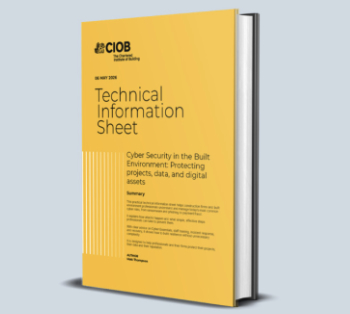
Protecting projects, data, and digital assets: A CIOB Academy TIS.
Managing competence in the built environment

ITFG publishes new industry guide on how to meet the ICC principles.