




Cambridge's Mill Road Free Library, part 3
Further to my articles ‘The battle for Cambridge’s Mill Road Free Library, Parts 1 and 2’ (Context 179 and 180, March and June 2024), Cambridgeshire County Council decided to sell the former library out of public ownership. After a six-month moratorium, seven bids were received, including an updated community bid. To give local people (whom the county had still not consulted on selling their library building) a voice, my wife Kati and I drafted a change. org petition, which has gained over 3,100 signatures.
In October 2024 the county council announced: ‘Mill Road Library set for a bright artistic future’. The committee had decided to sell it to an unnamed ‘community-minded bidder’ who had neither bid previously nor engaged in any way with the local community. County officers cited the bidder’s unconditional offer and his claimed ability to complete in 30 days as reasons for recommending his bid.
County officers continued to present the disposal of the former library solely as a commercial transaction, disregarding the strong community concerns. In the same meeting, after the preferred bidder for Shire Hall had pulled out, the county’s director of finance recommended the councillors to go to the bidder next in line. Had officers taken the same approach for the former library, a year earlier when Centre 33 pulled out, the community bid, then placed second, could have already been up and running in the building. Instead, the former library stands empty.
Efforts to persuade the county to include a clause in the heads of terms to give the community first refusal fell on deaf ears. The preferred bidder has not yet even been publicly named. The county’s response to a recent freedom of information (FOI) request was that contracts had not yet been exchanged. Nothing has yet been disclosed regarding what public benefit may be achieved by the sale.
The case is worth publicising as a warning about local authority property owners failing to set an example as owners of listed buildings; failing in their statutory duties regarding them; failing to resolve unauthorised works; and excluding legitimate community interests.
While the county has compounded its disregard for the community in relation to the former library, the nearby Gateway from India continues to offer a shining example of what local communities can achieve. This reincarnation of the former Hindu shrine from the library building was thanks to the enthusiasm and energy of local people. Now Piero D’Angelico and Abdul Kayum Arain of Mill Road Traders and Cambridge City mayor Baiju Thittala have catalysed a proposal for a United Indian Army War Memorial Fountain, to commemorate the four million soldiers of the British Indian Army who gave their lives in the first and second world wars. This will stand near the Gateway, next to Mill Road (one of Britain’s most multicultural streets), and in front of Ditchburn Place (built as Cambridge Union’s Workhouse in 1838). This was an emergency wartime hospital from 1939-46, then a maternity hospital, and is now social housing for the elderly.
The community spirit is alive and well in Cambridge. Whether the former library will play any part in the local community in the future is another matter.
See also:
This article originally appeared as ‘Mixed news from Mill Road’ in the Institute of Historic Building Conservation’s (IHBC’s) Context 184, published in June 2025. It was written by John Preston.
--Institute of Historic Building Conservation
Related articles on Designing Buildings Conservation.
IHBC NewsBlog
IHBC sponsors Gardens Trust event 23-4 Sept 2026
.jpeg)
'Learning from the Past, Shaping the Future’ takes place in Milton Keynes
Renovations to Frank Lloyd Wright's Fallingwater complete
.jpg)
World Heritage Preserved project opens house for tours again
Shakespeare Birthplace Trust places Hall's Croft on HAR Register
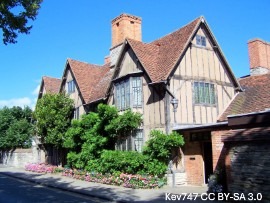
Stratford-upon-Avon home of Shakespeare's daughter is 'At Risk'
Lady Grange’s House repaired on St Kilda
.jpg)
National Trust for Scotland repairs stone cleit with link to famous island resident
Griff Rhys Jones on BBC Radio 4 Today programme
,_Green_Lane,_Derby.jpg)
The Victorian Society’s President unveiled its latest Top Ten Endangered Buildings 2026.
Need a MATE? Book your place now.
IHBC offers free webinars on applying for IHBC accreditation (Full & Associate).
UK Stained Glass Repository finds windows new homes

How are stained glass windows are rescued, stored and repurposed?
APPGEBE report sets high aims for quality
'Government must not sacrifice quality in drive to build 1.5m homes'
New measures protect Historic Shipwrecks from heritage crime

Underwater cultural heritage benefits from new HE guidance
How could the City of London skyline look in 6 years' time?

Visualisation shows approved planning applications as completed buildings
National Trust for Scotland calls for VAT cuts
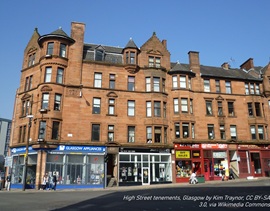
Heritage neglect is encouraged by current policies
IHBC's 'Context' Issue 186 features Industrial Heritage
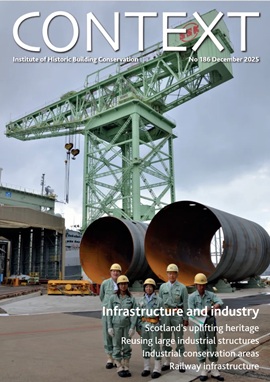
IHBC's members' journal reports on the challenges of conserving infrastructure
Book now for IHBC Annual School 2026
IHBC Annual School is taking place 18-20 June 2026 in Newcastle
RICHeS Research Infrastructure offers ‘Full Access Fund Call’
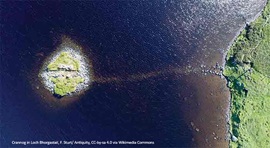
RICHeS offers a ‘Help’ webinar on 11 March
Latest IHBC Issue of Context features Roofing
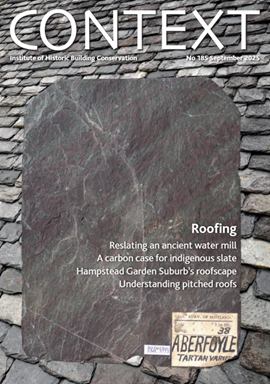
Articles range from slate to pitched roofs, and carbon impact to solar generation to roofscapes
Three reasons not to demolish Edinburgh’s Argyle House

Should 'Edinburgh's ugliest building' be saved?
IHBC’s 2025 Parliamentary Briefing...from Crafts in Crisis to Rubbish Retrofit
IHBC launches research-led ‘5 Commitments to Help Heritage Skills in Conservation’
How RDSAP 10.2 impacts EPC assessments in traditional buildings

Energy performance certificates (EPCs) tell us how energy efficient our buildings are, but the way these certificates are generated has changed.