





Journal of Historic Buildings and Places
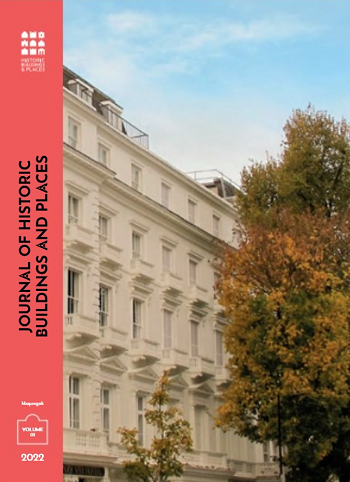
The Journal of Historic Buildings and Places is the first to appear under the guise of that eponymous organisation, replacing the Ancient Monuments Society and its series of Transactions (the last having been Volume 65). Under the stewardship of the editor, John Bold, the scholarship remains undiminished and there is much of diverse interest within its 166 pages.
Gary Winter and Alan Brody write about England’s heritage from the air and the value of photographs from the Aerofilms Collection, providing a unique archive of Britain from 1919 onwards. The well-illustrated essay explores the types of images in the collection, which range from ancient monuments, historic landscapes and ruined abbeys to industrial heritage, funfairs and football matches. The earliest part of the collection, dating between 1919 and 1953, has been scanned and is available online at the Britain from Above website.
A fascinating essay by Amy Bettinson discusses infill housing in post-war London, concentrating on Kensington and Chelsea. Nestled in London streets there is an untold story of post-war modernism in boroughs where lighter bomb damage left gaps in terraced housing. These might appear to be isolated incidents in the street-scene, but examples of this particular housing form of development can be found across the capital, often as high-density modernist blocks of flats inserted into the gaps in stuccoed, 19th-century terraces. These projects were controversial in their time (and remain so today), as architects considered how modernist buildings could fit into historic settings, seizing the opportunity to experiment in their design.
The discussion around post-war housing is heavily focused on large-scale schemes, and smaller-scale, high-density blocks of flats have generally been overlooked. These are not localised, isolated incidents in the townscape, but examples of a particular type of development found across the city but never previously properly documented as a group. The author considers that their relatively unobtrusive nature has left them extremely vulnerable, and few are listed. She suggests that a further study across the whole of London would be invaluable, as would examination of other cities where bombing was light and infill was scattered, so as to compare strategies. It is hoped that they are all documented properly soon, so that this chapter of English modernism is not left without protection or lost without trace.
While there are professional, academic and scholarly sources of information that may be usefully applied in heritage management, those within popular culture should not be overlooked. In an essay entitled ‘London on Stage’, Horatio Blood examines views of the capital depicted in popular prints, particularly the rich seam of imagery contained in the ‘penny plain, twopence coloured’ engravings of 19th-century toy theatres that reproduced in miniature the scenes presented in the real theatres of London. The well-illustrated essay casts an eye on some of those images and the publishing world from which it sprung.
Also well worth seeking out is the essay by Victoria Watson about the extremely sensitive issues around the restoration and expansion of the Museum of Modern Art (the NNG: New National Gallery) in Berlin, one of the iconic modern masterpieces of Mies van der Rohe. The building expresses unexampled clarity and virtuosity, and inevitably invites discussions about the appropriateness of changing the fabric and setting of the original building of 1968. The repairs undertaken by David Chipperfield Architects resulted in the building been closed to the public for five years until August 2021. Chipperfield was already familiar with Berlin museum culture through his rebuilding of the Neues Museum, completed in 2021. His approach was considered novel because he did not attempt to reproduce the past historic form of the war-damaged Neues Museum, preferring to work with what remains of the building materials in a new form. In the case of the Neues Museum, only part of the old building remained, necessitating the introduction of new features to complete it. This raises interesting issues of authenticity, intactness and interpretation of past, although only partial, architectural forms.
This article originally appeared in the Institute of Historic Building Conservation’s (IHBC’s) Context 174, published in December 2022.
--Institute of Historic Building Conservation
Related articles on Designing Buildings
IHBC NewsBlog
IHBC sponsors Gardens Trust event 23-4 Sept 2026
.jpeg)
'Learning from the Past, Shaping the Future’ takes place in Milton Keynes
Renovations to Frank Lloyd Wright's Fallingwater complete
.jpg)
World Heritage Preserved project opens house for tours again
Shakespeare Birthplace Trust places Hall's Croft on HAR Register
Stratford-upon-Avon home of Shakespeare's daughter is 'At Risk'
Lady Grange’s House repaired on St Kilda
.jpg)
National Trust for Scotland repairs stone cleit with link to famous island resident
Griff Rhys Jones on BBC Radio 4 Today programme
,_Green_Lane,_Derby.jpg)
The Victorian Society’s President unveiled its latest Top Ten Endangered Buildings 2026.
Need a MATE? Book your place now.

IHBC offers free webinars on applying for IHBC accreditation (Full & Associate).
UK Stained Glass Repository finds windows new homes
How are stained glass windows are rescued, stored and repurposed?
APPGEBE report sets high aims for quality
'Government must not sacrifice quality in drive to build 1.5m homes'
New measures protect Historic Shipwrecks from heritage crime

Underwater cultural heritage benefits from new HE guidance
How could the City of London skyline look in 6 years' time?

Visualisation shows approved planning applications as completed buildings
National Trust for Scotland calls for VAT cuts
Heritage neglect is encouraged by current policies
IHBC's 'Context' Issue 186 features Industrial Heritage
IHBC's members' journal reports on the challenges of conserving infrastructure
Book now for IHBC Annual School 2026
IHBC Annual School is taking place 18-20 June 2026 in Newcastle
RICHeS Research Infrastructure offers ‘Full Access Fund Call’
RICHeS offers a ‘Help’ webinar on 11 March
Latest IHBC Issue of Context features Roofing
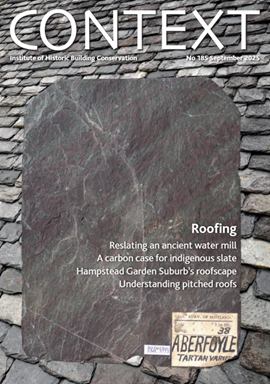
Articles range from slate to pitched roofs, and carbon impact to solar generation to roofscapes
Three reasons not to demolish Edinburgh’s Argyle House

Should 'Edinburgh's ugliest building' be saved?
IHBC’s 2025 Parliamentary Briefing...from Crafts in Crisis to Rubbish Retrofit
IHBC launches research-led ‘5 Commitments to Help Heritage Skills in Conservation’
How RDSAP 10.2 impacts EPC assessments in traditional buildings

Energy performance certificates (EPCs) tell us how energy efficient our buildings are, but the way these certificates are generated has changed.
Comments
[edit] To make a comment about this article, click 'Add a comment' above. Separate your comments from any existing comments by inserting a horizontal line.