





Sir Edwin Lutyens: Britain's greatest architect?

|
| Sir Edwin Lutyens: Britain’s greatest architect? Clive Aslet, Triglyph Books, 2024, 256 pages, 67 colour and black-and-white illustrations, hardback. |
Is Lutyens Britain’s greatest architect? There seems little doubt that Clive Aslet’s answer would be yes, but in making the case in this engaging book he draws particular attention to Lutyens’ later work – the war memorials, Viceroy’s House in Delhi and Liverpool’s unbuilt Metropolitan Cathedral – rather than the arts and crafts houses that brought him early attention. There is no shortage of books on Lutyens’ life and work, the earliest being Christopher Hussey’s four-volume Life of Sir Edwin Lutyens, followed by Lutyens’ great-granddaughter Jane Ridley’s comprehensive biography, but Aslet has aimed his pocket-sized book at a wider readership.
As a long-standing journalist and later editor of Country Life magazine, Aslet stresses the influence of Edward Hudson, founder of the magazine, who built Lutyens’ reputation as an architect by commissioning him on several occasions and recommending him to other clients. The clients provide a window through which to view the age in which Lutyens lived, and Aslet presents a fascinating picture of the architect’s unorthodox methods, such as cajoling them into accepting things they did not always want. Another merit of the book, given the vast number of buildings that Lutyens designed, is that it makes no attempt to cover every project, focusing on a small number that Aslet considers the most interesting, with a few others making a brief appearance where appropriate.
After a short introduction, the book is divided into 13 chapters, some with entertaining titles and small doodles taken from Lutyens’ letters to his long-suffering wife Emily. The first, Surrey Hills, covers his early career and the debt he owed to Gertrude Jekyll, who not only commissioned him to design her own house, Munstead Wood, but also brought order to his working life. Chapter 3, Boom It Like Anything, features Deanery Gardens, Lindisfarne Castle and Plumpton Place, all carried out for Hudson, while Tiger, Tiger deals solely with Marsh Court, the most experimental of Lutyens’ arts and crafts houses, built of white clunch blocks.
Chapter 6, The High Game, covers Lutyens’ first essays in classicism, the Country Life offices (1904) and Heathcote, Yorkshire (1905). At Heathcote he took inspiration from the 16th-century, Venetian mannerist architect, Michele Sanmicheli, with extraordinary results. The story of Castle Drogo, built between 1910-30 for the self-made millionaire grocer, Julius Drewe, also receives a full chapter. The first of Lutyens’ abstract works, described by Aslet as a sculpture, led on to the Cenotaph and to the Memorial to the Missing at the Somme erected at Thiepval, his supreme masterpiece designed in this pared-down geometric manner.
In 1929 Lutyens received the commission to design Liverpool’s Metropolitan Cathedral. It came late in his life and well after the great port city had started to decline. Yet Lutyens saw it as the moment of his life, remarking when construction began that dependent on how fast the money might come in it could take 25 or 250 years to complete. Aslet’s well-gauged description of the project ends with Christopher Hussey’s remark that the cathedral was ‘one of the most Romantic buildings ever conceived. Alas, Romance was dead.’ Lutyens himself was an enigmatic figure who never wrote about his work, and Aslet’s little book, with somewhat grainy photographs, makes a good attempt at revealing why he might indeed be Britain’s greatest architect.
This article originally appeared as ’The best of the best’ in the Institute of Historic Building Conservation’s (IHBC’s) Context 186, published in December 2025. It was written by Peter de Figueiredo, reviews editor of Context.
--Institute of Historic Building Conservation
Related articles on Designing Buildings Conservation.
IHBC NewsBlog
IHBC sponsors Gardens Trust event 23-4 Sept 2026
.jpeg)
'Learning from the Past, Shaping the Future’ takes place in Milton Keynes
Renovations to Frank Lloyd Wright's Fallingwater complete
.jpg)
World Heritage Preserved project opens house for tours again
Shakespeare Birthplace Trust places Hall's Croft on HAR Register
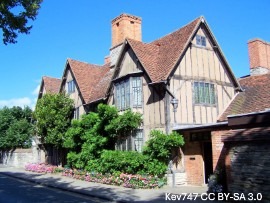
Stratford-upon-Avon home of Shakespeare's daughter is 'At Risk'
Lady Grange’s House repaired on St Kilda
.jpg)
National Trust for Scotland repairs stone cleit with link to famous island resident
Griff Rhys Jones on BBC Radio 4 Today programme
,_Green_Lane,_Derby.jpg)
The Victorian Society’s President unveiled its latest Top Ten Endangered Buildings 2026.
Need a MATE? Book your place now.
IHBC offers free webinars on applying for IHBC accreditation (Full & Associate).
UK Stained Glass Repository finds windows new homes
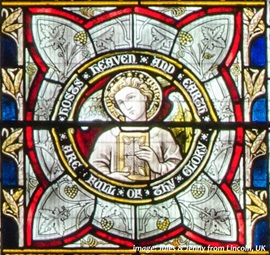
How are stained glass windows are rescued, stored and repurposed?
APPGEBE report sets high aims for quality
'Government must not sacrifice quality in drive to build 1.5m homes'
New measures protect Historic Shipwrecks from heritage crime

Underwater cultural heritage benefits from new HE guidance
How could the City of London skyline look in 6 years' time?

Visualisation shows approved planning applications as completed buildings
National Trust for Scotland calls for VAT cuts
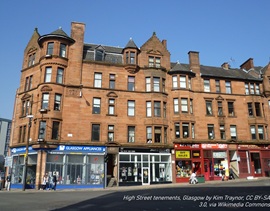
Heritage neglect is encouraged by current policies
IHBC's 'Context' Issue 186 features Industrial Heritage
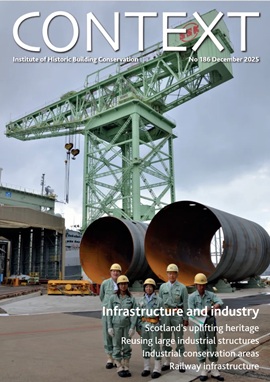
IHBC's members' journal reports on the challenges of conserving infrastructure
Book now for IHBC Annual School 2026

IHBC Annual School is taking place 18-20 June 2026 in Newcastle
RICHeS Research Infrastructure offers ‘Full Access Fund Call’
RICHeS offers a ‘Help’ webinar on 11 March
Latest IHBC Issue of Context features Roofing
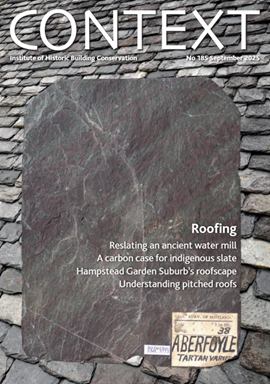
Articles range from slate to pitched roofs, and carbon impact to solar generation to roofscapes
Three reasons not to demolish Edinburgh’s Argyle House

Should 'Edinburgh's ugliest building' be saved?
IHBC’s 2025 Parliamentary Briefing...from Crafts in Crisis to Rubbish Retrofit
IHBC launches research-led ‘5 Commitments to Help Heritage Skills in Conservation’
How RDSAP 10.2 impacts EPC assessments in traditional buildings

Energy performance certificates (EPCs) tell us how energy efficient our buildings are, but the way these certificates are generated has changed.