





Mills News, April 2025 (No 182)
SPAB’s Mills Section produces its own twice-yearly publication Mills News, the latest issue of which is April 2025 (No 182). This substantial, very well produced and illustrated 42-page contribution to the specialist professional literature should stimulate interest beyond molinologists. Irrespective of whether readers engage with surviving wind or water mills of heritage value, this publication is informative for articulating both a philosophy of approach to repair and the embodiment of appropriate practical repair techniques.
This is reflected in the current issue by Andy Beardsley in Part One of a report on the recording of milling sites (particularly but not exclusively ruins) by the geospatial surveys and detailed digital recording, using terrestrial laser scanning, 360-degree imagery and drone photography. A second instalment will look at three uniquely documented mills. Beardsley makes the point that the surveys are intended to go beyond documentation: to actively shape conservation decisions for structures that are more than mere picturesque landmarks.
In a similar vein, the April 2025 issue has a helpful explanation of the content and coverage of the SPAB’s Mills Archive Trust. It draws attention to a specialist library of over 5,000 books and journals and an archive of 3,000,000 records of architectural plans, photographs and reports. It is an invaluable resource to bear in mind when considering future mill projects.
While the issue discusses a number of mill-specific repair projects, there is also a useful explanation of RENEWAT, which aims collaboratively to revitalise Europe’s watermills for the generation of sustainable energy. It has project partners from France, Italy, Albania, Croatia, Slovenia, Poland, Ukraine and Romania, but not yet the UK. It is noted that in Slovenia, for example, nearly 5,000 mills existed historically, but their potential remains largely untapped due to administrative and ecological challenges. The partnership is demonstrating that watermills are not merely heritage assets but modern, sustainable energy solutions capable of delivering local renewable power as part of a balanced and equitable management within river basins.
This article originally appeared in the Institute of Historic Building Conservation’s (IHBC’s) Context 185, published in September 2025.
--Institute of Historic Building Conservation
Related articles on Designing Buildings Conservation.
- Conservation area.
- Conservation.
- Heritage.
- Historic environment.
- IHBC articles.
- IHBC.
- SPAB Magazine Spring 2025.
- SPAB Magazine Summer 2025.
- SPAB Magazine Winter 2024.
- SPAB Magazine autumn 2023.
- SPAB Magazine Spring 2023.
- SPAB Magazine Spring 2024.
- SPAB Magazine summer 2023.
- SPAB Magazine Winter 2023.
IHBC NewsBlog
IHBC sponsors Gardens Trust event 23-4 Sept 2026
.jpeg)
'Learning from the Past, Shaping the Future’ takes place in Milton Keynes
Renovations to Frank Lloyd Wright's Fallingwater complete
.jpg)
World Heritage Preserved project opens house for tours again
Shakespeare Birthplace Trust places Hall's Croft on HAR Register
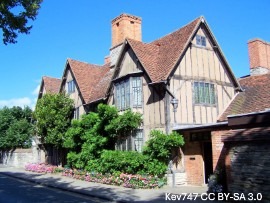
Stratford-upon-Avon home of Shakespeare's daughter is 'At Risk'
Lady Grange’s House repaired on St Kilda
.jpg)
National Trust for Scotland repairs stone cleit with link to famous island resident
Griff Rhys Jones on BBC Radio 4 Today programme
,_Green_Lane,_Derby.jpg)
The Victorian Society’s President unveiled its latest Top Ten Endangered Buildings 2026.
Need a MATE? Book your place now.

IHBC offers free webinars on applying for IHBC accreditation (Full & Associate).
UK Stained Glass Repository finds windows new homes

How are stained glass windows are rescued, stored and repurposed?
APPGEBE report sets high aims for quality
'Government must not sacrifice quality in drive to build 1.5m homes'
New measures protect Historic Shipwrecks from heritage crime

Underwater cultural heritage benefits from new HE guidance
How could the City of London skyline look in 6 years' time?

Visualisation shows approved planning applications as completed buildings
National Trust for Scotland calls for VAT cuts

Heritage neglect is encouraged by current policies
IHBC's 'Context' Issue 186 features Industrial Heritage

IHBC's members' journal reports on the challenges of conserving infrastructure
Book now for IHBC Annual School 2026

IHBC Annual School is taking place 18-20 June 2026 in Newcastle
RICHeS Research Infrastructure offers ‘Full Access Fund Call’
RICHeS offers a ‘Help’ webinar on 11 March
Latest IHBC Issue of Context features Roofing
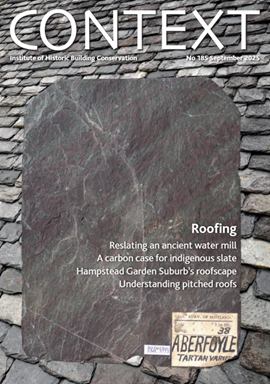
Articles range from slate to pitched roofs, and carbon impact to solar generation to roofscapes
Three reasons not to demolish Edinburgh’s Argyle House

Should 'Edinburgh's ugliest building' be saved?
IHBC’s 2025 Parliamentary Briefing...from Crafts in Crisis to Rubbish Retrofit
IHBC launches research-led ‘5 Commitments to Help Heritage Skills in Conservation’
How RDSAP 10.2 impacts EPC assessments in traditional buildings

Energy performance certificates (EPCs) tell us how energy efficient our buildings are, but the way these certificates are generated has changed.