




Biodiversity net gain in England
Contents |
[edit] Introduction
Biodiversity net gain (BNG) is a planning requirement in England that seeks to ensure development leaves biodiversity in a measurably better state than before development took place. Introduced through the Environment Act 2021, mandatory BNG requires most developments to achieve at least a 10% increase in biodiversity value compared with the pre-development baseline. The requirement became mandatory for major developments in February 2024 and for most small sites in April 2024. Biodiversity gains must generally be maintained for a minimum period of 30 years.
[edit] Legislative background
Mandatory BNG was introduced through Schedule 14 of the Environment Act 2021, which inserted Schedule 7A into the Town and Country Planning Act 1990. The requirement was implemented in phases:
- February 2024: Most major developments became subject to mandatory BNG requirements.
- April 2024: The requirement was extended to most small-site developments.
- Nationally Significant Infrastructure Projects (NSIPs) are subject to a separate BNG regime, which is expected to be implemented on a different timetable.
Before the introduction of the statutory regime, many local planning authorities (LPAs) sought biodiversity enhancements through planning policies and planning obligations, although requirements varied between authorities.
[edit] The 10% biodiversity net gain requirement
Developers must demonstrate that a development will achieve at least a 10% increase in biodiversity value relative to the site's pre-development biodiversity value. This increase can be delivered through a combination of on-site habitat enhancement, off-site habitat creation or enhancement, and, where necessary, statutory biodiversity credits.
The biodiversity gain objective applies to habitat units and also to specific metric categories such as hedgerow units and watercourse units where relevant. Biodiversity gains must generally be secured and managed for at least 30 years through legal agreements or conservation covenants.
[edit] Measuring biodiversity
Biodiversity value is measured using the statutory biodiversity metric developed by Natural England. The metric calculates biodiversity units based on factors including:
- Habitat type.
- Habitat size or area.
- Habitat condition.
- Habitat distinctiveness.
- Strategic significance and location.
- Risks associated with habitat creation or enhancement, including time required to reach target condition and delivery risk.
The metric is used to calculate both pre-development and post-development biodiversity value and provides a standardised approach for assessing losses and gains. It applies to a wide range of habitat types, including grassland, woodland, hedgerows, lakes and watercourses. Assessments are normally undertaken by suitably qualified ecologists.
[edit] Delivering biodiversity net gain
BNG is delivered in accordance with the mitigation hierarchy, which prioritises avoiding biodiversity loss before considering compensation measures. Where biodiversity impacts cannot be avoided, gains can be achieved through three principal routes:
- On-site habitat creation or enhancement: Biodiversity improvements are delivered within the development site boundary and are generally the preferred approach.
- Off-site habitat creation or enhancement: Where sufficient gains cannot be achieved on-site, developers may secure biodiversity units from land outside the development site. Off-site gains must be registered and legally secured.
- Statutory biodiversity credits: As a last resort, developers may purchase statutory biodiversity credits from the government where suitable on-site or off-site options are unavailable.
Habitats created or enhanced to deliver BNG must be managed and monitored to ensure they achieve the intended biodiversity outcomes over the required period.
[edit] Biodiversity gain plans and planning requirements
Most developments subject to mandatory BNG must comply with the statutory biodiversity gain condition attached to planning permission. Before development can commence, the developer must submit a Biodiversity Gain Plan for approval by the local planning authority.
The Biodiversity Gain Plan typically includes:
- Baseline biodiversity assessments.
- Statutory biodiversity metric calculations.
- Details of proposed habitat creation and enhancement measures.
- Information on any off-site biodiversity gains or statutory biodiversity credits.
- Long-term habitat management and monitoring arrangements.
Monitoring and reporting may be required to demonstrate that biodiversity gains are being delivered and maintained in accordance with approved plans.
[edit] Exemptions
Certain types of development are exempt from mandatory BNG requirements. These include:
- Householder applications, such as extensions and loft conversions.
- Development that has only a de minimis impact on biodiversity.
- Certain forms of permitted development.
- Urgent crown development and some other specified categories of development.
- Biodiversity gain sites used specifically for delivering biodiversity units.
- Some self-build and custom housebuilding developments that meet specified criteria.
The scope of exemptions is defined in legislation and associated regulations and may be amended over time.
[edit] Significance
BNG represents a significant change in the way biodiversity is considered within the English planning system. By requiring measurable improvements in biodiversity and securing their long-term management, the policy aims to contribute to nature recovery while allowing development to proceed. The use of a standardised biodiversity metric provides a consistent framework for assessing biodiversity losses and gains across different types of development.
[edit] Related articles on Designing Buildings
IHBC NewsBlog
IHBC sponsors Gardens Trust event 23-4 Sept 2026
.jpeg)
'Learning from the Past, Shaping the Future’ takes place in Milton Keynes
Renovations to Frank Lloyd Wright's Fallingwater complete
.jpg)
World Heritage Preserved project opens house for tours again
Shakespeare Birthplace Trust places Hall's Croft on HAR Register
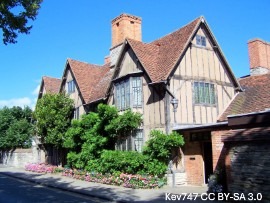
Stratford-upon-Avon home of Shakespeare's daughter is 'At Risk'
Lady Grange’s House repaired on St Kilda
.jpg)
National Trust for Scotland repairs stone cleit with link to famous island resident
Griff Rhys Jones on BBC Radio 4 Today programme
,_Green_Lane,_Derby.jpg)
The Victorian Society’s President unveiled its latest Top Ten Endangered Buildings 2026.
Need a MATE? Book your place now.

IHBC offers free webinars on applying for IHBC accreditation (Full & Associate).
UK Stained Glass Repository finds windows new homes

How are stained glass windows are rescued, stored and repurposed?
APPGEBE report sets high aims for quality
'Government must not sacrifice quality in drive to build 1.5m homes'
New measures protect Historic Shipwrecks from heritage crime

Underwater cultural heritage benefits from new HE guidance
How could the City of London skyline look in 6 years' time?

Visualisation shows approved planning applications as completed buildings
National Trust for Scotland calls for VAT cuts

Heritage neglect is encouraged by current policies
IHBC's 'Context' Issue 186 features Industrial Heritage

IHBC's members' journal reports on the challenges of conserving infrastructure
Book now for IHBC Annual School 2026
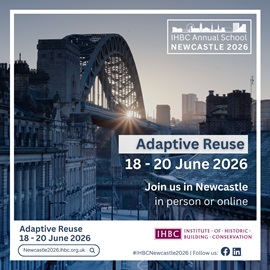
IHBC Annual School is taking place 18-20 June 2026 in Newcastle
RICHeS Research Infrastructure offers ‘Full Access Fund Call’
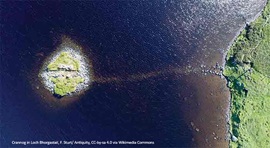
RICHeS offers a ‘Help’ webinar on 11 March
Latest IHBC Issue of Context features Roofing
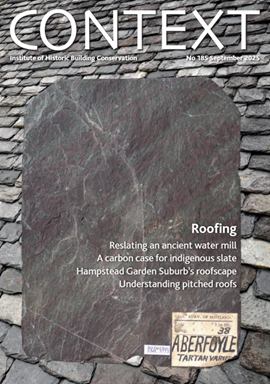
Articles range from slate to pitched roofs, and carbon impact to solar generation to roofscapes
Three reasons not to demolish Edinburgh’s Argyle House

Should 'Edinburgh's ugliest building' be saved?
IHBC’s 2025 Parliamentary Briefing...from Crafts in Crisis to Rubbish Retrofit
IHBC launches research-led ‘5 Commitments to Help Heritage Skills in Conservation’
How RDSAP 10.2 impacts EPC assessments in traditional buildings

Energy performance certificates (EPCs) tell us how energy efficient our buildings are, but the way these certificates are generated has changed.