





Engineering Building, Leicester University

Major’s Walk, Leicester
1960–3
James Stirling and James Gowan
Engineer: Frank Newby of Felix Samuely and Partners
Listed grade II*, 30 March 1993
This is a building of international significance, which defined modernism’s late-1950s shift towards a greater individualism and gave it a truly British character. Leicester eschewed Scandinavian influences for liver red Accrington brick and Dutch tiles, with aluminium-framed patent glazing, an updating of the industrial architecture of England’s nineteenth-century cities. Such a use of Victorian elements combined with constructivist forms and a twelve-storey tower is dramatic.
Leicester has the tightest site of the post-war universities, and the architects had to squeeze in workshops for heavy machinery, laboratories, lecture theatres, and a 30.5m (100ft) water tank to serve hydraulic experiments. The workshops, covering two-thirds of the area, had to have north-light glazing, but the plot does not run north–south. So while the building uses its site efficiently, the glazing runs at a diagonal, developed as a low-cost solution by Newby but denoted by wilful, lozenge-shaped terminals devised by Gowan. The interior is overwhelming because of the glowing, translucent light that results.
Comparisons can be made with Frank Lloyd Wright’s Johnson Wax complex at Racine, Wisconsin, the saturated light of the large, single-storey interiors similarly contrasted with their banded towers. The shapely forms of Leicester’s tower, thrust out on the stepping of two projecting lecture theatres, are credited to Stirling, again as refined by Newby.
The synthesis between Stirling and Gowan’s contrasting approaches gives the surprisingly skinny building its tautness. The partnership collapsed soon afterwards and, despite their subsequent individual achievements, for most critics this remains the sublime monument of the new brutalism. Perhaps the true partnership was between the architects and their engineer.

This was first published in 'England's Post-War Listed Buildings' by Elain Harwood and James O. Davies. Read a review of the book and interview with Elain Harwood here.
Read other extracts from the book:
Featured articles
Check out some of the best features and news from Designing Buildings as well as key stories from around the web.

New and updated CLC building safety guidance.
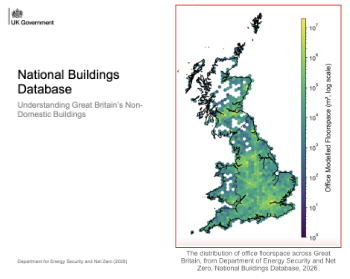
New UK National Buildings Database.
Building Safety Wiki Interviews

Chief executive of the British Woodworking Federation.
Planning condition discharge in England and Wales

A brief explanation from a building compliance expert, with further links.
Overheating guidance and tools for building designers

Guidance for dealing with element of building fabric control that have increasing importance.
Shading for housing, a design guide

From the Good Homes Alliance and British Blind and Shutter Association.
UK Standard Skills Classification (SSC)

A shared framework for describing skills needs.
Social media ban consultation comes to close

CIOB urges UK Government to consider social media’s role in careers guidance in ban debate.
The latest of eight Skills England apprenticeship units

The addition of battery manufacturing welcomed by ECA with a warning about the risks of fast-tracked apprenticeship units.
Building Control Independent Panel final report

A precis of a key report led by Dame Hackitt with full recommendations and link to the government response.
Building Safety recap April, 2026

A short and longer run-through of the month, with links to further information and sources.