





About Bilge Pump Supplier - ATO
Reliable Bilge Pump supplier offering durable, high-output pumps for marine vessels, RVs, docks, and demanding water-removal applications.
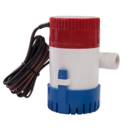
There’s a certain moment every marine engineer, boat owner, or equipment operator experiences: the uneasy glance at rising bilge water and the realization that “good enough” pumps rarely stay good for long. That’s why choosing a dependable Bilge Pump supplier is more than a procurement decision—it’s risk control. Many teams need pumps that won’t seize under debris, won’t overheat under continuous duty, and won’t collapse when sudden backflow hits. ATO Automation appears naturally in this space because the product line addresses those overlooked gaps with practical engineering rather than flashy claims.
Bilge systems vary wildly across workboats, small craft, fishing vessels, floating platforms, RV wet bays, and even industrial pits requiring tight drainage. A recreational boat may only need a compact 500–750 GPH pump, while commercial operations often push 2000 GPH or more with automatic float switches. That’s where a Bilge Pump supplier with a broad, technically consistent range becomes essential. ATO Automation provides options with sealed motors, impact-resistant ABS housings, stainless shafts, and ignition-protected designs that meet marine-grade expectations without overcomplicating installation.
The core pain point is reliability under dirty water and intermittent duty cycles. Many pumps lose capacity fast when hair, sludge, sand, or scale accumulate. A solid Bilge Pump supplier designs for this reality, not the laboratory version of it—using magnetically driven impellers, moisture-proof bearings, and thermal overload protection. Flow efficiency also matters: a pump rated for 1500 GPH might deliver far less if head height increases, so buyers appreciate transparent performance curves and realistic discharge data. ATO Automation integrates these metrics into its documentation, helping procurement teams spec accurately and avoid overspending or under-powering.
Some units include automatic float switches, whereas others rely on manual control; both have their place. High-surge environments benefit from anti-airlock features, while multi-chamber vessels often need redundancy or dual-pump configurations. A good Bilge Pump supplier anticipates this by offering matched accessories—strainers, hose fittings, backflow-preventing check valves, and wiring kits that endure moisture and vibration. In practice, this reduces installation errors, which are a major cause of early pump failure.
Technical highlights typically include high-efficiency 12V/24V DC motors, high-impact housings, sealed electronics, 3–5 meter max head rating depending on model, low-amperage draw for extended battery life, and noise-reducing impeller geometries. In several industry discussions and collaborative content pieces, marine technicians note that modern bilge pumps aren’t just about raw GPH—they’re about endurance and predictable shutdown/startup cycles. ATO Automation’s lineup aligns with these expectations, especially for OEM integrators and marine service companies seeking a reliable Bilge Pump supplier with consistent manufacturing standards.
For procurement teams optimizing CTR on product listings, clarity helps: emphasize flow rate, voltage, duty cycle, head height, and certification standards early. These are the details buyers scan for, and when highlighted properly, they drive higher click-through because they instantly confirm technical relevance.
Featured articles and news
UK Net Zero Carbon Buildings Standard V1 published

Free-to-access technical standard to enable robust proof of a decarbonising built environment.
Prostate Cancer Awareness Month

Why talking about prostate cancer matters in construction.
The Architectural Technology podcast: Where it's AT

Catch up for free, subscribe and share with your network.
The Association of Consultant Architects recap

A reintroduction and recap of ACA President; Patrick Inglis' Autumn update.
The Home Energy Model and its wrappers

From SAP to HEM, EPC for MEES and FHS assessment wrappers.
Future Homes Standard Essentials launched

Future Homes Hub launches new campaign to help sector prepare for the implementation of new building standards.
Building Safety recap February, 2026

Our regular run-down of key building safety related events of the month.
Planning reform: draft NPPF and industry responses.

Last chance to comment on proposed changes to the NPPF.

A Regency palace of colour and sensation. Book review.
Delayed, derailed and devalued
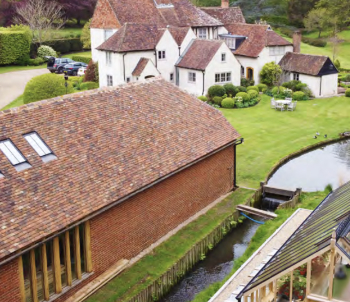
How the UK’s planning crisis is undermining British manufacturing.
How much does it cost to build a house?

A brief run down of key considerations from a London based practice.
The need for a National construction careers campaign

Highlighted by CIOB to cut unemployment, reduce skills gap and deliver on housing and infrastructure ambitions.
AI-Driven automation; reducing time, enhancing compliance
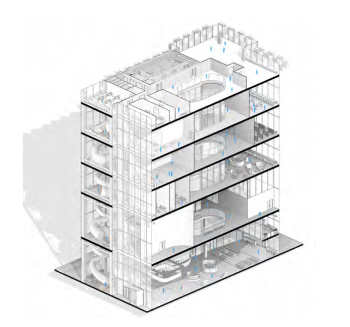
Sustainability; not just compliance but rethinking design, material selection, and the supply chains to support them.
Climate Resilience and Adaptation In the Built Environment
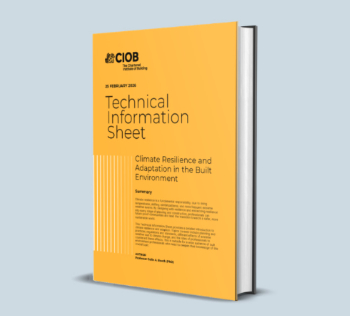
New CIOB Technical Information Sheet by Colin Booth, Professor of Smart and Sustainable Infrastructure.
Turning Enquiries into Profitable Construction Projects

Founder of Develop Coaching and author of Building Your Future; Greg Wilkes shares his insights.
IHBC Signpost: Poetry from concrete

Scotland’s fascinating historic concrete and brutalist architecture with the Engine Shed.